
ACH payment processing for gyms and fitness centers has become a core way to collect membership dues, personal training fees, class packs, and even retail add-ons with lower processing costs and fewer chargeback headaches than many card-heavy setups.
When you run a gym, cash flow stability matters more than flashy payment options. You need predictable billing, fewer declines, simple reconciliation, and a payment experience that doesn’t frustrate members.
ACH payment processing for gyms works especially well because the gym business model is recurring by nature. Monthly memberships, annual renewals, and installment plans align perfectly with bank-to-bank transfers.
It also supports larger-ticket items—like multi-month transformations or corporate wellness programs—without the same percentage-based card fees that can eat your margins.
That said, ACH payment processing for gyms is not “set it and forget it.” You must design around authorization rules, returns, risk controls, and member communication. If you don’t, you’ll see preventable returns, disputes labeled as unauthorized, and avoidable churn.
This guide explains how to implement ACH payment processing for gyms and fitness centers the right way—operationally, legally, and strategically—while staying member-friendly and search-engine friendly.
Why ACH Payment Processing for Gyms Is Growing
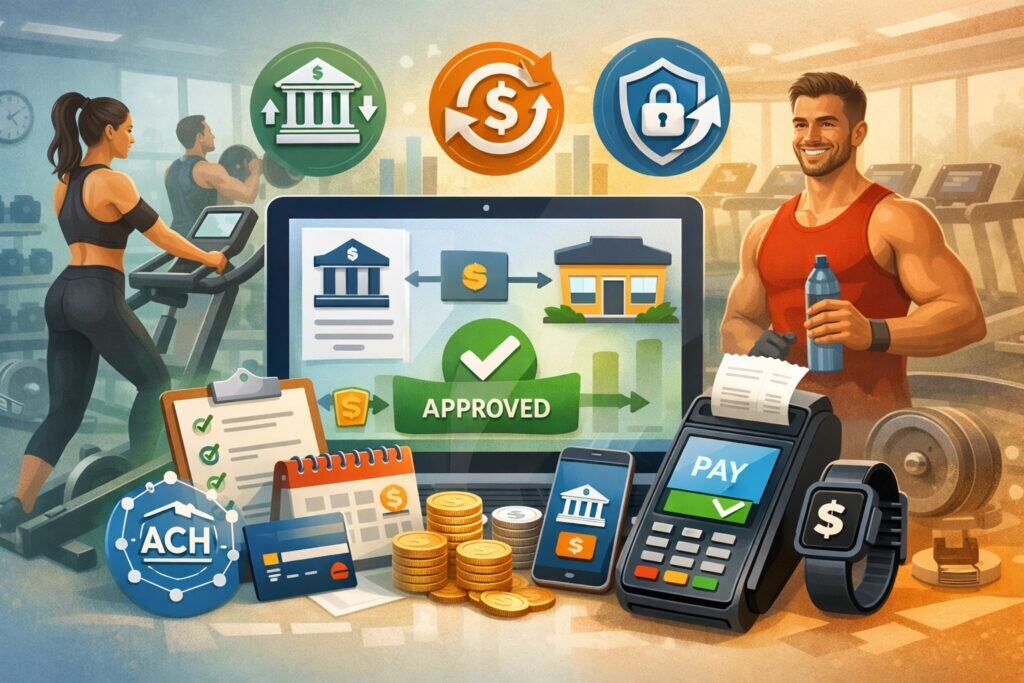
ACH payment processing for gyms is growing because operators are tired of margin pressure and volatility. Card processing is convenient, but it’s expensive at scale—especially when you factor in card updater issues, expiring cards, and higher fraud or dispute rates in subscription billing. ACH payments, by contrast, pull funds directly from a member’s bank account, which often stays stable for years.
Another driver is how members buy fitness today. People join for a structured plan and prefer “automatic payments” that feel simple and invisible. ACH payment processing for gyms makes autopay smoother for members who don’t want another card charge. It can also reduce declines caused by maxed-out credit limits, replacement cards, and travel blocks.
The network itself continues to expand in volume and value. In the third quarter of 2025, the ACH Network recorded 8.8 billion payments valued at $23.2 trillion, with notable growth in business payments.
Scale like this typically brings better tools, more innovation, and more bank support—benefits that trickle down to merchants such as gyms.
Finally, ACH keeps getting faster. Same Day ACH capabilities have expanded over time, and the per-transaction limit has been increased to $1 million for eligible payments.
On top of that, there has been industry discussion and formal feedback activity around raising the Same Day ACH limit to $10 million, with a proposed effective date in March 2027. That matters for larger fitness operators, franchises, and corporate wellness contracts that want faster settlement without wiring.
How ACH Payment Processing for Gyms Works

ACH payment processing for gyms moves money from a member’s bank account to the gym’s bank account through a standardized network. Instead of swiping a card, the member provides bank details (routing and account number) and authorizes the gym to debit the account for agreed charges—like monthly dues, annual renewals, or installment payments.
For a gym, an ACH payment typically follows this flow:
- The member signs an ACH authorization (digital or paper).
- The gym’s software or payment provider creates an ACH debit entry.
- The entry is submitted through banking rails to the member’s bank.
- Funds settle to the gym after the standard processing timeline (often a few business days, depending on the configuration and risk profile).
From a business standpoint, ACH payment processing for gyms is less about “instant approval” and more about “reliable collection.” Cards authorize in seconds, but can be reversed later via chargebacks. ACH is different: you can still get returns, but the process is more rules-based and typically less expensive to manage.
It’s also important to understand that ACH payment processing for gyms comes in different flavors. Some transactions are one-time (like a joining fee).
Many are recurring (monthly dues). Some may be same-day eligible depending on provider setup and bank participation. The best gym billing systems make this invisible to the front desk, while still providing clear reporting for finance.
Key Benefits of ACH Payment Processing for Gyms & Fitness Centers

ACH payment processing for gyms is popular because it can improve profitability and reduce chaos. The biggest win is usually cost control. Instead of paying a percentage of every membership payment, many ACH pricing models are flat-fee or lower-effective-cost than card processing for the same ticket size. For gyms with hundreds or thousands of members, that difference compounds quickly.
Another major benefit is fewer “card lifecycle” problems. Members replace cards, get new numbers after fraud, switch issuers, or hit spending limits—leading to declines and awkward collection follow-ups.
ACH bank accounts are less likely to change frequently, so membership billing becomes more stable. That stability can reduce involuntary churn and help revenue forecasting.
ACH payment processing for gyms can also support higher-ticket programs more naturally. Think personal training bundles, transformation challenges, or paid-in-installments annual plans. If you’ve ever watched a card processing fee carve into a $2,500 package, you understand why gyms shift larger invoices to ACH.
Operationally, ACH can improve reconciliation. When your billing system is configured well, you can map debits to member IDs, track return reasons, and automate running workflows.
This makes it easier to separate “payment failed because of insufficient funds” from “payment returned as unauthorized,” which should trigger very different member communication.
Finally, ACH aligns well with modern risk tools. Nacha and banks are placing more focus on account validation and fraud prevention, which supports safer onboarding when you collect bank details for the first time.
Challenges and Risks You Must Manage With ACH Payment Processing for Gyms
ACH payment processing for gyms is powerful, but it comes with responsibilities. The biggest risk category is authorization and customer consent. If your membership agreement is unclear, if your cancellation policy is confusing, or if your staff can’t explain the billing terms, you increase the chance a member will claim a debit was unauthorized.
ACH returns are another reality. Some returns happen because the member didn’t have enough funds. Others happen because the account number was wrong, the account was closed, or the member revoked authorization. A gym that treats all returns the same way will either lose money or lose members.
You also need to plan around timing. ACH isn’t always “same day,” and settlement can vary. If you depend on immediate funds to cover payroll or rent, you’ll want a cash-flow buffer or a billing schedule that accounts for settlement time.
Fraud is a smaller risk for most gyms than for online-only businesses, but it still matters—especially if you offer online signups. The industry has been strengthening rules and resources around account validation and first-use account information for ACH payments.
You should treat bank data like a sensitive credential: secure capture, restricted access, and clear retention rules.
Lastly, gym operations create unique edge cases: mid-month membership changes, freezes, medical holds, refunds, and charge adjustments. Your ACH payment processing for gyms strategy must include policy design and system configuration so you don’t “wing it” at the front desk.
Choosing the Right ACH Setup for a Gym: Standalone, Integrated, or Full Membership Platform
ACH payment processing for gyms can be implemented three common ways, and the right choice depends on how you sell, staff, and bill.
Standalone ACH (Basic Billing Tools)
Standalone ACH works when you have a simple membership model and don’t need deep automation. You may use an ACH-capable virtual terminal or a basic billing service. This can be fine for small studios with fewer SKUs and minimal contract complexity. The downside is that you’ll likely spend more time on manual reconciliation, manual retries, and member follow-ups.
Integrated ACH Inside Your POS or Gym Management Software
For most operators, this is the sweet spot. Your POS or gym management system handles check-ins, plans, and billing while the ACH payment processing for gyms happens behind the scenes.
Integration reduces staff mistakes, keeps member records synced, and supports automated dunning. You also get better reporting—like “return reasons by member cohort”—which helps you reduce future failures.
Full Membership Platform With Automated Collections
Larger gyms and multi-location operators often need a platform that treats billing as a lifecycle: onboarding → authorization → recurring billing → reminders → retries → collections → cancellation and win-back. In this model, ACH payment processing for gyms becomes one part of a larger revenue engine. It’s especially useful when you have annual plans, freezes, add-on services, and upgrades.
The best decision framework is to map your membership complexity. If you offer month-to-month only, a simpler approach works.
If you offer family plans, corporate rates, training packages, paid-in-installments memberships, or frequent plan changes, you’ll want a robust integrated system so staff doesn’t create billing errors that later become “unauthorized return” claims.
Member Authorization: The Make-or-Break Step in ACH Payment Processing for Gyms
If you want ACH payment processing for gyms to run smoothly, treat authorization like a product feature—not paperwork. The authorization language must be clear, readable, and consistent across your signup flow, membership contract, and cancellation policy.
A strong authorization experience usually includes:
- Exact business name that will appear on bank statements (descriptor clarity reduces disputes).
- Amount and frequency (or a clear method for variable amounts, like “monthly dues plus add-ons”).
- Timing (when debits occur, and how many days after signup).
- How to cancel, and when cancellation becomes effective.
- Refund and freeze policy references.
- A confirmation receipt or email for the member.
This is also where staff training matters. Members don’t complain because they hate paying. They complain when billing feels sneaky. If a staff member says “you can cancel anytime,” but your contract says “30-day notice,” you’re creating the exact conditions that lead to revoked authorization returns and reputation damage.
In 2025, it’s also smart to include “bank account updates” and “re-authorization triggers.” If a member changes payment details, your system should treat it like a new first-use account event from a risk perspective.
Nacha has emphasized account validation as a fraud-reduction measure, particularly around first-use consumer account information. Even if your provider handles validation, your process should support it.
Returns, NSF, and “Unauthorized”: What Gym Owners Need to Know
ACH payment processing for gyms will produce some returns—no matter how good your system is. What separates strong operators from struggling ones is how they classify, respond, and prevent those returns.
NSF (Insufficient Funds) Returns
NSF returns usually mean the member’s balance was low on debit day. This is a cash-flow timing issue, not necessarily a relationship issue. The best approach is automated retry logic combined with member-friendly notifications.
For example: send a text/email the day of failure, retry in 2–3 business days, then offer a link to update payment details or pay via another method.
Account Closed / Invalid Account Returns
These returns often indicate outdated bank details or data-entry errors. Prevention comes from clean data capture and validation. If you allow online entry, make the routing and account field formatting strict and avoid copy/paste errors. If staff enter it, use double-entry verification.
Unauthorized / Authorization Revoked Returns
This category is the most important from a risk standpoint. It can indicate a genuine member complaint, a cancellation misunderstanding, or poor documentation. Your response should be calm and structured:
- Pause future debits until you confirm consent status.
- Review the signed authorization and cancellation timeline.
- Communicate clearly and give the member an easy path to resolve.
- Fix the root cause (policy language, staff scripting, notice period clarity).
Many banks and operational guides remind originators that when a debit is returned as unauthorized or authorization revoked, the originator must stop initiating further debits under that authorization. For gyms, this is critical—continuing to debit after an “unauthorized” return can escalate the situation fast.
When you build your ACH payment processing for gyms programs with return categories in mind, you reduce losses and improve member experience at the same time.
Best Practices for Recurring Billing and Dunning in Fitness Memberships
Recurring billing is the heartbeat of ACH payment processing for gyms. Your goal is to collect on time without turning billing into a relationship conflict. That requires a dunning system that’s consistent, polite, and automated.
A high-performing gym billing workflow often includes:
- Pre-bill notice (optional but powerful): A reminder 2–3 days before debit day reduces surprises.
- Debit-day confirmation: A receipt email/text improves trust.
- Failure notification: Same-day alert with a friendly message and next steps.
- Smart retries: Retry based on return reason (NSF vs invalid account vs authorization revoked).
- Escalation path: After multiple failures, pause membership access until resolved—clearly stated in the contract.
- Self-service payment updates: Let members update bank details without calling the front desk.
A key detail: keep messages short and non-accusatory. Avoid language that sounds like collections on the first failure. Most members want to fix it quickly if you make it easy.
Also, align billing dates with member behavior. If you debit on the 1st, you’ll collide with rent and other household bills. Some gyms choose mid-month billing or allow members to pick a billing date window. That can reduce NSF returns and stabilize revenue.
Done right, ACH payment processing for gyms feels invisible. Members get their workouts. You get paid. The dunning system runs quietly in the background with minimal staff involvement.
Security and Compliance for Gym ACH Payments: Protecting Bank Data
ACH payment processing for gyms involves collecting sensitive bank information, so security is not optional. Even smaller studios should operate with “least access” principles: only the right staff can see bank details, and most staff should never see full account numbers at all.
Core security practices include:
- Tokenization: Store tokens, not raw bank account numbers, whenever possible.
- Access control: Role-based access in your gym software.
- Audit logs: Track who viewed or changed payment details.
- Secure capture: Use hosted payment forms or encrypted entry fields.
- Data minimization: Don’t keep what you don’t need.
There’s also a broader trend toward stronger verification at onboarding. Nacha has highlighted resources and rules around account validation, focused on validating first-use consumer account information for ACH payments. For gyms, this matters most when you offer online signups, promotions, or remote membership sales.
Fraud prevention isn’t only about bad actors. It’s also about preventing internal mistakes. Many “unauthorized” claims start as confusion: a member forgets they signed up, doesn’t recognize the descriptor, or didn’t understand the cancellation policy. Security and compliance are intertwined with communication.
If you want ACH payment processing for gyms to scale, treat bank-data safety as part of your brand promise. Members trust you with their bodies and their money. Your systems should reflect that.
Using Same Day ACH for Gyms: When Speed Actually Matters
Most gyms don’t need instant settlement for every transaction. But there are specific cases where Same Day ACH can be helpful in ACH payment processing for gyms:
- Large onboarding invoices for premium programs.
- Corporate wellness contracts where timing is tied to service dates.
- Fast reinstatement fees when a membership is paused due to non-payment.
- Urgent vendor payouts (less common for typical gyms, more common for franchises).
Same Day ACH capabilities have expanded, including a per-transaction dollar limit of $1 million for Same Day ACH entries. That already covers many high-value fitness use cases.
Even more interesting is the forward outlook. Industry groups have discussed proposals to raise the Same Day ACH limit to $10 million, with a proposed effective date in March 2027. If implemented, that would make Same Day ACH relevant for major franchise operations, facility buildouts, and large-scale corporate fitness agreements.
For a typical gym owner, the key is not to chase “faster” for its own sake. Instead, use speed strategically: keep recurring billing on a predictable schedule, and reserve same-day options for special situations where member access or service delivery depends on funds timing.
Future Predictions: Where ACH Payment Processing for Gyms Is Headed (2026–2027)
ACH payment processing for gyms is likely to become more automated, more verified, and more “invisible” to members. Three developments stand out.
1) Higher-value Same Day ACH use cases
With the network already supporting higher limits and ongoing discussion about pushing the limit further (potentially to $10 million with a proposed 2027 date), gyms could rely on ACH for more large-ticket transactions that previously defaulted to wire transfers or cards.
2) Account validation becomes standard onboarding
Account validation is moving from “best practice” to “expected practice,” especially for first-use account details. Expect more providers to embed validation automatically, and more gyms to benefit from fewer invalid-account returns and lower fraud exposure.
3) Better fraud and anomaly detection by banks
Bank-led tools to detect anomalous ACH activity have been expanding, including services aimed at spotting atypical patterns. While this is bank infrastructure, it influences gym operators because it can reduce suspicious activity and improve confidence in ACH-based billing models.
Overall, ACH payment processing for gyms is trending toward greater reliability. Gyms that invest now in clean authorization, clear billing policies, and strong automation will be best positioned to scale without turning payments into a constant operational headache.
FAQs
Q.1: What is ACH payment processing for gyms, and why should I use it?
Answer: ACH payment processing for gyms is a way to collect payments directly from a member’s bank account, typically for recurring dues and membership billing.
Many gyms use it because it can reduce processing costs, stabilize recurring revenue, and reduce card-related decline issues. It’s especially effective for monthly memberships, annual renewals, and installment plans because it matches the predictable rhythm of a fitness business.
Q.2: How long does ACH take to deposit for gym membership billing?
Answer: Timelines vary by provider, bank, and risk profile, but many ACH setups settle in a few business days. Some transactions may qualify for Same Day ACH depending on configuration and eligibility, which can speed up settlement for specific use cases.
The important operational move is to build billing schedules that account for ACH timing so your cash flow stays predictable.
Q.3: Can members dispute ACH payments like credit card chargebacks?
Answer: Yes, members can dispute ACH debits, often by claiming they were unauthorized or that authorization was revoked. That’s why clear authorization language and clear cancellation policies are essential.
A strong documentation trail—signed authorization, receipts, and cancellation confirmation—reduces disputes and helps resolve issues faster.
Q.4: What’s the best way to reduce ACH returns in a gym?
Answer: To reduce returns, focus on (1) accurate bank data capture, (2) clear member communication, and (3) smart dunning automation.
Pre-bill reminders, same-day failure notifications, and reason-based retry logic can reduce NSF-related losses. Account validation tools also help reduce invalid-account returns, especially for online signups.
Q.5: Is Same Day ACH useful for gyms?
Answer: Same Day ACH is useful when timing matters—like large invoices, reinstatements, or corporate programs. The per-transaction Same Day ACH limit has been increased to $1 million, and there has been discussion of raising it further to $10 million with a proposed effective date in March 2027.
Most gyms won’t need same-day processing for every membership payment, but it can be a valuable tool for special scenarios.
Conclusion
ACH payment processing for gyms and fitness centers is one of the most practical ways to stabilize recurring revenue, reduce payment friction, and protect margins. It fits the membership model naturally, supports higher-ticket programs, and can reduce dependency on constantly changing cards.
But success with ACH payment processing for gyms depends on execution. Clear authorization language, a clean cancellation process, strong dunning automation, and secure handling of bank data are not “nice-to-haves.”
They are the difference between smooth collections and constant disputes. As the ACH Network continues to grow in volume and value, and as tools like account validation become more common, gyms that modernize their processes will gain an operational edge.