
Running a gym is a daily balancing act: member experience, staffing, retention, equipment, and—quietly driving everything—cash flow. And cash flow is where merchant services can either become your growth engine or your biggest “invisible leak.”
For gym owners, merchant services aren’t just a way to accept cards at the front desk. They power recurring billing, online sign-ups, mobile check-ins, point-of-sale add-ons (smoothies, apparel, day passes), chargeback defense, and member trust.
The problem is that many gyms choose merchant services the same way they pick a treadmill—based on the pitch, the monthly price, or whatever another gym “seems to use.”
But gym payments have unique risk triggers: high chargeback potential, heavy recurring billing, cancellation sensitivity, seasonal revenue swings, and frequent card updates. That makes merchant services mistakes more expensive for gyms than for many other local businesses.
This guide breaks down the most common merchant services mistakes gym owners make, how to fix them, and what the next 12–36 months may look like for gym payments—so your merchant services help you grow instead of quietly draining profit.
Mistake #1: Choosing Merchant Services Based Only on the “Rate” Instead of the Real Cost
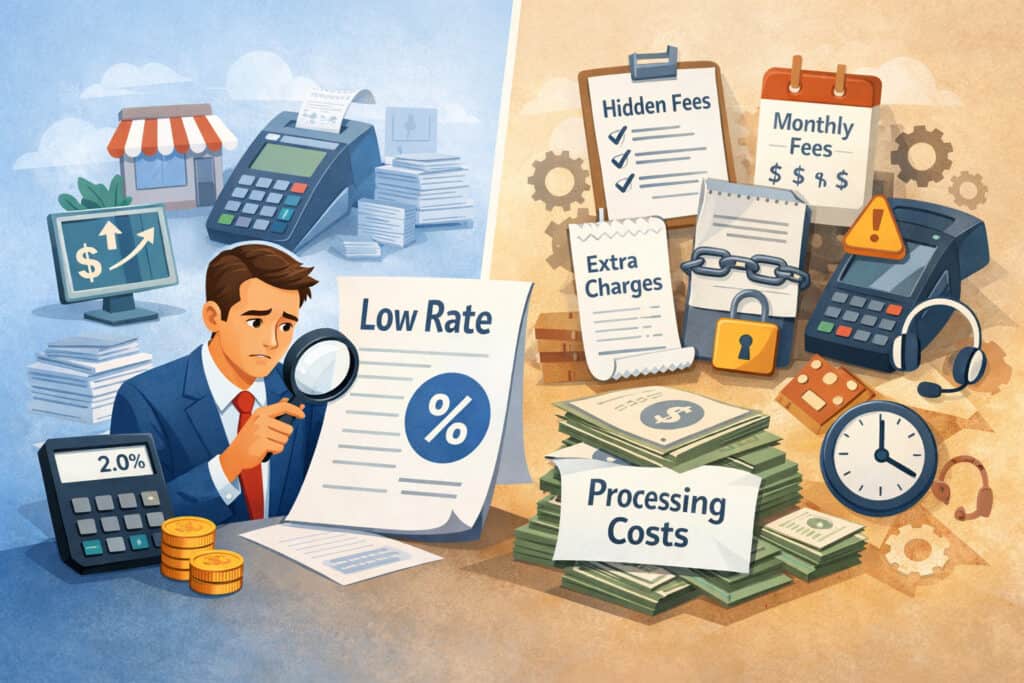
If you’ve ever been quoted “2.29% + 10¢” and thought you were done shopping, you’re not alone. Gym owners often pick merchant services based on a headline rate, without understanding what actually drives the final bill: interchange categories, card types, network assessments, transaction method (tap, chip, keyed, online), and hidden platform fees.
This is where gyms get blindsided—because recurring billing and online enrollments often price differently than in-person transactions.
The real cost of merchant services is not just the percentage. It’s also the fixed fees per transaction, the monthly account charges, PCI compliance costs, batch fees, gateway fees, chargeback fees, and “membership billing” platform fees.
And for gyms, even small “per-transaction” add-ons become painful at scale. If you run 1,200 monthly memberships, a tiny extra fee repeated 1,200 times becomes a major margin hit.
A smarter approach is to evaluate merchant services using effective rate (total processing fees ÷ total card volume) and to separate your payment flows: in-person, online, and recurring. Many gyms also fail to compare “card-present” vs “card-not-present” pricing.
If your gym collects sign-ups online and stores cards on file, your merchant services setup must be optimized for that reality—not just front-desk swipes.
What to do instead: Build a gym-specific merchant services “cost map”
Create a one-page “cost map” of your merchant services before you change anything. Pull your last two processing statements and list every fee line item.
Group them into: (1) percentage fees, (2) per-transaction fees, (3) monthly fixed fees, and (4) exceptions (chargebacks, retrievals, AVS fees, etc.). Then match those fees to how your gym actually gets paid: membership billing, day passes, retail items, personal training packages, and online class sales.
Next, ask your provider for pricing that matches each flow. A gym that does heavy recurring billing needs a clean strategy for stored credentials, tokenization, and card updater services.
A gym that does lots of walk-ins needs reliable tap/chip acceptance with a low failure rate. If your merchant services provider can’t explain how your membership billing is categorized and priced, that’s a red flag.
Finally, compare offers using the same measurement: your projected effective rate based on your real mix of transaction types. This keeps “cheap-sounding” quotes from hiding expensive add-ons.
When gyms fix this merchant service mistake, they often find savings without changing a single membership price—just by aligning pricing to how money actually comes in.
Mistake #2: Treating Recurring Billing Like a Set-It-and-Forget-It Feature

Recurring billing is the heart of most gyms—and the fastest way to create both predictable revenue and predictable disputes. Many gym owners assume recurring billing is “just a checkbox” inside their merchant services account. In reality, recurring billing is a specialized payment flow with specific rules, risk controls, and best practices.
Common failures include: storing card numbers improperly, not using tokenization, not sending pre-bill reminders, not keeping clear membership records, and not capturing proper authorization for membership terms.
These gaps create a dispute magnet. When a member claims “I canceled” or “I didn’t agree,” banks often lean toward the cardholder unless you provide proof and strong billing evidence.
This matters even more because regulators and consumer protection agencies increasingly scrutinize subscription-style billing. Gym memberships sit directly in that spotlight.
The Federal Trade Commission has been active around recurring subscription practices and cancellation friction. Even though legal status and note-by-note enforcement can shift, the direction is clear: easier cancellations, clearer disclosures, and less “gotcha” billing.
What to do instead: Engineer recurring billing with proof, transparency, and resiliency
Your merchant services recurring billing should be built around three goals: (1) reduce declines, (2) reduce disputes, and (3) make compliance painless.
Start with proper stored credential handling: use tokenization through your billing platform so your gym never stores raw card data. Then enable account updater services where available, so expiring cards update automatically and you don’t lose a member due to a simple expiration.
Next, fix the “evidence trail.” Your membership agreement should clearly state billing frequency, cancellation method, and any notice requirements. Make sure the member’s acceptance is captured (digital signature or checkbox with timestamp).
Send a welcome email that restates billing terms in plain language and includes a simple cancellation path. These steps reduce chargebacks because members can’t claim confusion as easily.
Finally, add decline recovery that doesn’t annoy members: retries spaced intelligently, a “card update” link, and an SMS/email notice that the payment failed. Declines hurt retention, but aggressive retry loops can also trigger fraud flags and disputes.
The best merchant services setups for gyms treat recurring billing like a system—not a feature—and that system protects revenue while lowering risk.
Mistake #3: Ignoring Cancellation, Refund, and Dispute Friction Until It Becomes a Crisis

Gym chargebacks often come from one of three moments: cancellation, freeze requests, and “I didn’t recognize this charge.” If your policies are unclear or hard to execute, your merchant services costs rise quickly—not just from chargeback fees, but from higher risk scores that can impact approvals, reserves, or even account stability.
The “cancellation friction” problem has been a major public issue in the gym industry. High-profile actions and lawsuits have centered on how hard it can be for members to cancel and how recurring charges continue after cancellation attempts. Even when a gym believes it’s compliant, if members perceive friction, complaints rise—and disputes follow.
Refund handling is another weak point. Some gyms delay refunds, offer only store credit, or require multiple steps. That may feel protective of revenue, but it can backfire because cardholders can bypass you and go straight to a dispute.
What to do instead: Use “dispute prevention” policies built into merchant services workflows
Dispute prevention is not a script your front desk reads—it’s an operational design supported by merchant services tools.
First, make cancellation simple and trackable. If members can sign up online, they should be able to request cancellation online too—or at minimum have a clearly documented pathway with confirmation. Even if specific legal standards vary, the trend in subscription expectations is unmistakable: fewer hurdles, more clarity.
Second, tighten descriptors. Many disputes start because the bank statement descriptor is confusing. Your merchant services provider should help you set a clear business name, city, and customer support number. Then mirror that exact descriptor in your welcome email and receipts so members recognize it.
Third, create a “chargeback packet” template: membership agreement, proof of attendance/check-ins, email logs, cancellation policy, and refund history. When a dispute hits, speed matters. The best merchant services operators win more disputes because they submit strong evidence fast.
Finally, use proactive communication: pre-bill notices for annual plans, freeze reminders, and expiration notices for promos. Prevention costs less than fighting disputes—and it keeps your merchant services profile healthier over time.
Mistake #4: Using the Wrong POS or Payment Flow for How Members Actually Buy

A gym is not just a “card present.” It’s a hybrid commerce model: front desk, mobile devices for events, online sign-ups, recurring billing, add-on retail, and sometimes class bookings. Gym owners commonly bolt together tools that don’t share data—creating a messy member experience and messy reconciliation.
Typical symptoms: members get double-charged because the POS and membership billing platform don’t sync; staff manually key in cards (higher fees and higher risk); online checkout fails on mobile; and refunds require “calling the processor” instead of clicking a button.
Bad payment flow design leads to more declines and more disputes. It also increases staff time—because employees end up acting as human payment routers. Your merchant services should reduce staff workload, not create it.
What to do instead: Design one payment architecture with consistent merchant services rules
Think of your gym payments as one system with multiple entry points. Your merchant services setup should unify:
- In-person: tap/chip with reliable terminals
- Online: mobile-optimized checkout
- Recurring: tokenized stored credentials
- Add-ons: retail and services tied to member profiles
Start by mapping member journeys: how they join, how they pay, how they upgrade, how they pause, and how they cancel. Then choose tools that share customer identity and payment tokens across journeys. The fewer times a member has to re-enter payment details, the fewer errors and the fewer disputes.
Next, reduce keyed transactions. Keyed payments cost more and are easier to dispute. Use tap-to-pay on mobile for pop-up events, enable payment links for remote personal training, and use secure invoices instead of collecting cards over the phone.
Finally, ensure your reporting matches how you run the business. If you can’t easily see membership revenue vs retail vs training packages, you’ll make pricing and staffing decisions on guesswork.
Strong merchant services architecture gives you clean revenue segmentation, lower support workload, and a smoother member experience—all of which improves retention.
Mistake #5: Not Taking PCI Security Seriously (Until After a Breach or Fine)
Payment security is not optional, and gym owners often underestimate their responsibility because they assume “the processor handles it.” Your merchant services provider and software partners play a big role, but the gym still has obligations—especially if staff handle card data, if terminals are on shared networks, or if you store payment information incorrectly.
PCI DSS has continued evolving. PCI DSS v4.0 was published to address modern threats, and future-dated requirements became mandatory after the transition period ended (the industry’s timetable has centered around March 31, 2025 for those future-dated controls becoming required).
This matters because many “small business habits” (shared logins, weak passwords, unsegmented Wi-Fi, outdated POS devices) clash with modern compliance expectations.
For gyms, the risk is amplified: lots of staff turnover, many part-time workers, busy front desks, and frequent “quick fixes” to get a payment through.
What to do instead: Build a “minimal exposure” merchant services security posture
Your goal is simple: make it almost impossible for your gym to touch sensitive card data. That means your merchant services strategy should prioritize tokenization and secure hosted payment pages for online signups, so raw card numbers never enter your systems.
Separate networks: member Wi-Fi should never share the same network as payment devices. Lock down terminals and restrict who can issue refunds or key-enter transactions. Use unique logins (no shared credentials), and enforce strong passwords and device updates. These basics align with the direction of modern PCI expectations around access control and security hygiene.
Complete your PCI validation honestly. Many gyms treat PCI emails like spam until they get hit with non-compliance fees. A good merchant services provider will guide you through the correct Self-Assessment Questionnaire (SAQ) path based on your setup—especially if you use a fully hosted checkout.
Mistake #6: Adding Surcharges or Convenience Fees Without Understanding the Rules
Gym owners feel processing costs are rising and look for quick relief: surcharging credit cards, adding “service fees,” or charging convenience fees for online payments. Done correctly, these strategies can offset costs. Done wrong, they can trigger network non-compliance, member anger, disputes, and even legal headaches.
Card brand rules govern how surcharges must be disclosed and capped. Visa and Mastercard each publish rules and guidance for merchant surcharging, including notice and disclosure expectations and caps.
Mastercard’s public guidance highlights a maximum surcharge cap (commonly referenced as up to 4% in their materials), along with disclosure requirements. Visa’s guidance also explains where surcharging is permitted and the conditions that apply.
On top of card rules, state-level requirements can vary, so gym owners who “copy what a café does” can walk into problems fast.
What to do instead: Choose a fee strategy your merchant services provider can keep compliant
Before you add any fee, decide which model fits your gym:
- Surcharge model: applied to credit card payments under card brand rules
- Service fee model: applied broadly (often requires careful structure)
- Cash discount model: advertised price reflects card acceptance cost, with a discount for cash
Work with a merchant services provider who can explain the difference—and who has tooling to do compliant disclosures on receipts and at checkout. If your system can’t display the fee clearly before payment, you’re asking for disputes.
Second, keep the member experience in mind. Gyms are retention businesses. A surprise fee at checkout undermines trust and increases “I didn’t authorize this” claims. If you implement fees, communicate them: signage, membership agreement language, and online checkout transparency.
Mistake #7: Letting Declines Pile Up Without a Recovery System
Declines are not just lost revenue—they’re a retention killer. When a member’s monthly membership charge fails and nobody notices, the gym loses money quietly for weeks. When the gym finally notices, it feels awkward to chase payment, and the member feels “nickel-and-dimed.” Then cancellations rise.
Many gyms mistakenly treat declines as a billing platform issue rather than a merchant services performance metric. But declines are driven by payment method mix, card expiry, insufficient funds, bank fraud filters, and how your system retries payments.
A basic decline process—one email and then “try again tomorrow”—is not enough. It can also backfire if you retry too aggressively and trigger bank risk systems.
What to do instead: Build smart dunning that protects merchant services performance
A good decline recovery (“dunning”) system has four parts:
- Immediate notice: Send an email/SMS the same day a payment fails, with a secure link to update the card.
- Account updater: Use automatic card update services when possible so expired cards refresh without member friction.
- Retry logic: Space retries (for example, 3–5 attempts across 10–14 days) instead of hammering daily.
- Front desk visibility: Flag the account at check-in so staff can handle it politely in person.
Your merchant services provider should support tokenized updates and secure payment links. Avoid staff taking cards on paper or typing them into random screens—that raises PCI risk and disputes.
Also track decline rates by payment channel. If online signups have higher declines, your checkout may be failing on mobile or causing AVS mismatches. Fixing those issues improves approvals without changing pricing.
Mistake #8: Underestimating Chargeback Risk and Losing “Winnable” Disputes
Gyms are naturally exposed to disputes: membership billing, cancellation misunderstandings, promotions, and “I forgot I signed up.” Many gym owners either ignore chargebacks until they become painful—or fight them inconsistently with weak documentation.
A chargeback is not just a fee. It can affect your risk profile. Too many chargebacks can lead to stricter terms, higher rolling reserves, or worse approval rates. That’s why chargeback management must be part of your merchant services plan, not an afterthought.
Some disputes are preventable (bad descriptor, unclear policy). Others are winnable (members used the gym after claiming cancellation). But you can’t win if you don’t have evidence ready.
What to do instead: Treat chargebacks as a merchant services KPI, not a random event
Set a weekly routine: review disputes, reasons, and patterns. Categorize disputes into “preventable,” “winnable,” and “policy gap.” Then assign fixes:
- Preventable: fix statement descriptor, add pre-bill reminders, improve cancellation confirmation
- Winnable: ensure check-in logs, signed agreements, and communication history are retrievable fast
- Policy gap: rewrite membership terms and staff training
Your merchant services provider should offer a dispute portal with clear deadlines and evidence upload. The moment a chargeback arrives, the clock starts. Late responses often lose by default.
Also, invest in member communication. A simple “billing reminder” email and an easy way to reach support reduce disputes because members contact you first instead of their bank.
Mistake #9: Not Negotiating Contract Terms (Reserves, Termination, and Support) Up Front
Many gyms only discover contract problems when they try to switch providers or when they face a cash-flow crunch. Hidden traps include long auto-renewal terms, expensive equipment leases, early termination fees, and sudden reserve requirements during high dispute periods.
Reserves are especially critical for gyms because membership revenue can look “stable” until a dispute wave hits—often triggered by a policy change, a relocation, a billing system migration, or a social media complaint. If your merchant services provider can unilaterally hold funds, your payroll and rent become vulnerable.
Support is another contract “gotcha.” When you have a billing outage or a batch fails, waiting 48 hours for an email reply is not acceptable for a gym that processes daily revenue.
What to do instead: Create a merchant services contract checklist before you sign
Before committing, get written answers to:
- Term length and auto-renewal details
- Early termination fees (ETFs) and equipment lease terms
- Reserve policy: triggers, percentage, duration, release timing
- Chargeback fees and retrieval fees
- Funding schedule (next-day, two-day) and cutoff times
- Support channel (phone/chat), hours, escalation path
- Integration responsibilities between POS and billing platform
Ask for an exit plan: what happens to tokens, customer vault data, and recurring billing credentials if you change providers? If your gym can’t migrate tokens, switching merchant services becomes a nightmare—and you risk declines and churn.
Mistake #10: Neglecting Reporting, Reconciliation, and Member-Level Payment Analytics
Gym owners often run revenue decisions on “bank deposits” rather than payment intelligence. Without clean reporting, you can’t answer basic questions: Which memberships are most profitable? Are declines rising? Which location has the highest dispute rate? Which promos lead to chargebacks? How much margin do you really keep after processing?
This is not just finance hygiene—it’s a growth strategy. Your merchant services reporting should connect revenue to member behavior, because gyms are retention machines. If payments are messy, you miss churn signals.
Also, reconciliation matters for taxes, payroll planning, and vendor payments. If your batches and deposits don’t line up cleanly, you waste hours monthly—time that could be spent improving the gym.
What to do instead: Build a merchant services reporting stack that matches gym operations
At minimum, your reporting should show:
- Gross sales by channel (front desk, online, recurring)
- Fees by channel and effective rate
- Declines by reason and trend
- Chargebacks by reason code and trend
- Refunds and cancellation refunds by staff/user
- Member-level payment history
Tie this data into your membership management system where possible. If you can’t, export weekly reports and track KPIs in a simple dashboard. Even a basic spreadsheet works—as long as it’s consistent.
Use reporting to improve approvals: if AVS mismatches are high, your online checkout may be collecting addresses poorly. If retry success is low, your dunning schedule may be wrong. If one staff member issues unusual refunds, you may have a training or fraud issue.
FAQs
Q1) What merchant services setup is best for a gym with recurring memberships?
Answer: The best merchant services setup for a membership gym combines three capabilities: secure recurring billing, clean dispute prevention, and high approval rates.
You want tokenization (so your gym doesn’t store raw card data), account updater support (to reduce lost revenue from expired cards), and a billing platform that produces strong records for disputes. You also need a payment experience that matches how members join: if signups are online, your checkout must be mobile-first, fast, and transparent.
Look for merchant services providers that understand stored credentials and recurring billing best practices—because gyms are not the same as one-time retail. Ask about decline recovery tools, retry logic, and member notification workflows. Chargeback tooling matters too: a dispute portal, clear evidence guidance, and fast support can protect your revenue.
Finally, don’t ignore the front desk. Even membership gyms sell add-ons—day passes, apparel, supplements, training packages. Your merchant services should unify those payments under consistent reporting so you know what’s driving profit. The best setup is the one that reduces friction for members and reduces complexity for staff.
Q2) Are surcharges allowed for gym payments, and how do I do them correctly?
Answer: Surcharging can be allowed in many places, but it is governed by card network rules and can be influenced by state-level requirements. Visa and Mastercard publish merchant guidance that covers what a surcharge is, where it may be permitted, and disclosure expectations. Mastercard also highlights surcharge caps and merchant responsibilities.
For gyms, the bigger question is whether surcharging helps retention or harms it. A gym is a relationship business—members pay repeatedly and judge fairness. If you add a fee, be transparent: signage, online checkout disclosure, and membership agreement language. Don’t surprise members at the final click or at the counter.
Work with your merchant services provider to implement fees the right way (receipt formatting, correct application to eligible card types, and reporting). If your tools can’t handle compliant disclosure automatically, you risk disputes and complaints.
A careful approach is essential, and many gyms prefer a pricing strategy that builds costs into membership rates rather than adding visible checkout fees.
Q3) Why do gyms get so many chargebacks compared to other local businesses?
Answer: Gyms combine three chargeback triggers: recurring billing, cancellation conflict, and “I don’t recognize this descriptor.” Unlike a restaurant, where the transaction is tied to a single visit, gym billing continues month after month.
If cancellation is unclear or slow, the member often disputes instead of contacting the gym. Public attention and legal activity around gym cancellation friction has also increased awareness and complaints in this category.
Another driver is documentation. Many gyms don’t capture clean digital proof of authorization, membership terms, or attendance/check-ins. When a dispute arrives, they scramble. Banks typically want a clear trail: agreement, billing terms, proof the member used the service, and evidence that the gym communicated cancellation/refund options.
Your merchant services strategy can reduce chargebacks by improving descriptors, sending billing reminders, confirming cancellations, and keeping records organized. Winning chargebacks is often less about arguing and more about producing strong, fast evidence.
Q4) What’s changing in payment compliance that gym owners should watch next?
Answer: Two big themes will keep shaping gym payments: stronger security expectations and stronger consumer expectations around subscription billing.
On security, PCI standards have continued to evolve, and PCI DSS v4.0 (including the limited revision v4.0.1) reflects the industry’s direction: better access control, stronger authentication habits, and clearer responsibility for merchants and service providers. Gyms should reduce exposure by using tokenization and hosted payment experiences so they don’t store card data.
On subscription billing, consumer protection pressure has increased around “negative option” style recurring charges and cancellation difficulty. Even when specific rules change through courts or updates, the market expectation is moving toward easier cancellations, clearer disclosures, and fewer hurdles.
Conclusion
The biggest merchant services mistakes gym owners make are rarely dramatic. They’re slow leaks: a pricing plan that doesn’t match recurring billing, a cancellation process that creates disputes, a POS stack that doesn’t sync, a security posture that’s too casual, or a lack of decline recovery. Over months, those leaks become thousands in lost revenue, higher dispute costs, and more member churn.
The fix is not “find the cheapest processor.” The fix is to build merchant services around how gyms actually operate: recurring memberships, hybrid payment channels, staff turnover, and retention-focused member experiences.
When your merchant services are designed for transparency, security, and high approval rates, you keep more of what you earn—and your members trust you more.