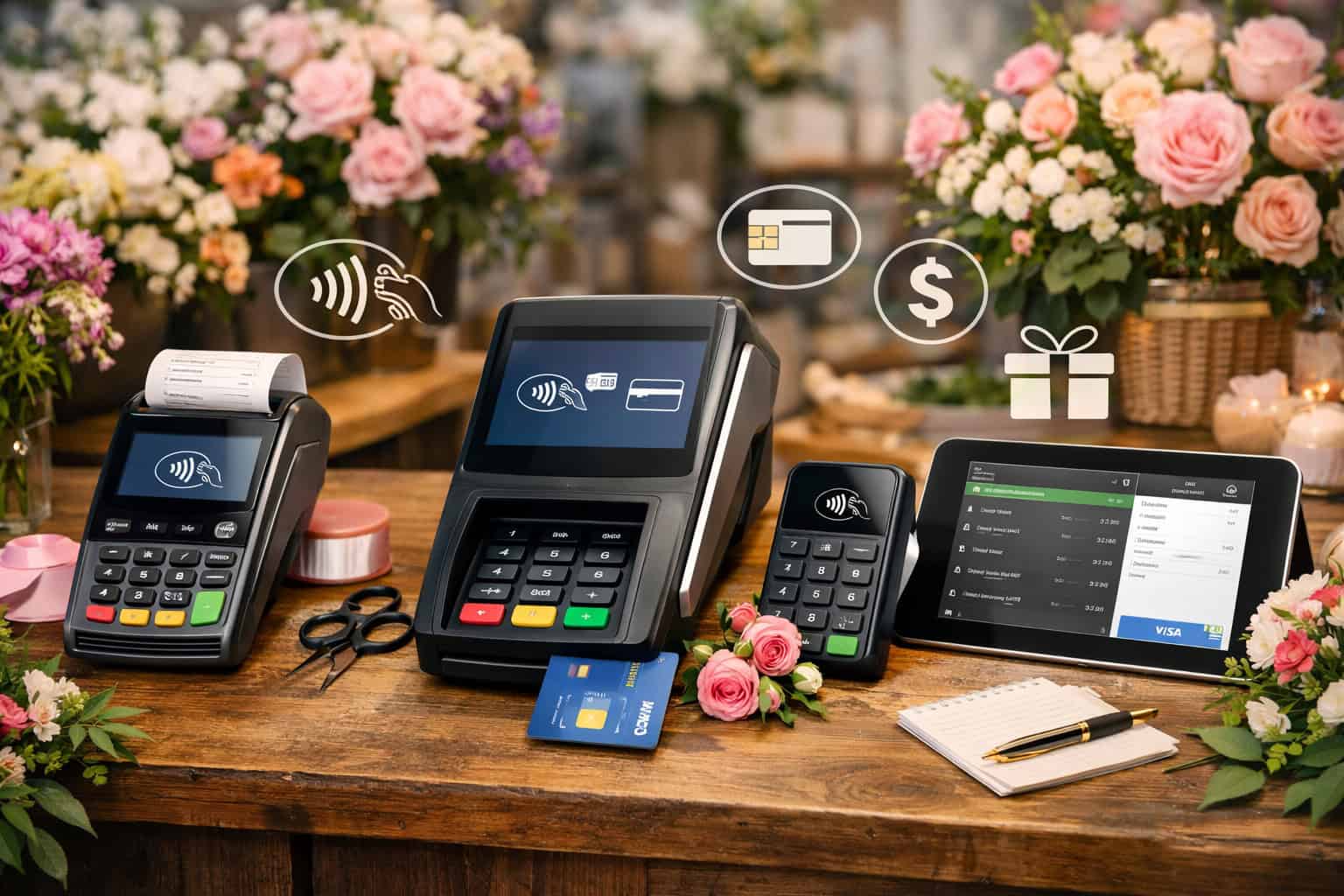
Florists don’t process payments like most retailers. A floral shop lives and dies by speed during rush windows (Valentine’s Day, Mother’s Day, prom weekends), by mobility (taking payments at the design table, curbside pickup, delivery confirmations), and by reliability (a terminal that drops Wi-Fi during a line out the door is a silent revenue killer).
That’s why EMV terminals matter so much in this niche. You’re not just checking a compliance box—you’re choosing the device that protects your margins, keeps checkout flowing, and supports the way floral businesses actually work.
In practical terms, EMV terminals help reduce counterfeit card fraud because chip transactions are harder to clone than magstripe swipes. But the “best” device for a florist isn’t only about the EMV chip.
It’s about contactless (tap-to-pay), battery life, built-in receipt printing, connectivity options, and how well the device fits your counter space and workflow—especially when you’re balancing walk-ins, phone orders, and pre-orders for pickup.
This guide focuses on EMV terminals that are proven, widely deployed, and well-suited to floral operations. You’ll learn which terminal styles match common florist workflows, what features to prioritize for bouquets, plants, and event work, and how to avoid common pricing and contract traps.
You’ll also get forward-looking guidance, because payment hardware and security standards keep changing, and floral businesses benefit from choosing EMV terminals that won’t feel outdated in a year.
What Floral Businesses Need From EMV Terminals (Beyond “Chip + Tap”)
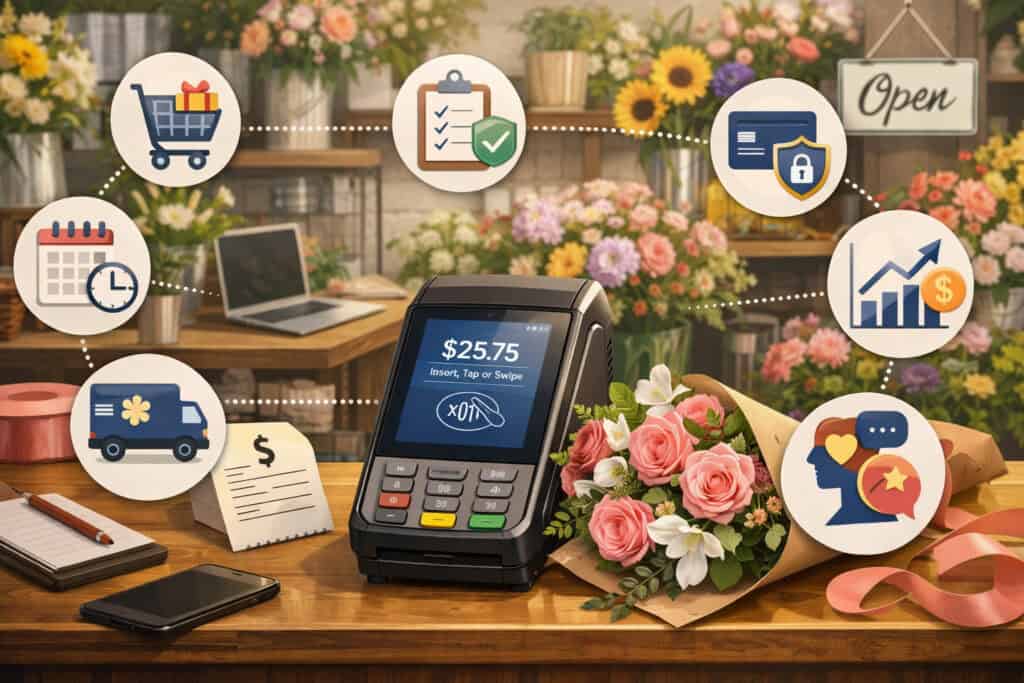
Floral businesses have unique checkout moments that expose weaknesses in the wrong hardware. Think about how often a customer pays while you’re holding a bouquet, walking them through ribbon upgrades, or confirming a delivery window. EMV terminals must support this kind of “in-motion retail,” not just a static counter sale.
First, florists need fast, consistent contactless. Tap payments shine when customers have one hand full of flowers, a stroller, or a phone. If your EMV terminals make tap feel slow or confusing, customers revert to inserting chips or handing you a card—both of which slow the line.
Second, mobility matters: being able to walk a terminal to the design bench reduces bottlenecks, especially when your counter is covered with arrangements.
Third, built-in printing is still a quiet advantage for many florists. Yes, text/email receipts are common, but a printed receipt can serve as an order confirmation for walk-in customers, a record for corporate clients, or a quick reference when reconciling same-day orders. That’s why many florists prefer EMV terminals with integrated printers, especially in busy seasons.
Fourth, connectivity options are non-negotiable. A florist shop may have dead spots near coolers or a busy Wi-Fi network shared with music, cameras, and tablets. The best EMV terminals offer flexible connectivity—Wi-Fi plus cellular, or Ethernet on the counter plus Bluetooth where needed.
Finally, don’t overlook durability: water splashes, ribbon scraps, and constant handling are normal in a flower shop, so your EMV terminals should be built for daily wear, not occasional use.
The 3 Best EMV Terminal Styles for Florists (Choose the Right Form Factor)
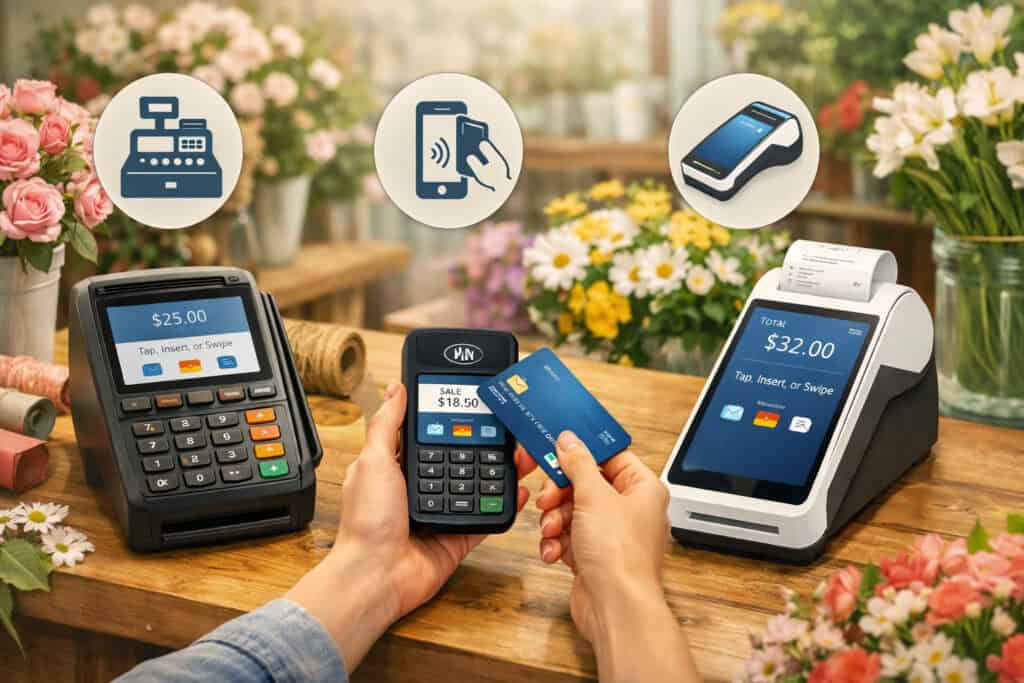
When people search “best EMV terminals,” they usually get a list of models. But florists get better results by first choosing the right terminal style. In flower shops, form factor drives speed, customer experience, and how often staff actually use the device correctly.
1) Mobile Smart Terminal (all-in-one handheld): This is often the best fit for florists because it combines chip, tap, and usually a built-in printer in a device you can carry to the customer.
Mobile smart EMV terminals support “pay at the design bench,” curbside payments, and line-busting on holidays. They reduce counter congestion and help staff stay focused on fulfillment instead of walking back and forth to a fixed terminal.
2) Countertop or Semi-Integrated Setup (pin pad + POS): If you run a dedicated register area with a POS system, a customer-facing pin pad can be ideal. The best EMV terminals in this category handle fast tap, clear prompts, and strong security. This style is common for higher-volume storefronts and can look more “professional” for corporate clients.
3) Portable Payment Terminal (classic handheld, more payment-first): Portable EMV terminals focus on payment reliability and battery life. They’re a strong choice for florists doing deliveries, pop-ups, and weekend markets, especially if you don’t need a full app ecosystem on the terminal itself.
The best approach for many floral businesses is a two-device strategy: a stable counter device for your main register plus a mobile unit for the shop floor and peak days. That blend keeps EMV terminals available where work happens, which is the real secret to faster checkout.
Best EMV Terminals for Floral Businesses: Top Picks in 2026
Below are standout EMV terminals that match common florist workflows. These aren’t the only options in the world, but they’re consistent performers and widely supported, which matters when you need replacements quickly during a holiday rush.
PAX A920 Pro / A920 Family (Best All-In-One Mobile EMV Terminal for Florists)
For many florists, the “sweet spot” is a smart mobile terminal that’s easy for staff, fast for customers, and flexible across checkout scenarios. The PAX A920 family is popular in that role, and the A920 Pro is a strong example of a modern all-in-one approach to EMV terminals.
PAX publishes a comparison of A920 models to help businesses choose between versions based on performance, screen size, and battery expectations.
What makes it florist-friendly is the combination of mobility + payment acceptance + built-in printing. The A920 Pro specs include chip & PIN, NFC contactless, magstripe, and an integrated printer, along with multiple connectivity configurations such as 4G + Wi-Fi + Bluetooth.
This matters when you’re taking payments near coolers, outside for curbside, or in busy shop areas where Wi-Fi may be inconsistent.
From a workflow standpoint, florists benefit because staff can present the terminal to the customer rather than taking the card away. That reduces errors and speeds up checkout. During peak holidays, a mobile device like this can act as a “second lane” without needing a second register.
When evaluating these EMV terminals, ask your processor about remote device management, replacement timelines, and whether your pricing includes software updates and security maintenance. In a floral business, downtime is expensive. A mobile terminal is a revenue tool—treat it like one.
Ingenico Move/5000 (Best Portable EMV Terminal for Deliveries and Off-Site Sales)
If your floral business includes deliveries, event setup, or frequent off-site selling, portability becomes the priority. The Ingenico Move/5000 is positioned as a mobile companion for merchants who want to take payments away from the checkout, with an interface designed for mobile use.
For florists, this style of EMV terminals is especially useful for:
- taking deposits at venues
- collecting balances at delivery
- pop-up flower bars and seasonal stands
- mobile sales at partner locations (cafes, boutiques, wedding shows)
The Move/5000 product documentation emphasizes support for EMV chip and contactless NFC, and some references also describe additional capabilities like QR support and options for secure payment deployments depending on the integration.
The key florist advantage is operational: you reduce “we’ll invoice you later” situations, which can quietly increase unpaid balances and admin overhead.
Another florist-friendly factor is the customer experience. Portable EMV terminals let you keep the payment moment close to the handoff moment—when the customer receives the arrangement, confirms details, and feels confident. That’s when upsells (vase upgrade, premium ribbon, add-on card) convert best.
If your business does a lot of delivery collection, make sure the portable unit supports the connectivity your team actually uses (Wi-Fi in-store, cellular when out). Portable EMV terminals only help when they connect reliably.
Verifone P400 (Best Customer-Facing EMV Pin Pad for a Busy Counter)
Some floral shops thrive with a dedicated register lane and a customer-facing pin pad. In that setup, the terminal becomes part of your brand experience: clear prompts, quick tap, and a screen customers can see without twisting around a bouquet display.
The Verifone P400 is positioned as a secure device that accepts MSR, EMV, and NFC payments and is used with broader commerce services in some setups. Verifone also provides installation guidance for the P400/P400 Plus, including notes about contactless behavior depending on how the application initializes the contactless module.
For florists, the advantage of this class of EMV terminals is speed and consistency. A customer-facing pin pad works well when:
- your staff ring at a fixed station
- you want customers to insert/tap on their own
- you process high volumes of small-to-mid ticket sales
- you want a clean counter workflow with fewer handoffs
If you run a POS system, this style can also reduce training time because staff mostly focus on the POS while customers handle the payment steps. During holiday surges, that division of labor speeds lines.
One caution: hardware lifecycles and support policies can vary by provider and reseller. Before choosing any pin pad style EMV terminals, confirm your support plan, warranty, and replacement process so your counter lane doesn’t become a single point of failure.
Features Checklist Florists Should Prioritize When Comparing EMV Terminals

Florists can simplify decisions by using a florist-specific checklist. The “best” EMV terminals are the ones that remove friction in the exact places floral businesses feel it most: peak surges, multi-step orders, and mobile handoffs.
Contactless performance and prompt clarity should be at the top. Tap is only fast if customers understand what to do. Look for devices with responsive NFC and screens that clearly indicate “tap/insert/swipe” without lag.
Next, battery life and charging workflow matter more than most businesses realize. If you choose mobile EMV terminals, also choose a charging routine: a dock at the register, a spare charger in the back, and clear handoff rules between shifts.
Connectivity options are another priority. If your shop Wi-Fi is crowded or reaches poorly near coolers, a device that supports both Wi-Fi and cellular can save sales. PAX lists multiple comms configurations for the A920 Pro, including 4G + Wi-Fi + Bluetooth options, which is the kind of flexibility florists benefit from.
Integrated receipt printing is still valuable for floral operations that handle frequent special orders or corporate accounts. Printed receipts can act as mini order confirmations when customers are in a hurry.
Security certifications also matter because floral shops handle a lot of seasonal spikes, and fraud attempts often rise when volumes rise. Devices commonly cite PCI-related certifications and EMV contactless support in their specs.
Finally, consider staff ergonomics. Flower shops are hands-on environments—wrapping, cutting, arranging. The best EMV terminals are easy to hold, easy to clean, and quick to operate with minimal tapping.
Setup and Workflow Best Practices for Floral Shops Using EMV Terminals
Even the best EMV terminals can feel slow if your workflow is messy. Floral businesses get the biggest speed gains by designing checkout around peak moments and predictable order types.
Start by mapping your top payment scenarios: walk-in bouquet, plant purchase, custom arrangement, pre-order pickup, delivery balance, and event deposit. Then decide where the payment should happen in each case.
For example, walk-in bouquets often work best with a counter lane and customer-facing tap. Custom arrangements often close best when payment happens at the design table, right after the customer approves the look and price. That’s where mobile EMV terminals shine.
Next, standardize how you handle tips (if applicable), signatures, and receipt choices. Too many prompts slow the line. Ask your provider to configure the prompt flow so it’s fast and fits your brand.
Also standardize device placement: if the terminal is always “somewhere,” staff waste time hunting. Create a “terminal home” position for every device and a rule for where it goes between transactions.
Train your team with florist-specific scripts:
- “You can tap right here when it lights up.”
- “If the tap doesn’t go through, insert the chip and leave it in until it beeps.”
- “Would you like the receipt printed or sent by text?”
Those scripts sound simple, but they reduce hesitation, which is what makes EMV terminals feel slow.
Finally, plan for the holidays. Add at least one extra device for peak weeks if you can, and test everything the week before. Florists don’t get second chances on Valentine’s Day. Good EMV terminals are only “best” if they’re ready when the rush hits.
Security, Chargebacks, and Compliance: How EMV Terminals Protect Floral Businesses
Floral businesses sometimes assume fraud is “a big retailer problem.” In reality, fraud can hit florists hard because orders are time-sensitive, often placed quickly, and frequently involve delivery—conditions that can increase disputes if your process is inconsistent.
EMV terminals reduce certain fraud types, especially counterfeit card fraud that relies on cloning magstripe data.
When a chip card is inserted, the transaction uses dynamic cryptograms that are difficult to replicate. That means EMV terminals help reduce the risk of someone using a copied card in your store.
Contactless transactions also use cryptographic methods, and modern EMV terminals are designed to support these flows securely when configured correctly.
But security is more than chip acceptance. Ask about end-to-end security options from your provider (like encrypted swipe/tap flows and secure device management). Also focus on operational chargeback prevention:
- Always provide clear receipts (printed or digital).
- Capture accurate delivery details and time windows.
- Use consistent policies for substitutions, because seasonal availability changes.
- Train staff to confirm customer info for phone orders.
Many disputes in floral businesses are “expectation disputes,” not pure fraud. Still, the right EMV terminals and the right settings reduce risk. Device makers often highlight PCI-related security certifications in their device descriptions, and that’s worth factoring into your decision.
A florist doesn’t need to become a security engineer. You just need EMV terminals that meet modern standards, plus a workflow that creates clear proof of purchase and delivery.
Costs and Pricing Models: What Floral Businesses Should Expect to Pay for EMV Terminals
Florists often get quoted a “low” price for hardware and later discover the real cost is hidden in monthly fees, software add-ons, and contract terms. The best EMV terminals deal is the one that stays affordable after month three—not the one that looks cheapest on day one.
Common pricing models include:
- Outright purchase (higher upfront, lower ongoing device fees)
- Leasing/rental (lower upfront, often higher total cost)
- “Free terminal” offers (usually funded by higher processing or monthly fees)
For floral businesses, the risk of leasing is that you may pay far more than the terminal’s value over the term. The risk of “free” offers is getting locked into a processor or rate plan that doesn’t fit seasonal volume swings. Florists have lumpy revenue—quiet weeks and explosive holidays—so flexibility matters.
When comparing EMV terminals, ask for a full cost breakdown: device cost, monthly device fees, gateway/software costs, warranty/replacement fees, PCI/security fees (if any), and any minimum processing requirements.
Also ask about device replacement during peak season: if a terminal fails on a holiday weekend, will you get a replacement overnight, or in 7–10 days?
A smart florist tactic is to choose EMV terminals that can scale. Start with one main device and add a second for peak seasons. If your provider supports easy expansion, you can add capacity without overcommitting year-round.
Costs matter, but the cheapest device can be expensive if it slows checkout. In floristry, speed is profit—and EMV terminals are part of your speed system.
Integrations That Matter to Florists: POS, Inventory, Delivery, and Invoicing
Florists aren’t just selling a “product.” You’re selling a time-sensitive service with perishable inventory, substitutions, and delivery logistics. That means your EMV terminals decision should consider how payments connect to operations.
If you use a POS, the ideal flow is: ring items, take payment, and have the system record what was sold, when, and under which order name. This reduces end-of-day reconciliation and helps during disputes. In a semi-integrated or integrated setup, customer-facing EMV terminals can reduce manual entry and speed payment prompts.
For delivery-heavy florists, consider how you handle deposits and balances. Portable EMV terminals (like delivery-friendly models) can reduce invoicing friction and increase on-time collections.
If you primarily do phone orders and custom work, you may want a workflow where the terminal supports quick “keyed” transactions in a secure, policy-compliant way—though you should still aim to use chip/tap when possible.
Also consider gift and loyalty programs. Many florists run seasonal promotions and corporate repeat accounts. Some terminals and platforms support on-screen prompts, customer messaging, or add-on services depending on the ecosystem.
Verifone’s positioning for the P400 includes connections to broader commerce services in some configurations, which can matter for businesses thinking about in-store and online coordination.
Reliability and Support: The Most Underrated Factor for EMV Terminals in Flower Shops
Florists experience “hardware pain” differently than many businesses because sales peaks are concentrated into a handful of critical days. If your terminal dies on a random Tuesday, it’s inconvenient. If it dies on February 14, it’s catastrophic. That’s why reliability and support should be weighted heavily when selecting EMV terminals.
Start with a replacement policy. Ask your provider:
- How fast can you ship a replacement?
- Do you offer advance replacement?
- What happens if the device fails during a holiday?
- Is there a loaner program?
Then look at device management. If you run multiple EMV terminals, it helps when updates, settings, and troubleshooting can be handled remotely. If your provider can’t support devices quickly, your staff will end up “making it work” with manual workarounds that slow checkout.
Also factor in training. A terminal that’s powerful but confusing can increase errors. In floristry, errors show up as wrong totals, missed upsells, or mismatched receipts—especially when seasonal staff are helping. The best EMV terminals have clear prompts, consistent behavior, and minimal “mystery screens.”
Finally, reliability isn’t only hardware—it’s connectivity. If you have a cooler room with poor Wi-Fi, a mobile unit with flexible comms (like Wi-Fi plus cellular options) is a real operational hedge, and PAX highlights multiple connectivity configurations in its A920 Pro specs.
When a florist chooses EMV terminals, they’re choosing a support relationship too. In peak season, support speed is part of your brand promise.
Future Predictions: Where EMV Terminals Are Headed (and What Florists Should Do Now)
Payments keep evolving, and florists benefit from choosing EMV terminals that won’t be stranded by the next wave. Three shifts are especially relevant.
1) Tap-to-phone (SoftPOS) has become more common: More businesses will accept contactless payments directly on smartphones. For florists, this can be useful for pop-up flower bars, delivery teams, or overflow lanes.
However, dedicated EMV terminals will still win for speed, battery consistency, and customer familiarity—especially when you want printed receipts or a robust checkout flow.
2) Security standards and certifications continue to advance: Payment security requirements evolve over time. Choosing modern EMV terminals from reputable vendors makes it easier to stay aligned with future requirements and avoid forced upgrades.
Devices that already support strong security baselines and current certification families provide a better runway. Vendor specs often highlight PCI-related certification families and EMV support, which is a starting point for your due diligence.
3) Omnichannel expectations keep rising: Customers increasingly expect to browse online, order by phone, pick up in-store, or receive delivery without friction. That means florists will keep blending “in-store payments” and “remote payments.”
Your EMV terminals should be part of a payment setup that supports multiple channels without creating reconciliation chaos.
What should florists do now? Pick EMV terminals that match your workflow today, but choose providers and ecosystems that can grow with you: add devices quickly, support new payment types, and keep security current without surprise costs.
FAQs
Q1) What are EMV terminals, and do florists really need them?
Answer: EMV terminals are payment devices that accept chip-card transactions (and often contactless tap). Florists benefit because chip transactions reduce certain counterfeit fraud risks compared with magstripe swipes.
Beyond fraud, EMV terminals improve checkout consistency: customers recognize chip and tap flows, which reduces confusion during peak lines.
Florists “really need” EMV terminals because floral sales are often emotional and time-sensitive. Customers are buying gifts, apologizing, celebrating, or preparing for events. If checkout is slow or unreliable, it damages the experience.
A modern chip-and-tap flow feels smooth and professional. That matters when someone is spending more than they planned on upgrades like premium vases, deluxe wrapping, or same-day delivery.
Also, floral businesses often do delivery and phone orders. Having the right EMV terminals doesn’t solve everything about remote payments, but it anchors your in-person acceptance with secure methods. The best practice is to pair reliable in-store EMV terminals with a broader payment setup for invoices and deposits.
Q2) Should a floral shop choose a mobile EMV terminal or a countertop setup?
Answer: It depends on how you sell. If you mostly take walk-ins at a fixed counter and you have a stable POS lane, countertop EMV terminals (or a customer-facing pin pad) can be very fast. Customers tap, insert, or enter a PIN while your staff continues wrapping and bagging.
If you do lots of custom arrangements, curbside, or consultative selling at the design bench, mobile EMV terminals can feel like a superpower. You can close the sale right where the customer says “yes,” which increases sales and reduces abandonment.
Mobile devices also help during holidays by creating a second checkout lane without needing a full second register.
Many florists do best with both: one counter device for steady daily flow and one mobile unit for rushes. That “two-lane” approach makes EMV terminals work with your business rhythm instead of forcing your business to work around the hardware.
Q3) Which is better for florists: PAX A920 Pro or Ingenico Move/5000?
Answer: They serve slightly different florist needs. The PAX A920 Pro style EMV terminals are often chosen for all-in-one smart terminal experiences, including touchscreen workflows and built-in printing, with multiple connectivity configurations listed in PAX’s specs. That makes it great for in-store mobility and line-busting.
The Ingenico Move/5000 is widely positioned as a portable companion device for mobile payments away from the checkout, supporting EMV and contactless flows and fitting delivery/off-site use cases. That makes it attractive if you heavily emphasize delivery collection, venue work, or mobile selling.
The “better” choice comes down to workflow. If your team wants a modern handheld that can double as a mini checkout station with printing, you’ll likely lean toward an all-in-one smart terminal approach.
If you want a payment-first portable unit to take payments anywhere reliably, Move/5000-style EMV terminals can be a strong fit.
Q4) What should florists ask a provider before buying EMV terminals?
Answer: Florists should ask questions that protect peak-season operations. Start with total cost: device price, monthly fees, support fees, and any contract terms. Then ask about replacement timelines, especially during holiday weeks. Ask whether device settings can be updated remotely and whether software/security updates are included.
Also ask about connectivity and fallback behavior. If Wi-Fi fails, do your EMV terminals support cellular or another method? Ask how offline transactions are handled (many businesses prefer to avoid true offline approvals because of risk). Ask about receipt options and whether printed receipts are supported.
Finally, ask about scaling. Can you add a second device for Valentine’s Day without renegotiating everything? The best EMV terminals plan is one that lets a florist add capacity quickly when demand spikes.
Conclusion
Choosing the best EMV terminals for a floral business is really about choosing the best checkout experience for a high-emotion, high-urgency retail environment.
Florists need speed during holiday surges, mobility for consultative selling, and reliability for deliveries and curbside pickup. That’s why the “best” device isn’t always the fanciest—it’s the one that matches how your shop actually operates.
If your shop thrives on walk-ins with a steady register lane, customer-facing EMV terminals like a pin pad style can keep checkout predictable and fast.
If your shop thrives on custom work, upsells, and closing sales away from the counter, mobile EMV terminals like the PAX A920 family can streamline the moment a customer commits. PAX’s own A920 model comparisons and A920 Pro specs highlight the kind of mobility, payment acceptance, and connectivity options florists typically want.
For florists who sell off-site, handle deliveries, or take payments on the go, portable options like Ingenico Move/5000-style EMV terminals are built around mobility and shop-floor (or field) acceptance.
Looking ahead, tap-based payments and omnichannel expectations will keep growing. The safest move is to pick EMV terminals that solve your current workflow pains while keeping you flexible for future changes—like adding devices for peak season, supporting newer payment types, and staying aligned with evolving security standards.