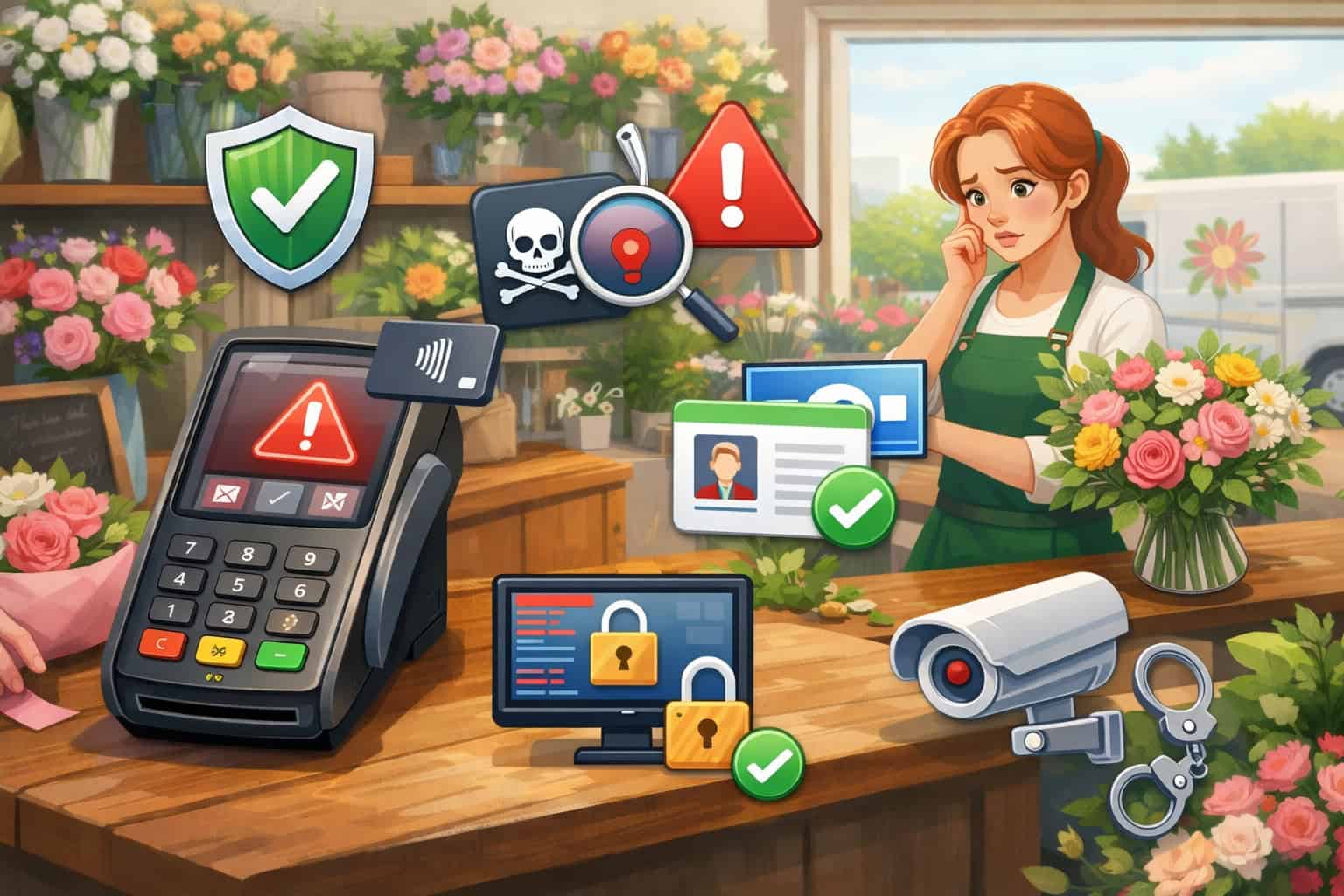
Running a flower shop is built on trust, speed, and emotion. Customers often buy flowers for birthdays, condolences, anniversaries, and last-minute “I’m so sorry” moments—so orders come in fast, often with delivery requests, custom notes, and urgent timelines.
That same urgency is exactly what makes florists attractive to criminals. Fraudsters know that a flower shop will rush to fulfill an order before a cardholder notices an unauthorized charge, and they know fresh product can’t be “returned” once it’s delivered.
The good news: flower shop fraud prevention is very achievable without turning your checkout into a fortress that scares away real customers. The goal is layered fraud prevention—small, consistent checks that stop the most common scams, reduce chargebacks, protect cash flow, and keep your reputation intact.
Fraud prevention also helps you avoid monitoring programs and costly thresholds from card networks that can affect processing costs and risk status. Visa has updated and consolidated monitoring into the Visa Acquirer Monitoring Program (VAMP), with enforcement starting in late 2025 and ongoing threshold updates.
This guide focuses on practical, florist-specific fraud prevention steps for in-store, phone, online, and delivery orders. You’ll learn how to spot patterns, build “friction in the right places,” document orders so disputes don’t drain you, and prepare your team for the next wave of scams.
Why Flower Shops Are Targeted and What Fraud Looks Like in Real Life

Flower shops sit at the intersection of fast fulfillment and high emotional urgency—two conditions criminals love. A typical fraudulent order often includes one or more of these signals: a large bouquet, premium add-ons (chocolates, gift baskets), same-day delivery, and a customer who wants to “keep it simple” by skipping verification steps.
Many scams also involve multiple attempts with different cards until one goes through, because criminals test stolen details quickly.
A major reason florists get hit is that many orders are card-not-present (online and phone), where the merchant cannot physically verify the card. Disputes and chargebacks across digital commerce continue to rise, and industry reports project continued growth in dispute volumes in coming years.
For a flower shop, even a small number of chargebacks can be painful because the product is perishable, labor is already spent, and delivery costs can’t be recovered.
Flower shop fraud prevention starts by understanding the most common attack types:
- Stolen card orders (classic CNP fraud): Fraudster buys flowers with stolen card data and delivers to an address they control (or a mule).
- Friendly fraud (first-party disputes): A real customer orders, receives the flowers, then claims they didn’t authorize or didn’t receive them.
- Account takeover: Criminal accesses a customer account and places an order using saved payment methods.
- Overpayment and refund scams: Fraudster “accidentally” overpays and pressures you to refund via a different method.
- Business email compromise and invoice fraud: Criminal impersonates a supplier, landlord, or partner and redirects payments. This scam type is widespread and shows up consistently in cybercrime reporting.
The through-line is speed: criminals want you to produce value before you realize something is wrong. Strong fraud prevention is mostly about slowing down the right orders by a few minutes, not slowing down every honest customer.
Build a Flower Shop Fraud Prevention Mindset: Risk Is a Process, Not a Plugin

Many merchants look for a single fraud prevention tool—something they can switch on and forget. For florists, that approach fails because fraud shifts with seasons (Valentine’s Day, Mother’s Day), marketing campaigns, and delivery coverage areas.
Real flower shop fraud prevention is a repeatable process: you assess risk, add controls, measure results, and adjust.
Start by defining what “good” looks like for your shop:
- Low false declines: Your fraud prevention should not block loyal customers buying bouquets at the last minute.
- Consistent verification: The same rules apply no matter who is working the phone or packing deliveries.
- Fast escalation: Suspicious orders are reviewed quickly, so you still deliver on time when it’s legitimate.
- Clear evidence capture: You can defend a dispute with calm, organized records.
Then set a simple risk policy that your whole team can follow. The most effective fraud prevention policies are short enough to be remembered:
- Orders over $X or with same-day delivery get an extra verification step.
- Any order with a billing/shipping mismatch gets reviewed.
- Any customer requesting a refund to a different method is automatically blocked.
- Any customer who refuses basic checks is politely declined.
Why does structure matter? Because card network monitoring is driven by ratios and counts, not feelings. Visa’s updated monitoring approach under VAMP evaluates disputes and fraud signals and ties consequences to thresholds.
Mastercard also maintains extensive chargeback guidance and rules frameworks that emphasize strong merchant practices.
A practical mindset shift: treat fraud prevention like food safety. You don’t “solve” it once—you follow consistent hygiene and reduce risk every day.
Secure Your Checkout Channels: In-Store, Online, Phone Orders, and Delivery Payments

Your flower shop likely takes payments through multiple channels, and each channel needs channel-specific fraud prevention. Criminals choose the weakest door, not the main entrance.
In-Store Fraud Prevention for Card Present Sales
In-store fraud is less common than online, but it still happens—especially with counterfeit cards, stolen wallets, and rushed purchases. Your best fraud prevention protections are operational:
- Use chip/tap whenever possible: If your terminal supports contactless, encourage tap for speed while still using secure standards.
- Train staff not to “key enter” unless necessary: Keyed transactions are riskier and can increase disputes.
- Check for suspicious behavior, not appearance: Examples: unusually high purchase with no questions, customer tries multiple cards, customer insists on swiping when chip fails.
- Split tender controls: Fraudsters sometimes split across multiple cards to bypass limits; require manager approval over a threshold.
Keep in mind: in-store fraud prevention isn’t about interrogating customers. It’s about enforcing consistent payment behaviors that reduce unsafe transaction types.
Online Checkout Fraud Prevention for Florist Websites
Online orders are the highest-risk channel for most florists. Strong flower shop fraud prevention online typically includes:
- Address verification checks when available (billing address match signals).
- CVV requirement (avoid allowing customers to skip it).
- Velocity limits (limit number of attempts per IP/device/email in a short period).
- Bot protection (block scripted card testing).
- Email and phone validation (format checks plus “is this reachable?” logic).
- Customer account security (password rules, login alerts, and optional MFA for saved cards).
Also protect your confirmation and customer service workflows. Fraudsters often place an order and then immediately contact you to change the delivery address. Your policy should require a clear verification step before any high-risk change.
Phone Orders (MOTO) Fraud Prevention
Phone orders are a florist staple—especially for corporate clients, older customers, and last-minute buyers. Unfortunately, phone orders are also a favorite for stolen card use because there is no device fingerprint or behavioral data.
For phone-order fraud prevention, build a consistent script:
- Confirm billing name, billing ZIP, and phone number.
- Ask for delivery recipient name and contact (a real delivery usually has a reachable recipient).
- For high-risk orders, require a call-back to the phone number on file rather than the one provided in a rushed call.
- Never accept “I’ll email you the card photo.” That creates privacy and compliance risks and increases fraud.
If your shop takes a lot of phone orders, consider a separate workflow: “We’ll confirm in 10 minutes and then start design.” That small delay is a powerful fraud prevention tool that still feels customer-friendly.
Delivery and Pay-On-Delivery Fraud Prevention
If you accept payment at delivery, you can reduce some card-not-present fraud, but you introduce new risks: fake addresses, unsafe delivery situations, and disputes about whether the delivery happened.
A smart fraud prevention approach here includes:
- Confirm recipient phone at delivery window.
- Require signature or photo proof for high-value deliveries.
- Use GPS-stamped delivery confirmation via your driver app when possible.
- For apartments and offices, capture front desk name or suite number details.
These delivery confirmations become your evidence in disputes and chargeback scenarios, and they also reduce customer service confusion.
The Florist’s Fraud Red Flags: A Practical Scoring System Your Team Can Use

Flower shop fraud prevention becomes much easier when your staff doesn’t rely on gut instinct. Instead, use a simple scorecard. Each red flag adds points; above a set score, you verify. This creates consistent fraud prevention without profiling customers.
Here are florist-specific red flags that tend to correlate with fraud:
- Same-day delivery + high ticket (especially premium roses or large sympathy arrangements).
- Billing address mismatch with delivery address, especially when far apart.
- Multiple card attempts or multiple declines before approval.
- New customer with no order history and unusually large basket.
- The recipient can’t be reached or the buyer refuses to provide a recipient phone.
- The customer is pushy about skipping verification or insists you “just run it.”
- Unusual delivery location (vacant lots, storage units, freight forwarding addresses).
- Email patterns (random strings, mismatched name/email, disposable domains).
- Overpayment/refund request shortly after order placement.
Now turn those into a simple fraud prevention policy:
- 0–2 points: Auto-approve.
- 3–5 points: Confirm billing ZIP + call-back verification.
- 6+ points: Require additional proof or cancel/refund to original method only.
This system works because it keeps fraud prevention predictable. Legit customers may trigger one flag (like same-day delivery), but fraud often triggers multiple.
Also remember seasonality. Around major floral holidays, fraud attempts often spike because criminals expect merchants to be overwhelmed. During those periods, your fraud prevention threshold should tighten automatically—without slowing down every transaction.
You can do that by raising verification requirements only for high-risk combinations (like high value + mismatch + rush).
Payment Technology Controls That Actually Reduce Florist Fraud and Chargebacks
Many merchants turn on every feature in their payment gateway and hope it helps. Effective flower shop fraud prevention is more selective: choose controls that reduce real fraud while keeping checkout smooth.
Use 3-D Secure Strategically for Online Orders
3-D Secure (often seen as “bank verification” during checkout) can reduce unauthorized card disputes for some transactions. But if it’s forced on every order, it can increase cart abandonment—especially for last-minute flower buyers. A better fraud prevention approach is dynamic 3DS:
- Trigger 3DS only on high-risk orders (high value, mismatch, new customer, rush delivery).
- Keep friction low for repeat customers and low-risk baskets.
This preserves conversion while strengthening fraud prevention where it matters.
Use Device and Behavior Signals Instead of Only Rules
Modern fraud prevention benefits from signals like:
- device fingerprint consistency
- typing speed and checkout behavior
- IP geolocation mismatch vs billing region
- repeated attempts across multiple cards
Even basic versions of these signals can reduce card testing attacks—one of the most damaging forms of fraud because it drives up declines, fees, and risk flags.
Implement Velocity Controls That Match Floral Shopping Patterns
Florists often see legitimate bursts (corporate clients sending multiple arrangements). So velocity-based fraud prevention must be tuned:
- Limit attempts per card per hour (stops brute force).
- Limit attempts per IP per hour (stops bot testing).
- Allow “bulk ordering” workflows for corporate accounts (so good customers aren’t blocked).
When you tune velocity to your real customer patterns, fraud prevention becomes stronger without hurting revenue.
Tighten Refund Controls (A Major Fraud Prevention Win)
Refund abuse is a hidden profit killer for flower shops. Your fraud prevention rules should include:
- Refund only to the original payment method.
- No refunds to prepaid cards without manager approval.
- No “partial refund then re-charge” games.
- Document the reason for every refund and link it to an order record.
Refund discipline is one of the highest-ROI fraud prevention steps because it blocks overpayment scams and reduces internal mistakes.
Chargeback Defense for Flower Shops: How to Win Disputes with Better Evidence
Chargebacks are not just a “bank problem.” They’re a documentation problem. The best flower shop fraud prevention includes chargeback readiness so that if a dispute happens, you can respond quickly with strong proof.
Chargeback volumes and dispute pressure are expected to remain a significant issue across digital commerce. Card networks also publish extensive guidance for dispute processes and rules that shape what evidence matters.
For florists, the most winnable disputes typically hinge on “proof of delivery” and “proof of authorization.” Build your standard evidence package:
- Order confirmation showing item details, total amount, delivery date/time window.
- Customer communications (emails/texts) confirming delivery address and message card.
- Delivery proof: signature, photo at door, GPS/time stamp, recipient confirmation call log.
- Refund/replace policy shown at checkout and in the receipt.
- Customization proof: if it was custom (colors, vase, note), include that detail.
A powerful fraud prevention tactic is to make your delivery confirmation dispute-friendly:
- Photos should include the arrangement and a recognizable doorstep/entry context.
- If delivered to a desk, record the receptionist name.
- If left at the door, record attempted contact with the recipient.
Also improve your descriptor and receipts. Many disputes begin because the buyer doesn’t recognize the charge. Your fraud prevention here is simple:
- Use a descriptor that clearly includes your shop name.
- Send an immediate email receipt with your support phone.
- Include “Order # and Delivery Date” so customers can match the purchase.
When customers can quickly recognize and resolve confusion, they’re less likely to file a dispute.
Team Training and Store Operations: The Most Overlooked Fraud Prevention Layer
Technology helps, but most florist fraud losses come from operational gaps: inconsistent verification, rushed staff, and unclear policies. Strong flower shop fraud prevention is a training program, not a lecture.
Start with role-based training:
- Phone order staff: scripts, verification steps, when to escalate.
- Designers: do not start production on flagged orders until cleared.
- Drivers: delivery proof requirements, safe delivery protocols, what to do at suspicious addresses.
- Managers/owners: refund approval, dispute response, fraud trend review.
Then create a one-page “Fraud Prevention Playbook” and keep it near the register and phone. It should include:
- Red flag scorecard
- verification steps
- escalation process
- refund rules
- documentation checklist
A good training pattern is micro-drills:
- Once a week, review one fraud scenario in 5 minutes.
- Rotate scenarios: same-day big order, address change request, refund to different card, unreachable recipient.
This keeps fraud prevention fresh without overwhelming the team.
Also protect against internal mistakes and insider risk:
- Limit who can issue refunds.
- Require a second approval for refunds above a threshold.
- Audit refunds weekly.
- Remove access when staff changes roles.
Fraud prevention isn’t only about criminals outside your shop; it’s also about ensuring your systems can’t be misused or accidentally misapplied.
Protect Supplier Payments and Business Accounts from Invoice and Email Scams
Flower shops don’t only lose money through card fraud. They also get hit through business email compromise, fake invoices, and bank-detail changes. These scams are common across small businesses and are repeatedly highlighted in cybercrime reporting.
A typical florist scenario looks like this: you receive an email that appears to be from a wholesaler or service provider saying, “Our bank details changed—please pay the next invoice to this new account.” If you comply, the money is gone.
Fraud prevention for supplier payments is about verification discipline:
- Never accept bank detail changes via email alone.
- Use a known, saved phone number to confirm any payment change.
- Require two-person approval for new payees or changed payment instructions.
- Add a waiting period (even 24 hours) before first payment to a new account.
- Turn on multi-factor authentication for email and banking logins.
Also secure your domain and staff email habits:
- Use strong passwords and MFA.
- Train staff to hover over email addresses and check subtle misspellings.
- Be cautious with attachments and “urgent” language.
These steps are boring—and that’s why they work. Effective fraud prevention often looks like a consistent, calm process rather than dramatic security tools.
Compliance, Monitoring Programs, and Risk Thresholds Florists Should Understand
Even if you don’t care about card network programs, they can still affect you through fees, processing restrictions, and risk reviews. Your fraud prevention strategy should aim to keep disputes low enough to avoid triggering monitoring pressure.
Visa has consolidated monitoring into VAMP and published fact sheets and updates outlining program changes and thresholds over time. Mastercard provides merchant guidance and rules resources that shape dispute processes and compliance expectations.
What this means in real florist terms:
- A spike in fraud or chargebacks around a holiday can follow you for months.
- High dispute ratios can lead to added scrutiny from processors.
- Your processing relationship can become more expensive if risk indicators rise.
Fraud prevention is your best long-term defense because it reduces both actual losses and risk signals.
Practical steps to stay in the safe zone:
- Track disputes monthly: count, rate, reason codes.
- Track fraud attempts and declines (card testing can be an early warning).
- Reduce “unrecognized charge” disputes by improving descriptors and receipts.
- Use consistent proof-of-delivery workflows.
If you notice an upward trend, act immediately. Fraud prevention works best when it’s proactive. Waiting until you “feel” a problem usually means it’s already expensive.
It’s also worth understanding that cyber-enabled fraud losses overall remain large and are reported as increasing in recent annual summaries, which is a reminder that scammers are not slowing down.
(This is one of the few times it’s necessary to state the context clearly: these reports are published by federal agencies in the United States, and the threat environment applies directly to local small businesses.)
Future Predictions: Where Flower Shop Fraud Prevention Is Headed Next
Fraud changes because commerce changes. Over the next few years, flower shop fraud prevention will likely be shaped by three major trends.
First, AI-driven scams will become more personalized. Expect more realistic customer emails, more convincing voice calls, and smoother “customer service manipulation.” That means your fraud prevention can’t rely only on whether a message “sounds real.” It must rely on verification processes that are hard to social-engineer.
Second, dispute monitoring and ecosystem accountability will keep tightening. Visa’s program consolidation and ongoing updates signal continued focus on disputes, fraud reporting, and related risk metrics. As monitoring evolves, small merchants benefit from fraud prevention that reduces both fraud and non-fraud disputes (like confusion or dissatisfaction).
Third, more fraud will happen before checkout, not just during payment. Card testing and bot activity can damage your approval rates and create processor concerns even if no orders ship. Future-ready fraud prevention includes bot controls, velocity limits, and checkout hardening that stops automated abuse early.
What should a florist do now to be future-ready?
- Invest in fraud prevention controls that use multiple signals (device, behavior, identity).
- Strengthen customer communication to prevent misunderstandings that become disputes.
- Build a culture where verification is normal, polite, and quick.
- Keep seasonal “holiday mode” rules ready to activate.
Fraud prevention is becoming less about one dramatic lock and more about a smart, adaptive system.
FAQs
Q.1: How can I reduce fraud without hurting conversion for last-minute customers?
Answer: The key is selective friction. Most honest flower buyers are in a hurry, so your fraud prevention shouldn’t add steps to every checkout. Instead, apply extra verification only when risk signals stack up—like high order value plus address mismatch plus same-day delivery.
Dynamic tools such as risk-based verification, selective 3-D Secure, or manual call-backs for flagged orders can stop criminals while letting low-risk customers check out quickly.
Also improve “low-friction proof” methods. For example, sending an instant SMS to confirm delivery details can both reassure the real buyer and give you a logged confirmation. This supports fraud prevention and reduces “I don’t recognize this charge” disputes.
Keeping receipts clear and descriptors recognizable is a conversion-friendly fraud prevention strategy because it reduces customer anxiety and buyer confusion later.
Finally, set expectations in your checkout copy: a short note like “To protect customers, some orders may require quick confirmation” makes fraud prevention feel normal and professional rather than suspicious or accusatory.
Q.2: What should I do if an order feels suspicious but I don’t want to lose the sale?
Answer: You don’t have to choose between revenue and safety. Strong flower shop fraud prevention gives you “middle steps” before canceling. Start with a gentle verification ladder:
- Confirm billing ZIP and full name.
- Call back using the number associated with the order (not a new number provided in a follow-up message).
- Verify delivery recipient contact and require a reachable phone number.
- For very high-risk orders, request an alternate payment method that is safer for your workflow (and never accept emailed card images).
If the customer refuses basic fraud prevention checks, that refusal is itself a signal. You can decline politely: “For security, we can’t process this order without verification. You’re welcome to place the order in-store or use a different method.” This protects your shop while still offering a path forward for legitimate buyers.
Q.3: How do I protect my shop from refund and overpayment scams?
Answer: Refund discipline is one of the most effective fraud prevention moves for florists. Make these rules non-negotiable:
- Refunds only go back to the original payment method.
- Never refund to a different card, cash, gift card, or transfer because the customer “needs it fast.”
- Never accept “accidental overpayment” requests followed by pressure to refund elsewhere.
- Require manager approval for large refunds and keep a written reason attached to the order record.
This works because overpayment scams rely on breaking the payment trail. Fraud prevention is about keeping the trail intact. If a customer truly made an error, refunding to the original method resolves it safely.
Conclusion
Protecting a flower shop from fraudulent transactions isn’t about treating every customer like a criminal. It’s about building a calm, consistent fraud prevention system that stops the most common scams while keeping real buyers happy.
When you combine smart checkout controls, clear operational policies, strong delivery proof, and disciplined refunds, you reduce losses, reduce chargebacks, and protect your processing stability.
Start small: implement a red-flag scorecard, tighten refund rules, require better delivery proof, and standardize phone-order verification. Then layer in smarter fraud prevention tools like velocity limits and selective verification for high-risk orders. Track outcomes monthly so your system stays tuned—especially during peak floral seasons.
Fraud will keep evolving, and monitoring programs and dispute expectations will continue to matter. But a florist who treats fraud prevention like a repeatable process—not a one-time fix—can stay profitable, protect customers, and deliver beauty with confidence.