By alphacardprocess December 26, 2025
Merchant Category Codes for Gyms and Fitness Centers can feel like a boring back-office detail—until a payment gets downgraded, a rewards category fails, a membership dispute spikes, or a processor flags your account for “unexpected risk.”
Your Merchant Category Codes (often shortened to “MCCs”) quietly shape how card networks, banks, and processors interpret your business. They influence acceptance decisions, pricing, fraud settings, chargeback monitoring, and even how customers earn points when they pay you.
For gym owners, studio operators, personal trainers, and fitness brands that sell memberships, classes, packages, retail supplements, or spa-style services, the “right” MCC isn’t just a label. It’s a signal to the payments ecosystem about what you sell, how you bill, and what risk patterns to expect.
When that signal matches reality, approvals are smoother and billing is more predictable. When it doesn’t, the fallout can include avoidable account reviews, higher processing costs, or customer friction.
This guide breaks down Merchant Category Codes for Gyms and Fitness Centers in plain language, explains the most common MCCs you’ll see in the fitness space, and shows how to reduce misclassification problems—especially if you run a modern fitness business with hybrid revenue (memberships + online + retail + wellness add-ons).
You’ll also find practical examples, operational tips, and forward-looking predictions so you can build a payments setup that keeps working as fitness commerce evolves.
Understanding Merchant Category Codes for Gyms and Fitness Centers

Merchant Category Codes for Gyms and Fitness Centers are four-digit codes used by card networks to categorize what a merchant primarily sells. MCCs are assigned during merchant account setup by the acquiring bank (or payment processor working with an acquiring bank), following network classification rules and data standards.
In other words, you don’t usually “pick” your MCC like you choose a subscription plan—you influence it through your business model, application details, website copy, billing descriptors, and underwriting review.
Why does this matter for fitness businesses? Because gyms and studios have a few traits that the payments world cares about: recurring billing, membership cancellations, seasonal churn, deferred delivery of services (selling packages upfront), and a higher likelihood of disputes when customers stop attending. MCCs help networks and banks predict those patterns.
MCCs are also used downstream. Issuing banks use them to decide whether a transaction earns bonus rewards (like “fitness” or “recreation” categories) and to power controls like spending limits for corporate cards.
Some compliance and reporting frameworks also rely on category logic. Even though cardholders rarely see an MCC directly, it affects their experience—especially if they expect a charge to code as “gym” and it posts as “miscellaneous services.”
Historically, MCCs became more standardized as electronic payments scaled and reporting expectations increased. For example, consumer finance sources commonly note MCCs became a formal requirement for businesses in the mid-2000s through tax/reporting-driven standardization.
If you operate any kind of fitness organization, learning the Merchant Category Codes for Gyms and Fitness Centers is like learning the “metadata” of your business in the payments world. It won’t replace good customer service or a clean cancellation policy—but it can prevent painful surprises.
Who assigns gym MCCs and what data determines the classification?
Merchant Category Codes for Gyms and Fitness Centers are assigned by the acquiring bank (often through your processor) when your merchant account is created, based on network guidelines and the underwriter’s understanding of your business.
If you’re using a payment facilitator or an all-in-one platform, the platform may map you into a category internally—but the concept is the same: your payments provider classifies you according to what you primarily do and sell.
Classification typically considers:
- Your primary offering: memberships, classes, training, wellness services, or retail.
- Your billing model: recurring membership billing, upfront packages, pay-per-visit, or hybrid.
- Where you deliver service: in-person, online, mobile/on-site, or mixed.
- Your online presence: website wording, pricing pages, cancellation terms, and product mix.
- Your ticket size and volume: average sale, peak season patterns, chargeback history (if you’re switching providers).
- Business documentation: articles of incorporation/LLC, business license, marketing materials, and sometimes contracts.
This is why two “fitness businesses” can end up with different Merchant Category Codes for Gyms and Fitness Centers even if customers think they’re similar.
A members-only athletic club with a monthly dues model may land in a membership club MCC, while a wellness spa with massage packages may fall under a personal services/spa MCC. The MCC is supposed to match the merchant’s core activity—not every side service.
A key best practice: make your business model obvious and consistent. If your website reads like a supplement store, your application reads like a studio, and your checkout reads like a spa, you’re practically inviting misclassification.
Clean alignment across your public pages and underwriting materials improves the odds of getting the correct Merchant Category Codes for Gyms and Fitness Centers.
The most common Merchant Category Codes for Gyms and Fitness Centers

Merchant Category Codes for Gyms and Fitness Centers often cluster around a few “fitness-adjacent” categories. The most frequently relevant MCC for many gyms is the membership-club classification that explicitly includes exercise and health clubs, but it’s not always the best fit depending on how you operate.
Below are the core MCCs you should understand, with practical “when it fits” guidance. (Note: exact mapping can vary slightly by provider, but the network descriptions are your anchor.)
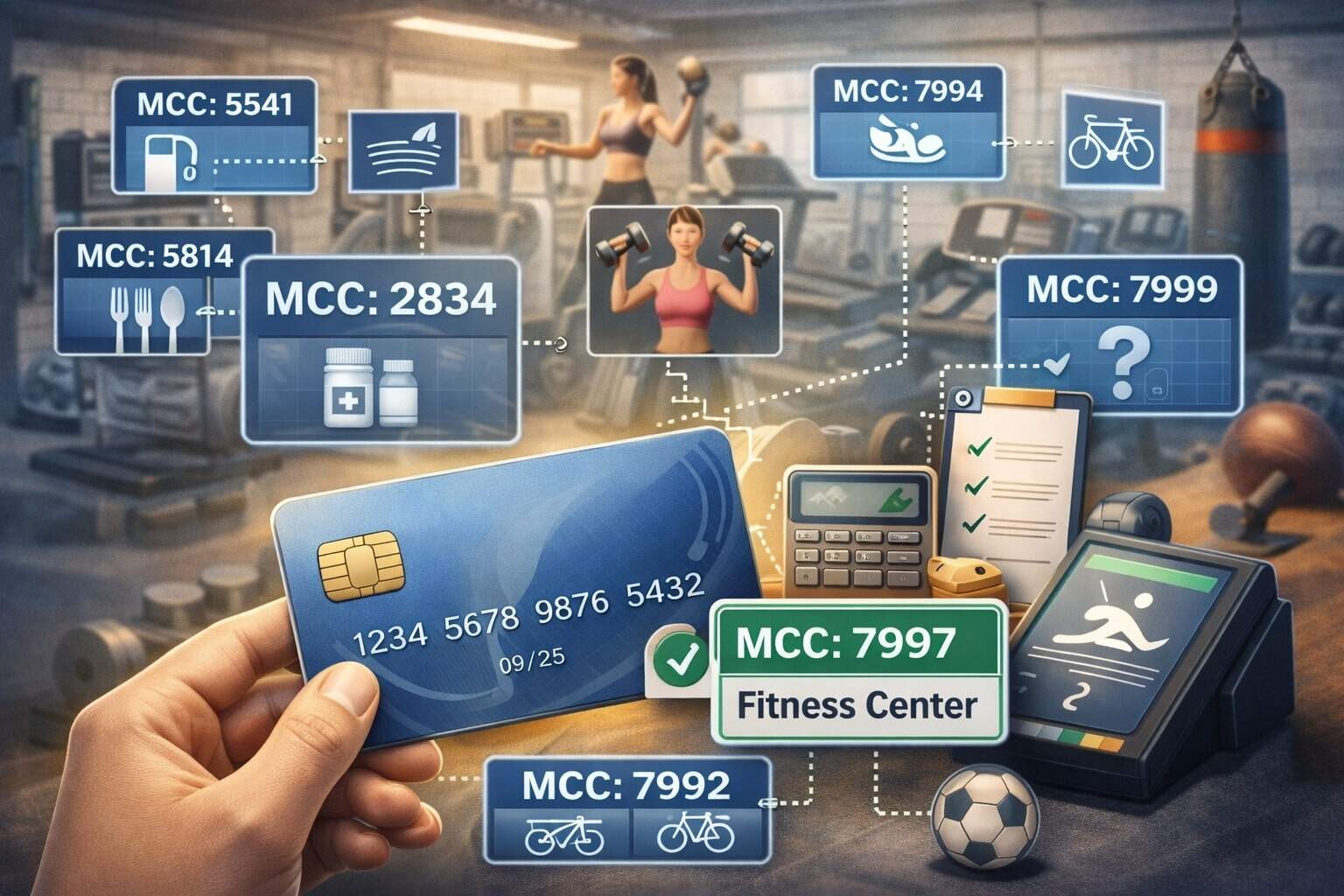
MCC 7997: Membership clubs that include exercise, athletic, and health clubs
MCC 7997 is one of the most important Merchant Category Codes for Gyms and Fitness Centers, especially for businesses that look like membership-based clubs.
In the Visa Merchant Data Standards Manual (October 2025 edition), MCC 7997 is described as covering membership-based sports and recreation facilities and explicitly lists exercise, athletic, fitness, and health clubs among the included merchant types.
This code is often appropriate when you have a club-like model: monthly dues, member access, recurring billing, and ongoing services delivered over time. It also commonly aligns with facilities offering multiple on-site amenities—weight floor, cardio, group classes, locker rooms, and sometimes spa-style add-ons.
Visa’s description also acknowledges that merchants under this MCC “may also provide spa services,” which matters because many gyms now bundle recovery services like sauna, cold plunge, and stretching sessions.
Where businesses get tripped up is the word “membership.” You can be a “gym” in everyday language but not operate like a membership club in payment terms.
If you mainly sell single-session services, performance coaching packages, or beauty/wellness treatments, you might be better aligned with another MCC. But for classic gyms, fitness clubs, and many studios running recurring memberships, MCC 7997 is frequently the cleanest match.
Operational tip: if you want MCC 7997 and you truly are membership-driven, make that unmistakable in underwriting: publish clear membership tiers, cancellation terms, and recurring billing disclosures. That reduces friction during account reviews and supports stable classification.
MCC 7298: Health and beauty spas (often overlaps with recovery-focused fitness brands)
Some Merchant Category Codes for Gyms and Fitness Centers become relevant because the modern fitness experience blends with wellness.
If your business is heavily oriented toward spa-like services—facials, skincare, body treatments, or recovery therapies that look more like “spa” than “gym”—you may be classified under an MCC tied to health and beauty services.
Visa’s MCC listings explicitly point to “Health and Beauty Spas” as a neighboring category in the same area of the classification guide, near where MCC 7997 is defined. This matters because many recovery studios and “wellness clubs” market themselves as fitness brands but sell mostly bodywork-style services.
If your revenue is primarily sauna/cold plunge memberships, IV therapy add-ons (where permitted), aesthetic services, or spa packages, your provider may view you through that lens.
The practical impact is not only how you’re labeled but how you’re risk-modeled. Spas can have different dispute patterns than gyms, especially when selling packages, memberships, or high-ticket bundles.
If you’re a hybrid gym + recovery studio, it’s important to document your revenue split and your primary service. If 70% of your revenue is training and classes, calling yourself a spa can backfire. If 70% is spa-style recovery, trying to force a “gym” MCC can also backfire.
The best approach is alignment: let your MCC reflect what customers actually buy most often, then build your policies and billing flow to match that category’s typical expectations.
MCC 7297: Massage-related services and why it matters for gyms
Massage therapy—whether offered in-house or via partnered practitioners—often creates classification and billing complexity. Visa’s classification references “Massage Parlors” as a related category near fitness and club codes.
While the label may sound outdated, the practical point is current: if your business primarily sells massage sessions, your payment profile will not look like a typical gym.
For fitness businesses, the most common scenario is a gym that offers massage as an add-on service. If massage is truly an add-on (say 5–15% of revenue), you can often remain classified under the core gym/club MCC, and simply ensure your receipts and descriptions are clear.
But if massage becomes a primary offering—like a recovery lounge where massage packages drive most sales—your provider may re-evaluate your Merchant Category Codes for Gyms and Fitness Centers.
Also consider how massage is billed. If massage is fulfilled by independent contractors collecting payments through your front desk, you may be processing on their behalf. That can raise compliance questions for some providers.
A cleaner structure is either (1) separate merchant accounts per service line when appropriate, or (2) a single merchant account with transparent sub-service descriptions and consistent policies.
The goal isn’t to chase a particular MCC—it’s to prevent mismatches that lead to monitoring flags or disputes. When customers see a descriptor that doesn’t match what they bought, disputes rise. Correct category alignment and clear descriptors reduce that risk.
MCC 7999: Recreation services not elsewhere classified (the “catch-all” to avoid when possible)
MCC 7999 is a broad recreation category and sometimes becomes a default when a provider can’t confidently place a business elsewhere. Visa describes it as “Recreation Services (Not Elsewhere Classified),” used for a wide variety of physically participatory recreation services that don’t fit a more specific MCC.
For gym owners, MCC 7999 is a double-edged sword. It can be a practical fit for unusual models—pop-up fitness events, niche recreation formats, or mixed experiences that don’t align with classic gym, club, or training categories. But as a “catch-all,” it can also cause downstream issues:
- Rewards category mismatches for customers expecting “gym” coding.
- Underwriting confusion if your marketing screams “membership gym” but the account is “misc recreation.”
- Harder benchmarking for risk systems that compare you to a broad set of unrelated recreation merchants.
If your provider assigns MCC 7999 and you run a conventional gym or membership-based studio, it’s worth challenging the classification with evidence: service menu, membership contracts, website screenshots, and revenue breakdown.
The more your business matches a specific MCC like 7997 (membership clubs including health clubs), the more you benefit from being classified accurately.
Use MCC 7999 when it truly fits—not when it’s just the easiest bucket.
How MCC selection affects approvals, pricing, and risk controls for fitness businesses
Merchant Category Codes for Gyms and Fitness Centers influence what happens behind the scenes the moment your account is underwritten. Providers use your MCC to route you through a risk model: they set reserve policies, chargeback monitoring thresholds, fraud tools, and sometimes even payout timing.
Fitness businesses often have recurring billing and delayed service delivery (the customer pays today for services used over weeks). That pattern can elevate perceived risk compared to a simple retail sale. When your MCC correctly signals “membership club / health club,” risk systems are more likely to apply the right expectations.
For example, MCC 7997 explicitly covers membership-based sports and recreation clubs, including exercise and health clubs. That clarity helps the underwriting model “recognize” you.
Misclassification can increase friction. If you are coded like a retail store but you run monthly dues and have a cancellation policy, disputes can spike because the processor’s default settings may not match subscription realities.
If you are coded like a spa but you primarily run athletic memberships, your transactions may be compared to different benchmarks.
Pricing can be affected as well. While pricing depends on many variables (ticket size, volume, card mix, environment, fraud controls), MCC can be a factor in how transactions are routed and risk-weighted. It can also shape which compliance checks are applied—particularly when combined with recurring billing indicators.
Practical risk-reduction moves that support the right Merchant Category Codes for Gyms and Fitness Centers:
- Clear recurring billing disclosures at checkout and on receipts.
- Easy-to-find cancellation and refund policy.
- Customer notifications for plan changes, renewals, and failed payments.
- Accurate descriptors that match your brand name and service.
- Consistent product mix (avoid sudden pivots without notifying your provider).
If you treat MCC as part of your payments strategy—not just a label—you’ll get fewer surprises during growth spurts, seasonal spikes, or business model changes.
Merchant Category Codes for Gyms and Fitness Centers and customer rewards
Merchant Category Codes for Gyms and Fitness Centers can directly affect customer satisfaction, even when customers never mention MCC by name. Many cardholders pay close attention to rewards.
If they expect a gym membership to earn “fitness” or “recreation” rewards but the transaction posts as a different category, they may feel misled—especially if they chose your membership because they believed it would qualify for bonus points.
Issuing banks use MCCs as an input for rewards logic. Consumer finance education sources explain that MCCs help determine bonus category eligibility and how cards “know” what type of merchant you are.
This means your MCC can influence a customer’s perception of your brand value, even though you don’t control their bank’s reward mapping.
For gyms, the cleanest path is accurate category alignment and clean descriptors. If your business genuinely fits MCC 7997 (membership clubs including exercise/fitness/health clubs), you increase the odds of consistent “gym-like” coding across networks.
That doesn’t guarantee every issuer will treat it the same way, but it reduces the “why did this code weird?” moments.
Also consider mixed carts. If you sell supplements, apparel, and memberships in the same checkout, some providers may still treat the entire transaction as your core MCC, while others may apply additional data logic. To reduce confusion, separate receipts, separate line-item descriptions, and consistent naming help.
Bottom line: correct Merchant Category Codes for Gyms and Fitness Centers don’t just support your processor—they support your customer experience.
How to find your current gym MCC and fix misclassification
Merchant Category Codes for Gyms and Fitness Centers are not always displayed in a simple dashboard, but you can still confirm them. Start with three practical methods:
- Ask your payment provider directly: Support or underwriting can usually confirm the MCC on file.
- Check transaction data tools: Some gateways, reporting exports, or acquirer statements show MCC (especially in detailed settlement reports).
- Use a customer’s banking record (carefully): Some business card portals or detailed transaction views show category info. This isn’t always the MCC itself, but it can hint at misclassification.
If you suspect misclassification, approach the fix like an underwriting re-review:
- Provide a one-page business summary: what you sell, how customers pay, and how services are delivered.
- Share a revenue breakdown: memberships vs classes vs retail vs recovery services.
- Point to public web evidence: your pricing page, service menu, membership terms.
- Explain billing mechanics: recurring vs one-time, contract term length, free trials, cancellation workflow.
Then request that the provider evaluate a more accurate MCC. If your model matches membership-based fitness club behavior, cite the network’s own definition: Visa’s MCC 7997 includes exercise, athletic, fitness, and health clubs and lists them as included merchants.
Important: don’t try to “optimize” MCC purely for cheaper fees or rewards. Providers can view that as a red flag. The goal is accuracy. Accuracy reduces account instability and improves long-term processing outcomes.
MCC strategy for multi-service fitness businesses (gym + studio + online + retail)
Modern operators rarely fit a single neat box, which is why Merchant Category Codes for Gyms and Fitness Centers require strategy. If your business includes:
- In-person memberships
- Class packs and drop-ins
- Online training subscriptions
- Personal training packages
- Retail supplements/apparel
- Recovery services (sauna, cold plunge, massage)
…then the “primary activity” concept becomes critical. Your provider will usually want one primary MCC, even if you have multiple revenue streams. The strategic move is to decide what you truly are from a revenue and customer expectation standpoint, then build your checkout flows to support that identity.
For example, if you are primarily a membership gym (MCC 7997) but also sell retail supplements, consider separating large retail purchases into a dedicated retail checkout experience (even if it’s the same merchant account).
Keep descriptors clear and avoid blending expensive retail carts with membership signups in the same transaction, because that can distort your risk profile.
If you are primarily a recovery lounge (closer to spa-style services), don’t market and bill like a traditional gym and hope the MCC stays “fitness.” Align your contracts, service terms, and customer communications to match what you sell most.
Also, be careful with “anything goes” membership promises. Unlimited access across multiple service types can increase dispute risk when a customer is unhappy with one part of the experience and tries to cancel everything. Your policies should state exactly what is included, what is add-on, and how billing changes work.
The best MCC strategy is operational clarity. Payments systems love predictability, and Merchant Category Codes for Gyms and Fitness Centers are one of the ways that predictability is encoded.
Future predictions: where Merchant Category Codes for Gyms and Fitness Centers are heading
Merchant Category Codes for Gyms and Fitness Centers will likely remain essential, but the way they’re applied will evolve as fitness commerce becomes more digital and more blended with wellness.
Here’s what is most likely over the next few years:
- More classification scrutiny for hybrid businesses: As “fitness + wellness + beauty + medical-adjacent” concepts grow, providers will look harder at what’s being sold, not just what the brand claims.
- Greater transparency in merchant data standards: Card networks periodically update merchant data standards manuals to improve classification clarity. Visa’s manual is explicitly maintained with edition updates and change summaries.
- Subscription governance gets tighter: Expect stronger enforcement around recurring billing disclosures, trial conversions, cancellation mechanisms, and descriptor clarity—because those factors correlate with disputes in membership categories.
- More granular category mapping at the issuer level: Even if MCCs remain stable, issuers can layer richer logic (merchant name + MCC + location + history) to assign rewards categories and detect anomalies.
- Fitness marketplaces and embedded payments will push reclassification: If you run a multi-location platform or aggregator, your structure may look like a marketplace rather than a gym, changing how you’re categorized and underwritten.
The smartest play is to build a payment stack that can adapt: clean billing terms, configurable checkout experiences, and a provider relationship that supports your growth model. MCC accuracy will remain the foundation, but operational best practices will increasingly determine whether you can scale smoothly.
FAQs
Q.1: What is the best MCC for a traditional membership gym?
Answer: For many traditional membership gyms, the most fitting Merchant Category Codes for Gyms and Fitness Centers often include MCC 7997 because it is defined as covering membership-based sports and recreation facilities and explicitly includes exercise, athletic, fitness, and health clubs.
That said, “best” should mean “most accurate.” If your business model is truly membership-driven—monthly dues, member access, ongoing services—MCC 7997 is frequently aligned.
If you mostly sell one-off services, wellness treatments, or non-membership experiences, another category may be more accurate. Your provider will look at what you primarily sell and how you bill. Trying to force a gym MCC when your revenue is mostly spa-style services can create future underwriting issues.
A reliable way to validate is to compare your offerings to the network definition. If your website, receipts, and contracts look like a classic club model, you are more likely to qualify for the membership club classification without friction.
Q.2: Can a fitness studio and a gym have different MCCs even if both sell classes?
Answer: Yes, and it happens often. Merchant Category Codes for Gyms and Fitness Centers are driven by the primary business model, not the customer’s casual description. A studio selling class packs and drop-ins may be evaluated differently than a facility selling monthly access memberships with recurring billing and club-style amenities.
Even inside MCC 7997, the network language emphasizes membership-based sports and recreation clubs and lists multiple club types. A studio that doesn’t function as a “club” may still be categorized nearby—but classification depends on the provider’s interpretation and how you present your business during underwriting.
To reduce “wrong MCC” risk, keep your checkout and website consistent: if you’re membership-based, say so clearly. If you’re class-based, show class pricing and attendance rules. Consistency improves classification accuracy.
Q.3: Does my MCC change if I add recovery services like sauna, cold plunge, or massage?
Answer: Adding recovery services doesn’t automatically change your MCC, but it can trigger a review if the service mix shifts significantly. Visa’s MCC 7997 definition notes that membership clubs in this category may also provide spa services, which supports many gyms that add recovery as an add-on.
The turning point is revenue dominance. If recovery becomes your primary offering, your provider may consider a spa-oriented MCC instead. Massage-heavy models can also raise different underwriting questions, especially if you sell packages upfront or if services are provided by contractors under your brand.
If you expand into recovery, proactively update your provider with a clear revenue breakdown and ensure your policies cover those services. Preventing surprise is often more important than the exact code.
Q.4: How do I know if I’m misclassified?
Answer: Common signs include: customers complaining their purchase didn’t count as “gym” for rewards, unexplained processing holds, sudden requests for extra documentation, or underwriting questions that seem unrelated to your actual business.
Because issuers use MCC to drive rewards and category logic, customers may notice category mismatches. Consumer education sources explain MCCs are used to determine bonus eligibility and category recognition.
The clean way to confirm is to ask your provider for the MCC on file and compare it to your business reality. If you’re a membership-based gym, you can reference the network definition that includes exercise and health clubs under MCC 7997.
Q.5: Can I have more than one MCC for the same business?
Answer: Most single merchant accounts have one primary MCC. Some complex organizations may operate multiple legal entities or multiple merchant accounts (for example, one for a retail store and one for memberships). But splitting accounts should be done for operational clarity and compliance—not just to chase better pricing or rewards mapping.
If you truly have two distinct lines of business with different risk profiles and customer expectations, separate merchant accounts can reduce confusion and disputes.
But it also adds overhead: separate settlements, reporting, chargeback workflows, and reconciliation. Discuss structure with your payments provider and ensure your business and tax setup supports the approach.
Conclusion
Merchant Category Codes for Gyms and Fitness Centers are a small detail with outsized impact. The right MCC improves underwriting alignment, reduces avoidable monitoring flags, supports predictable billing, and helps customers experience your brand the way they expect. The wrong MCC can lead to reward category complaints, payment friction, and preventable account reviews.
For many membership-driven gyms and clubs, MCC 7997 is a central reference point because it explicitly includes exercise, athletic, fitness, and health clubs in the membership club category definition. But accuracy matters more than preference—your best MCC is the one that truthfully reflects your primary service and billing model.
As fitness continues blending with wellness, recovery, and digital subscriptions, the businesses that win will treat payments like a product: clear policies, clean checkout flows, honest service descriptions, and proactive provider communication.
When you align operations with the correct Merchant Category Codes for Gyms and Fitness Centers, you build a payment foundation that scales—without surprises.