By alphacardprocess January 30, 2026
Florists don’t run “ordinary retail.” You’re selling high-emotion products, handling last-minute requests, juggling delivery windows, and managing perishable inventory with thin margins. That’s why EMV-compliant card readers for florists matter more than most people realize.
A slow checkout can create a line right when the phone is ringing and drivers are waiting. A declined payment can derail a delivery route. A chargeback can wipe out the profit from multiple arrangements.
EMV compliance is also about protecting your business. Chip transactions (EMV) reduce counterfeit fraud compared to swipe-only transactions, and modern readers typically add contactless (NFC) support for tap payments and mobile wallets.
If your shop takes payments at the counter, over the phone for pickup, at curbside, at a wedding venue, or at a pop-up, you need EMV-compliant card readers for florists that match all those moments.
The “best” reader isn’t the same for every flower shop, because your workflow (walk-ins vs. events vs. delivery-heavy) drives what hardware and POS features you actually need.
This guide breaks down what to look for, how to choose, and which EMV-compliant card readers for florists are most practical right now—plus what’s coming next so you don’t buy something that feels outdated in a year.
Why EMV Compliance Matters in a Flower Shop Checkout
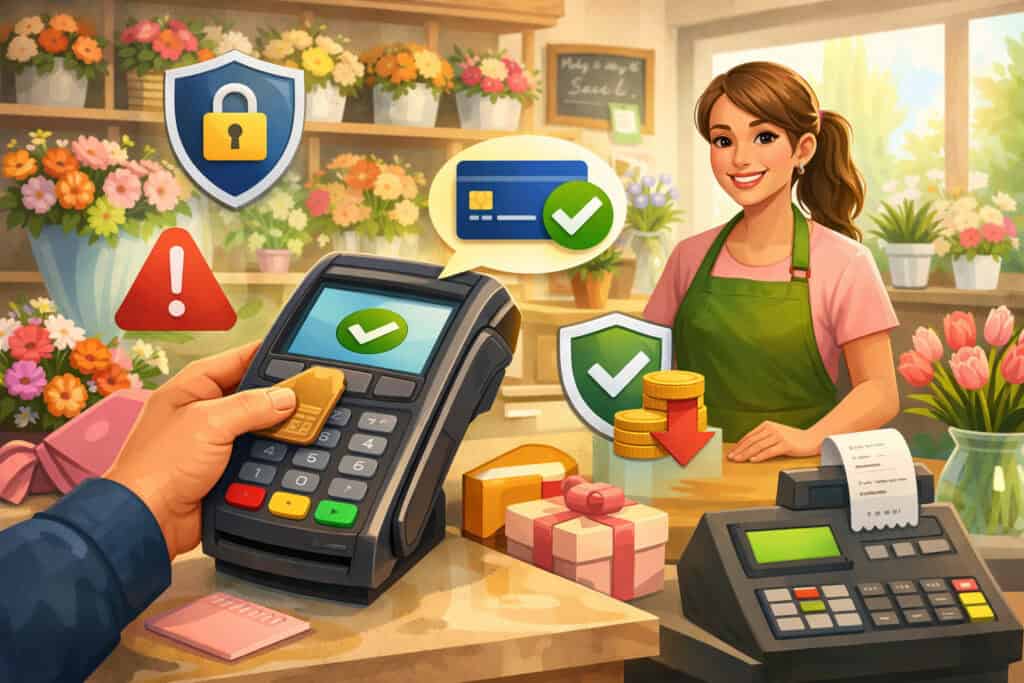
EMV isn’t just a buzzword—it’s the core standard behind chip card payments. In practical terms, EMV-compliant card readers for florists help you avoid the expensive mess of counterfeit card fraud and disputed transactions.
Florists are a surprisingly common target for fraud attempts because orders can be placed quickly, delivered immediately, and resold or consumed with little trace. When you accept chip payments, the transaction uses dynamic cryptography that makes it far harder to clone a card than traditional magnetic-stripe swipes.
There’s also the “liability shift” reality: when a chip card is used but a merchant processes it as a swipe (or uses non-EMV equipment), the merchant can end up holding the bag for certain fraud claims. Even if your shop has great customer service, fraud disputes don’t care about good intentions. They care about payment methods and evidence.
Beyond fraud, EMV-compliant card readers for florists usually bundle other modern safeguards and conveniences: contactless payments, tokenization, encrypted payment flows, and tighter integrations with POS apps.
That matters because security requirements and customer expectations have moved forward fast. Customers increasingly prefer tap-to-pay with a phone or contactless card, especially during rush periods (holidays, Valentine’s week, prom, Mother’s Day). A reader that supports fast tap transactions can cut checkout time and keep your front counter calm.
Finally, compliance isn’t only EMV. Your overall payment environment should align with the broader card security ecosystem, including PCI expectations that continue to evolve.
PCI’s future-dated requirements became mandatory after March 31, 2025, making it even more important to rely on modern, well-supported payment solutions rather than cobbling together outdated hardware and apps.
What Florists Need That Other Retailers Often Don’t

A café can survive with a simple countertop terminal and a basic menu. A florist usually can’t. The best EMV-compliant card readers for florists must fit a workflow that mixes quick items (single stems, add-on balloons, chocolates) with complex orders (custom arrangements, weddings, sympathy pieces, corporate accounts). That means your payment setup should do more than accept cards.
First, florists benefit from mobile flexibility. You might take payment at the design table, at curbside pickup, or in a greenhouse/warehouse area. A Bluetooth reader paired to a phone or tablet helps you keep the customer engaged while your staff finalizes ribbon color, vase upgrades, or a message card.
For event work, the ability to accept EMV and contactless payments at a venue is often the difference between capturing add-on sales or missing them.
Second, florists need fast item lookup and modifiers. Your “SKU” might change by season, stem availability, or holiday theme. You want a POS and reader combo that can handle variants, quick buttons, discounts, delivery fees, and tips without slowing down.
Third, florists should care about receipts and proof. Delivery disputes happen. A system that can send digital receipts, capture signatures where appropriate, or tie notes to an order can save time later.
This is why many florists graduate from a basic pocket reader to a handheld POS device with a screen, barcode scanning, and better order management.
Fourth, florists often run high peaks and low valleys. Pricing models matter: monthly software fees, payment processing rates, hardware costs, and add-ons (inventory, loyalty, marketing, delivery routing). The “cheapest reader” can become the most expensive solution if it forces clunky operations or constant upgrades.
When you match these needs correctly, EMV-compliant card readers for florists become a profit protector, not just a payment tool.
Key Buying Criteria for EMV-Compliant Card Readers for Florists
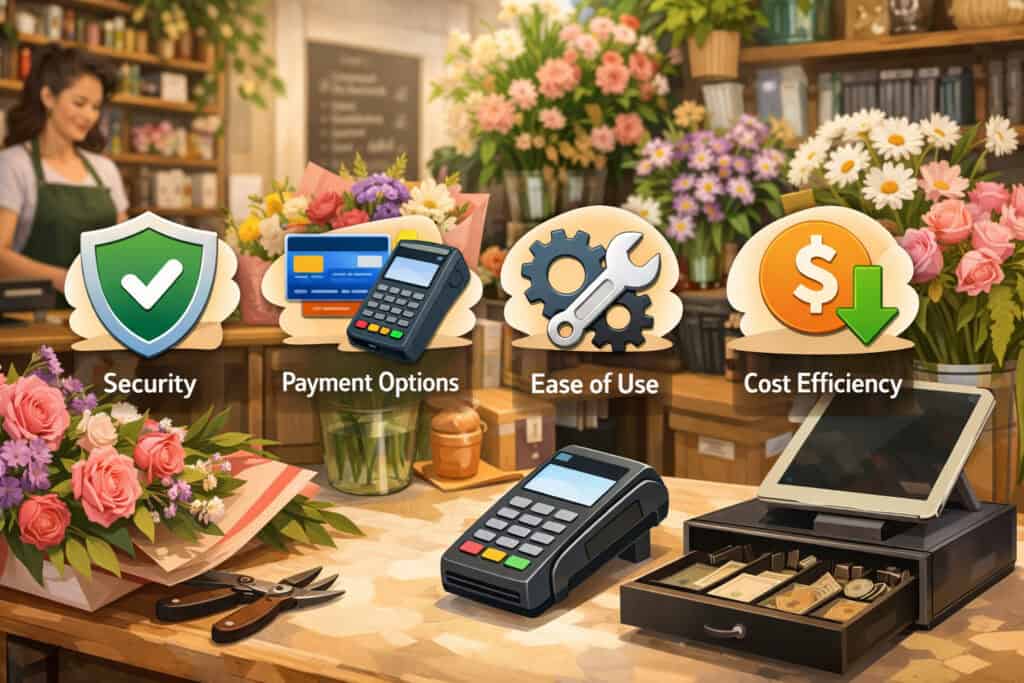
Choosing EMV-compliant card readers for florists is easier when you score options against a florist-specific checklist. Start with the payment basics, then evaluate operational fit.
1) Payment Types and Speed
At minimum, you want chip (EMV) + contactless (NFC) support. Tap payments speed up lines and feel modern. If your customers often use mobile wallets, prioritize readers known for stable contactless performance.
Some models also support PIN entry (more common in certain scenarios), and that can be useful if you sell to international visitors or do higher-ticket sales.
2) POS Compatibility and Inventory Workflow
The reader is only half the system. Your POS needs to support item variants, custom notes, delivery fees, partial deposits (common for weddings), refunds, exchanges, and simple reporting.
If your POS is eCommerce-heavy, you may value online/offline inventory syncing. If you’re storefront-heavy, you may value fast tile buttons and barcode scanning.
3) Connectivity and Reliability
Bluetooth is convenient, but it must be stable. Look for improved pairing, solid battery life, and clear charging habits. Some setups allow USB connections for added reliability. If you sell at pop-ups, consider whether you need cellular or offline modes.
4) Security and Compliance Hygiene
“EMV compliant” is foundational. Also pay attention to encryption, tokenization, device support lifecycle, and how the provider handles security updates. PCI expectations have tightened over time, and relying on modern, supported platforms reduces risk.
5) Hardware Options for Growth
Many florists start with a pocket reader, then add a countertop device, then add a handheld. Buying into an ecosystem that supports upgrades (without forcing a total restart) is a practical advantage.
If you apply these criteria, you’ll narrow down the best EMV-compliant card readers for florists based on how you actually work—not how a generic “best reader” list ranks them.
Top EMV-Compliant Card Readers for Florists (Best Picks by Use Case)
Below are leading EMV-compliant card readers for florists, organized by how florists typically use them: mobile checkout, counter checkout, events, and growth into multi-device setups.
Square Reader for Contactless & Chip (2nd Generation): Best Simple Mobile Reader for Walk-Ins and Pop-Ups
If you want an easy starting point, Square’s Contactless & Chip Reader (2nd generation) is a strong “grab-and-go” option among EMV-compliant card readers for florists. It’s designed to accept chip cards and contactless payments, including mobile wallet taps, with a focus on portability.
Square specifically highlights longer battery life, faster Bluetooth pairing, and enhanced security compared with earlier versions—exactly the kind of everyday reliability that matters when you’re bouncing between the counter and curbside pickup.
For florists, the real value is speed and flexibility. You can walk to a customer finalizing a bouquet and take payment immediately. During the holiday rush, you can run a second “mobile lane” to reduce lines. For pop-ups, markets, or event add-ons, the reader supports quick transactions without dragging a full terminal.
This is also one of the simplest ecosystems for training staff. Many flower shops rely on seasonal or part-time help, and a reader that’s intuitive reduces mistakes at checkout. Pair it with a phone or tablet and keep your front counter open for design work rather than turning it into a bottleneck.
For a florist that’s not ready for a full hardware buildout, this is one of the most practical EMV-compliant card readers for florists to start with—and it scales later if you add more Square hardware.
Square Handheld / Handheld POS: Best for Busy Counters and Fast Item Scanning
Florists who operate like high-velocity retailers during peak seasons should consider a handheld POS device, not just a small reader. Square introduced a portable handheld POS device positioned as more mobile than a countertop terminal, with a touchscreen and built-in tools designed for running a checkout lane anywhere in the shop.
Reports note features like a barcode scanner and an all-day battery approach—useful if your store sells grab-and-go items, vases, gift add-ons, and seasonal bundles that benefit from quick scanning.
Why this matters for EMV-compliant card readers for florists: scanning reduces mis-rings during chaos. During Valentine’s week, speed beats perfection, but accuracy protects margin. A handheld device can help you keep inventory more accurate while moving customers through the line.
This kind of device also supports a “floating checkout” model. Instead of forcing customers to queue in one place, you can take payment where the customer is standing—especially helpful in narrow shops where lines block coolers and display areas.
For florists doing events or corporate deliveries, a handheld POS can also function as a mobile order station. You can invoice, accept payment, and capture notes in one flow. It’s a step up from basic readers, but for the right shop, it’s among the most operationally powerful EMV-compliant card readers for florists.
Clover Go: Best for Florists Who Want Mobile Payments with a Broader POS Ecosystem
Clover Go is a compact mobile reader designed to pair with smartphones and tablets, supporting swipes, NFC contactless, and EMV transactions.
Clover’s device documentation describes it as EMV-capable and able to accept chip and contactless payments, including major mobile wallets, without requiring the merchant to handle EMV certification themselves.
For florists, Clover Go shines when you want a mobile reader but also want the option to expand into a broader Clover hardware lineup later (countertop terminals, handhelds, customer-facing displays, etc.). That matters if you’re planning to add a second register for holiday peaks or open a second location.
Operationally, Clover Go can work well for curbside payments, delivery pickups, or market-style selling. Many florists also like having a reader that “feels” like part of a more traditional POS ecosystem, especially if they’re switching from legacy terminals.
The key is to evaluate the POS software experience you’ll run on top of it, including how it handles custom items, delivery fees, discounts, and reporting. If you choose the right setup, Clover Go can be one of the most flexible EMV-compliant card readers for florists for mobile-first selling while keeping an upgrade path open.
Clover Go + Dock: Best for a Hybrid Counter + Mobile Setup
A florist’s day is rarely purely mobile or purely countertop. The Clover Go dock concept—described as a way to mount the reader for secure countertop payments while still keeping it portable—fits that hybrid reality well.
Clover documentation notes a dock accessory intended to mount and charge the reader for counter use, with added physical security options.
From a florist perspective, this matters because your counter can become a “home base” during busy hours, but you still want the ability to detach and take payment to the design area, to the cooler, or outside for curbside pickup.
A dock approach can also reduce the chaos of misplaced readers and low-battery surprises, because your staff naturally returns it to a charging spot.
This setup is particularly useful for smaller shops where you don’t have space for a large terminal, but you want a professional counter checkout. It also helps when you train multiple staff: everyone knows where the reader lives, and you reduce pairing problems.
If you’re looking for EMV-compliant card readers for florists that can behave like a countertop device without losing mobility, a dockable approach is one of the simplest upgrades that genuinely improves daily operations.
Shopify Tap & Chip Card Reader: Best for Florists Selling In-Store + Online With One Inventory
Florists who sell arrangements online (pre-orders, seasonal collections, corporate gifting) often care most about inventory syncing and unified customer data.
Shopify’s Tap & Chip card reader is marketed as an EMV-compliant contactless reader that connects via Bluetooth or USB-C and syncs sales with Shopify POS—meaning in-person sales and online sales can live in one system.
For a florist, this can be a big deal if you’re trying to stop overselling limited items (like a specific vase or premium add-on) across both channels. A unified system helps you maintain consistent pricing, reduce manual updates, and run promotions that work online and in-store.
This reader is also designed for selling “anywhere you sell,” which maps well to pop-ups, partner events, and wedding expos. If your shop participates in community events, this can be one of the most practical EMV-compliant card readers for florists because it keeps your catalog and checkout flow consistent no matter where you sell.
The main caution is ecosystem fit: Shopify POS is strongest when your business is committed to Shopify as the core commerce platform. If that’s you, the Tap & Chip reader is a clean hardware choice that supports modern payments and keeps operational data tied together.
PayPal Card Reader / Zettle-Style Reader: Best for Florists Who Want a Familiar Payments Brand and Mobile Wallet Support
PayPal’s business POS ecosystem includes a card reader designed to accept contactless and card payments, plus mobile wallets like Apple Pay, Google Pay, and Samsung Pay. PayPal’s own product information confirms these acceptance capabilities, which is a core requirement for most EMV-compliant card readers for florists today.
Florists often choose PayPal-branded options for one simple reason: customers recognize it, and owners feel comfortable with the brand from online payments history. If your shop already uses PayPal for invoices, deposits, or online checkout, keeping in-person and online payment reporting in one ecosystem may reduce admin workload.
From an operational standpoint, this setup can work well for a single-location florist doing a mix of walk-ins and phone orders with in-store pickup. Many florists also value the ability to stay lightweight: one reader, one phone/tablet, and you’re selling.
To choose well here, evaluate how the POS app handles florist realities: delivery fees, partial payments, refunds on perishable goods policies, and item notes. If it fits your workflow, PayPal-based EMV-compliant card readers for florists can be a clean solution with wide consumer acceptance of tap payments.
SumUp Solo: Best Budget-Friendly Standalone Option for Simple Florist Operations
SumUp Solo is positioned as a chip-and-contactless reader that supports major card brands and NFC payment options like Apple Pay and Google Pay. SumUp’s own product page explicitly states the Solo accepts both contactless and chip cards, making it a valid contender in the EMV-compliant card readers for florists category.
Where it can fit best for florists is in simple, low-overhead setups: a small studio florist, a weekend market seller, a seasonal pop-up, or a florist who already has a separate ordering system and just needs reliable in-person payment acceptance.
Standalone-style devices can reduce dependency on keeping a phone paired all day, depending on the exact workflow and configuration.
Florists who prioritize minimal monthly costs often look at solutions like this. While you still need to consider processing fees, a lightweight device approach can feel financially safer than a full POS subscription—especially if you’re testing a new location or scaling slowly.
The tradeoff is usually depth: advanced inventory, delivery workflow, and reporting may not be as strong as full POS ecosystems. But if your operational needs are straightforward, SumUp Solo can be one of the most approachable EMV-compliant card readers for florists to keep payments modern without overbuilding your tech stack.
Stripe Terminal BBPOS WisePad 3: Best for Florists With Custom Apps or Advanced Integrations
Some florists outgrow off-the-shelf POS tools. Maybe you sell through a custom ordering portal, run a subscription bouquet program, integrate with specialized delivery routing, or manage corporate accounts in a bespoke workflow.
Stripe Terminal devices like the BBPOS WisePad 3 are built for in-person payments that plug into custom software via Stripe’s Terminal SDK. Stripe describes WisePad 3 as a compact, battery-powered mobile reader with a display and PIN pad for accepting chip and contactless payments.
For florists, this is most relevant when you want your payment experience to be a “module” inside your own system rather than the center of it.
You can design checkout flows around deposits, balance due at delivery, custom invoices for corporate customers, and hybrid online/in-person payment journeys—while still using EMV hardware.
Stripe’s documentation also notes connectivity options (Bluetooth Low Energy and USB for certain setups), which matters for reliability and deployment across multiple devices.
This is not the simplest path, and it’s not necessary for every shop. But for tech-forward florist operations, Stripe Terminal can be one of the most future-flexible EMV-compliant card readers for florists, because you can evolve your software without replacing your payments foundation.
Stripe Reader S700 and Other Stripe Terminal Devices: Best for a “Modern Hardware Fleet” Strategy
If you want an ecosystem that includes countertop and handheld devices—especially across multiple registers or locations—Stripe Terminal’s broader device lineup can matter. Stripe’s devices page highlights multiple reader types, including smart readers like the S700 designed for more customizable POS experiences.
For florists, a multi-device strategy makes sense when you run:
- a busy front counter plus a design-table checkout,
- wedding/event sales that happen offsite,
- multiple stores, or
- high seasonal volume requiring pop-up registers.
Instead of mixing random hardware, you choose a device family that you can standardize: same onboarding, same update policy, same reporting pipeline, and consistent payment behavior across the business.
This becomes more valuable as your operation grows. A small shop might only need one reader. A growing florist might need one reader per staff member during peak weeks. Having a scalable approach to EMV-compliant card readers for florists reduces friction when expansion is happening fast and you don’t have time for tech chaos.
Matching the Right EMV-Compliant Card Readers for Florists to Common Florist Scenarios
Picking from the best EMV-compliant card readers for florists becomes simple when you map devices to real scenarios.
Scenario A: “Single Counter, Mostly Walk-Ins”
If your store is mostly walk-in retail with occasional phone orders, prioritize a stable counter experience plus a simple mobile fallback. A small contactless+chip reader paired with a tablet can work, but consider whether you’ll benefit from a handheld POS device during rush weeks. You’re aiming for speed, stable connectivity, and easy staff training.
Scenario B: “In-Store + Online Inventory Sync”
If you sell online heavily, you want a system that keeps products and inventory aligned across channels. This reduces overselling and makes reporting cleaner. Shopify’s approach is designed around syncing POS and ecommerce sales in one catalog, which is why Shopify-style EMV-compliant card readers for florists often win in this scenario.
Scenario C: “Wedding/Events and Offsite Selling”
If you do wedding expos, venue consultations, or corporate pop-ups, mobile reliability is king. Focus on battery life, pairing stability, and contactless speed. A basic mobile reader can work, but a more capable handheld POS can make you look more professional and let you capture more order details on the spot.
Scenario D: “Custom Systems, High Integration Needs”
If you’re integrating with custom CRM, delivery routing, subscription billing, or a specialized florist ordering workflow, consider Stripe Terminal-style EMV-compliant card readers for florists so payments fit into your system rather than forcing your operations to fit the POS.
When you choose based on the scenario, you avoid buying a “popular” device that doesn’t match how your shop actually functions.
Setup and Operational Best Practices Florists Should Follow
Even the best EMV-compliant card readers for florists can underperform if setup is sloppy. The goal is to reduce declines, reduce checkout time, and make sure every transaction is tracked cleanly.
Train Staff for “Tap First, Chip Second, Swipe Last”
If your reader supports contactless, make tap the default. It’s faster and customers like it. Chip is the fallback for cards without contactless. Swipe should be the last resort, because it increases risk and can increase dispute friction. This simple script reduces confusion at the counter.
Lock Down Roles and Refund Permissions
Florists often have seasonal help. Your POS should allow role-based permissions so refunds and manual adjustments aren’t wide open. This is both a loss-prevention and an error-prevention move.
Build Checkout Buttons That Reflect Florist Reality
Create quick keys for: delivery fee tiers, rush fees, vase upgrades, premium stems, add-ons (balloons, chocolates), card message add-ons, and seasonal bundles. The fewer custom line items you type manually, the fewer mistakes you’ll make during chaos.
Use Digital Receipts to Reduce Post-Delivery Disputes
Digital receipts and clear item descriptions help later. It’s easier to resolve “I didn’t order that” or “I never got it” complaints when your order record is clean, timestamped, and tied to a payment.
Keep Devices Charged and Standardize a Charging Station
Mobile readers die at the worst time. Create a physical habit: every device returns to the charging dock or a charging shelf at close, and backup battery packs are labeled and ready.
Operational discipline turns EMV-compliant card readers for florists into a competitive advantage—your shop feels smoother, faster, and more trustworthy.
Future Trends: Where EMV-Compliant Card Readers for Florists Are Headed
The next wave of EMV-compliant card readers for florists is about reducing hardware dependency and increasing mobility.
Tap to Pay on Phones Will Keep Growing
Merchants can increasingly accept contactless payments directly on compatible phones without an external reader. Square, for example, supports Tap to Pay on iPhone so a seller can accept NFC payments using only an iPhone, no reader required.
Apple also maintains an official list of payment service providers that support Tap to Pay on iPhone in different regions, showing the ecosystem’s expansion.
For florists, this matters because it reduces your “single point of failure.” If your reader breaks or runs out of battery during a holiday rush, a phone-based tap acceptance option can keep sales moving.
Handheld POS Devices Will Replace “Reader + Tablet” in Busy Shops
As more merchants prefer all-in-one devices with scanners, cameras, and POS apps, handhelds will continue to grow. That’s particularly relevant for florists who have rush periods where speed and accuracy are everything.
Security Standards Will Keep Tightening
PCI requirements continue evolving, and merchants are expected to maintain stronger security hygiene over time. Relying on modern providers and supported hardware reduces your risk of being caught with outdated systems.
Better Offline and Cellular Options
Expect more devices that can keep taking payments even when Wi-Fi is unreliable, which is helpful for pop-ups, street markets, or venues. For florists doing events, this is a major convenience trend.
Future-proofing your EMV-compliant card readers for florists doesn’t mean buying the most expensive option. It means choosing a platform that can adapt as checkout behavior shifts.
FAQs
Q.1: What does “EMV-compliant” actually mean for a florist?
Answer: For a florist, “EMV-compliant” means your card reader can properly process chip card transactions using the EMV standard, not just swipe magnetic stripes.
In daily terms, it means customers can insert (“dip”) a chip card, and the transaction uses modern cryptographic verification that makes counterfeit fraud much harder. Most EMV-compliant card readers for florists also support contactless (NFC) payments, letting customers tap their card or phone.
This matters because florists often deal with high-volume rush periods and occasional high-ticket orders. Fraudsters like businesses where goods can be delivered quickly.
EMV makes counterfeit card fraud more difficult, and using modern EMV equipment also reduces the chance you’ll be stuck with liability for certain fraud disputes when a chip card could have been processed as chip.
EMV compliance also tends to correlate with better device support, security updates, and integration into modern POS platforms. In other words: it’s not only about “taking chip.” It’s about running a checkout experience that aligns with today’s expectations and security environment.
Q.2: Do I need a receipt printer with EMV-compliant card readers for florists?
Answer: Not always. Many florists can run a clean operation with digital receipts and SMS/email confirmations, especially for pickup orders and everyday walk-ins.
However, a receipt printer becomes more valuable if your customer base expects paper receipts, if you do a lot of corporate transactions that require printed documentation, or if you want an extra paper trail during delivery-heavy seasons.
Some shops also use printed receipts as an internal workflow tool—stapling them to order tickets or delivery notes. If that’s your process, choose EMV-compliant card readers for florists that work smoothly with printers, or consider an all-in-one terminal/handheld that prints or supports a compatible dock/printer setup.
The key is consistency. If you print sometimes and don’t print other times, staff can get confused during rush periods. Decide on a standard: “Always digital unless the customer requests paper” or “Print for deliveries and corporate orders.” Then set up your system to follow that standard with minimal button taps.
Q.3: Can I use Tap to Pay on a phone instead of buying a reader?
Answer: In many cases, yes—Tap to Pay on compatible phones lets you accept contactless payments without a separate device. Square, for example, supports Tap to Pay on iPhone for accepting NFC payments directly from your phone. Apple’s developer information also lists payment service providers that support Tap to Pay on iPhone in specific regions.
For florists, phone-based acceptance is a great backup and can be enough for very small operations or pop-ups. It’s especially useful during peak times: if your main reader has issues, a phone can keep sales moving.
That said, phone-based tap acceptance may not cover every payment situation. Customers with chip-only cards may still need a traditional reader. And if you need a customer-facing screen, receipt printing, or advanced POS workflows, a dedicated device can still be better.
A practical approach is hybrid: choose one of the reliable EMV-compliant card readers for florists, and enable Tap to Pay as a redundancy layer.
Q.4: How many EMV-compliant card readers should a florist have?
Answer: A simple rule: one primary checkout device plus one backup method. For a one-counter shop, that might mean one main reader/terminal and a second mobile reader or Tap to Pay capability as backup.
For busy florists, especially during holiday peaks, you should plan capacity: one device for the counter, and one mobile device to break lines.
If you do events, add a dedicated event kit: reader, charger, backup battery, and a data plan or hotspot plan if needed. For delivery-heavy shops, consider whether drivers ever collect payments (some do for certain corporate clients). If yes, you may want a separate mobile device assigned to that role.
The goal isn’t to buy a pile of hardware. The goal is to prevent downtime. Florists lose the most money not from fees, but from missed sales during rush periods. The right number of EMV-compliant card readers for florists is the number that prevents “we can’t take your payment right now.”
Q.5: What’s the biggest mistake florists make when choosing EMV-compliant card readers?
Answer: The most common mistake is buying a reader based only on hardware price, without evaluating the POS workflow and real operating costs. A cheap reader can be expensive if it forces slow checkout, messy reporting, confusing inventory handling, or limited scaling.
Florists are workflow businesses: you’re coordinating orders, timing, substitutions, delivery fees, and customer notes. If your POS and payment flow don’t support that smoothly, staff will create manual workarounds—and that becomes the real cost.
Another mistake is not planning for peak season. Your system might feel fine in a quiet week, then collapse under Valentine’s volume. You want EMV-compliant card readers for florists that remain stable when Bluetooth connections are stressed, batteries are drained, and staff are moving fast.
Finally, some florists don’t think about redundancy. A second acceptance method (backup reader or Tap to Pay) can save an entire rush day.
Conclusion
The best EMV-compliant card readers for florists are the ones that protect you from fraud, speed up checkout, and fit your daily reality—walk-ins, custom orders, seasonal rushes, and offsite events.
Start with core requirements: EMV chip support and contactless tap payments. Then choose based on your workflow: mobile selling, hybrid counter + mobile, ecommerce inventory sync, or custom integrations.
If you want a straightforward mobile solution, Square’s Contactless & Chip Reader emphasizes better pairing, battery life, and security in a simple package. If you want an all-in-one approach that boosts speed and scanning during chaos, handheld POS devices are increasingly compelling.
If your business runs on unified commerce, Shopify’s EMV-compliant Tap & Chip reader pairs neatly with synced POS and inventory. If you want a broader POS ecosystem with mobile flexibility, Clover Go is a strong path with documented chip and contactless support.
If you want a recognized payments brand and mobile wallet acceptance, PayPal’s reader supports contactless and major mobile wallets. And if you’re building advanced workflows or custom apps, Stripe Terminal devices like WisePad 3 give you modern EMV hardware designed for integrated experiences.