
Running a fitness business is equal parts coaching, community, and cash flow. If your revenue depends on memberships, class packs, personal training, and add-ons, you need billing that is consistent, predictable, and resilient when cards expire or members forget to update details.
That’s exactly what an automated billing system for gyms is built to do: collect payments on time, reduce manual follow-ups, and create a smoother experience for members and staff.
A modern automated billing system for gyms typically combines recurring membership billing, a payment gateway, customer payment vaulting, automated receipts, dunning (retry + reminders), and reporting.
It also connects to your gym management software so check-ins, class access, freezes, and cancellations tie back to billing rules. When set up properly, the system becomes the “engine room” that quietly runs in the background while you focus on retention and service.
Because billing touches sensitive payment data, automated systems also need to be designed around security and compliance. In recent years, the industry has pushed harder toward tokenization, stronger authentication controls, and more rigorous security testing expectations under updated payment security standards.
For gyms, that matters because recurring payments can mean long-lived stored credentials, frequent retries, and lots of member profile changes.
This guide walks through how an automated billing system for gyms works, what to prioritize, how to implement it without chaos, and what future improvements are likely to shape gym billing over the next few years.
What an automated billing system for gyms does (and why it’s different from “just taking payments”)

An automated billing system for gyms does more than charge a card every month. It coordinates billing logic, member status, access control, communication, and reconciliation in one consistent workflow.
Traditional payment acceptance is transactional: a member pays at the front desk, you hand them a receipt, and you’re done. Automated billing is relationship-based: you’re managing an ongoing financial agreement tied to membership terms, service delivery, and member lifecycle changes.
At the core, an automated billing system for gyms supports recurring charges (monthly, quarterly, annual), installment plans (for long-term packages), and usage-based add-ons (like locker rental, towel service, small group training, or late fees).
It also handles edge cases: prorations when someone joins mid-cycle, freezes for medical or travel reasons, upgrades and downgrades, and membership holds that pause access while keeping the account active.
The “automation” part matters most when things don’t go perfectly. Cards expire, bank-issued replacements arrive, members switch banks, and sometimes payments fail for temporary reasons.
A good automated billing system for gyms includes tools to reduce failed payments—such as tokenization, account updater services, network token support, and smart retry schedules—while also keeping the member experience respectful with clear reminders and self-serve updates.
Finally, automated billing is about clean books. It should automatically generate invoices/receipts, apply taxes (where required), track revenue by product category, and reconcile deposits to daily batches. That means fewer spreadsheet fixes, fewer missed charges, and fewer awkward conversations at the desk.
Core components of an automated billing system for gyms
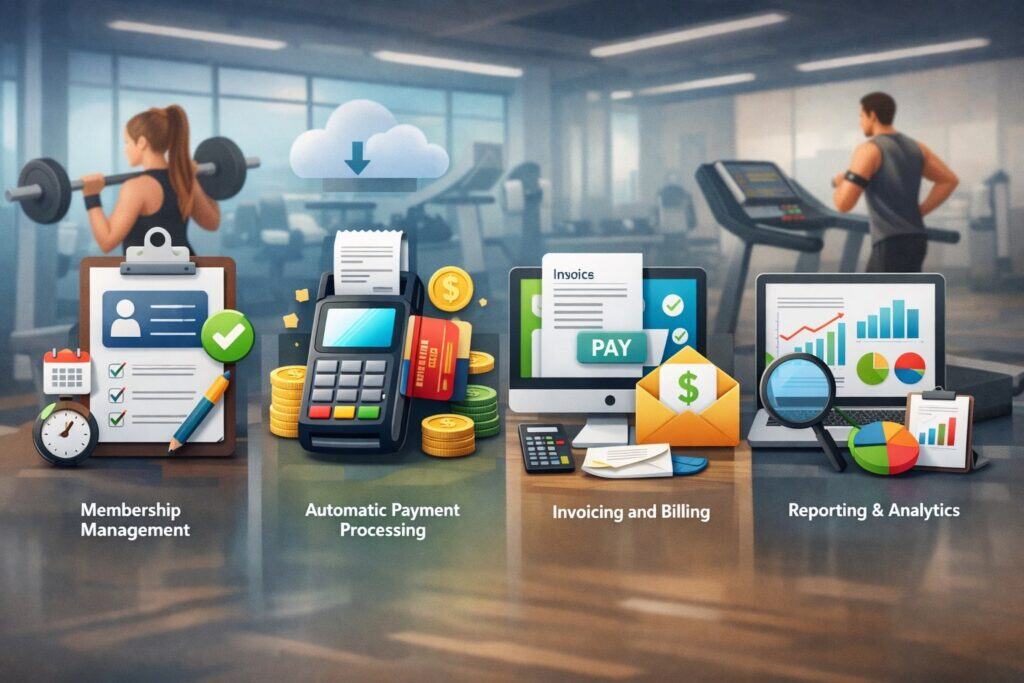
A dependable automated billing system for gyms is built from several layers that work together. If any one layer is weak—like a clunky member portal or unreliable payment retries—you’ll feel it in churn, staff workload, or revenue leakage.
- Gym management software (GMS): This is where memberships, check-ins, class schedules, and member profiles live. The billing rules typically originate here: who is billed, how often, and what access they receive.
- Payment gateway + processor connection: The gateway routes transactions for authorization and settlement. The processor handles the movement of funds and ties into acquiring relationships. For recurring billing, you want stability, strong reporting, and support for modern credential-storage patterns.
- Tokenization / secure vault: Instead of storing raw card numbers, modern systems store tokens. Tokenization reduces risk and can lower compliance scope when implemented properly. Network tokenization can also help keep recurring credentials current when cards are reissued, which helps reduce churn caused by “card expired” failures.
- Recurring billing engine: This schedules charges, generates invoices/receipts, applies prorations, and enforces business rules (late fees, grace periods, freeze logic, and cancellations).
- Dunning + communication automation: Dunning means automated retries and outreach when a payment fails. You want configurable retry logic and member-friendly messages (email/SMS), plus self-serve payment update links.
- Reporting + reconciliation: This includes daily batch totals, deposit matching, revenue breakdown by membership type, tax reporting, and chargeback visibility.
A well-designed automated billing system for gyms also supports multiple payment methods (cards, ACH), integrates with accounting tools, and keeps audit trails so you can resolve disputes quickly.
Choosing the right automated billing system for gyms: evaluation criteria that actually matter

Most gyms compare billing systems based on pricing and features, but the best decision comes from aligning the platform with your operating model. The “right” automated billing system for gyms depends on whether you run high-volume memberships, boutique classes, hybrid personal training, or multi-location operations.
Start by mapping your revenue model. Do you sell mostly monthly memberships, or do you rely on class packs and recurring training subscriptions? Do you require contracts with early termination fees? Do you offer family plans, corporate discounts, or subsidized memberships through local employers? Your billing system must handle these variations without constant manual overrides.
Next, focus on failure recovery. Many platforms can schedule recurring charges, but fewer excel at preventing revenue loss when payments fail. Ask about account updater coverage, network token support, and configurable retries.
Industry resources consistently emphasize that combining network tokens and updater capabilities can improve approval rates and reduce disruptions in stored credential payments.
You should also evaluate member experience. A modern automated billing system for gyms should include a clean member portal where clients can update payment methods, view invoices, manage autopay, and see upcoming charges. If members can’t self-serve, your staff becomes the billing department.
Operationally, insist on strong role-based permissions, clear audit logs, and reliable export options for accounting and payroll. If you plan to scale, confirm multi-location controls, centralized reporting, and the ability to standardize billing rules while allowing location-level flexibility.
Finally, don’t ignore support. Billing touches revenue—when something breaks, you need fast answers, not ticket limbo.
Setting up an automated billing system for gyms step by step (without losing your mind)
Implementation is where many gyms stumble—not because automated billing is complicated, but because small decisions compound. A successful rollout starts with a clean plan, clear data, and a short “parallel run” where you verify results before switching fully.
- Step 1: Define your membership catalog clearly. Create standardized products: monthly membership tiers, initiation fees, annual maintenance fees (if used), class packs, and training subscriptions. Each product should have a billing frequency, price, tax handling (if applicable), and cancellation terms.
- Step 2: Build billing rules for real-life scenarios. Your automated billing system for gyms should handle prorations, mid-cycle upgrades, freezes, and grace periods. Decide: when a payment fails, how long do you allow access? Do you offer a 3–7 day grace period, or does access pause immediately? Make the rule consistent so staff isn’t improvising.
- Step 3: Configure payment methods and stored credential logic. If you accept card-on-file, use tokenization and vaulting correctly. Modern tokenization approaches can reduce risk and improve lifecycle management for recurring payments.
- Step 4: Set up dunning workflows. Define retry timing (for example: retry in 2 days, then 5 days, then 7 days), messaging cadence, and what happens after repeated failure. Create messages that are firm but respectful and include a simple update link.
- Step 5: Import and validate member data. Data migration errors create billing disasters. Validate email/phone formats, membership status, billing dates, and outstanding balances. If you’re switching systems, run a report of “next billing date” for every member and spot-check a sample.
- Step 6: Run a parallel billing test. For at least one billing cycle segment (often 1–2 weeks), compare what the new automated billing system for gyms would charge against the old system’s charges. Fix discrepancies before going live.
- Step 7: Train staff with scenarios, not menus. Train front desk staff on what to do when payments fail, when members request cancellations, and how to apply freezes correctly. Scenario training prevents inconsistent member experiences.
Done well, setup creates calm predictability: fewer missed payments, fewer awkward billing conversations, and clearer member expectations.
Payment methods in an automated billing system for gyms: cards, ACH, and what to prioritize now
A strong automated billing system for gyms supports at least two payment rails: card payments and bank-to-bank payments (ACH). Cards are convenient, but they fail more often over time due to expirations, reissues, and limits. ACH can be more stable for long-term memberships, but it has its own member onboarding and verification considerations.
- Card payments (credit/debit): Cards are ideal for fast sign-ups and impulse purchases like drop-ins, retail items, and intro offers. For recurring billing, prioritize stored credential resilience.
Network tokenization can help keep payment credentials current and reduce fraud risk by replacing the primary account number with a token managed through the networks. This matters for gyms because members often keep subscriptions for months or years—exactly when card reissues happen. - Account updater + network tokens: Many gyms see involuntary churn because payments fail after a card changes.
Industry guidance notes that combining network tokens with account updater services can improve performance and continuity for recurring payments. Even if you don’t manage these directly, choose a provider that does. - ACH (bank payments): ACH is useful for longer-term memberships, higher-ticket training packages, and members who prefer not to use cards. Faster ACH options have expanded over time, and industry groups continue exploring higher same-day limits, which signals ongoing investment in speed and usability.
For gyms, the practical takeaway is that bank payments are becoming more competitive for certain use cases, especially if your system supports simple onboarding and clear payment confirmation. - What to prioritize now: Offer cards for convenience, add ACH for stability, and make sure your automated billing system for gyms supports modern tokenization and smart retries. This combination reduces failed payments, improves member choice, and helps stabilize revenue month to month.
Security and compliance for automated billing systems for gyms
Any automated billing system for gyms touches sensitive payment information, which makes security and compliance non-negotiable. Even if you outsource most of the risk to a payment provider, you still need to understand what you’re responsible for—especially around access controls, device security, and how payment data flows through your systems.
A key compliance framework for card payments is PCI DSS. The current version (PCI DSS 4.0) introduced stronger expectations for authentication, access management, and testing, with major transition deadlines that pushed organizations to adopt updated requirements within a defined timeline.
Many compliance references note that PCI DSS 4.0 became the active standard in 2024, with older versions retired by a 2025 deadline.
For gym owners, the operational point is simple: if your system stores, processes, or transmits cardholder data, you must use secure methods and complete the appropriate validation (often via SAQs), and you should minimize your “scope” by using tokenization and hosted payment pages when possible.
Practical security steps for an automated billing system for gyms include:
- Use tokenization and avoid storing raw card data: Tokenization reduces exposure and can reduce compliance scope when implemented properly.
- Enforce role-based access controls: Front desk staff shouldn’t see more than they need.
- Turn on multi-factor authentication for admin accounts and any staff with refund or export access.
- Limit exported data and secure reports (especially if they include member contact info and billing history).
- Maintain device hygiene on POS terminals and front desk computers: updates, malware protection, and restricted installs.
- Document workflows for refunds, cancellations, and disputes so you can respond consistently.
Security isn’t just about avoiding problems—it also builds trust. Members are more likely to stay enrolled when they feel confident their billing is handled professionally.
Reducing failed payments and chargebacks with an automated billing system for gyms
If your gym is growing, you’ll eventually discover that revenue loss often comes from the “boring middle”: not fraud, not dramatic disputes—just everyday failed payments, unclear policies, and inconsistent handling at the front desk. A well-configured automated billing system for gyms can dramatically reduce these issues when you set it up with intent.
- Failed payments (involuntary churn): The biggest driver is outdated payment credentials. That’s why modern systems lean on tokenization, account updater services, and—increasingly—network tokenization to keep stored credentials current and reduce unnecessary declines.
Network token approaches are widely described as improving lifecycle management and lowering fraud risk by replacing card numbers with tokens. In plain terms: fewer “your card expired” surprises. - Smart retry logic: Not all declines are the same. Some are “soft” (temporary) and succeed on retry; others won’t. Your automated billing system for gyms should allow you to schedule retries that avoid hammering the same day and time repeatedly.
Many gyms see better recovery by retrying a few days later, then again near payday patterns for their demographic. - Clear member communication: Your reminders should be short, polite, and action-oriented. Avoid vague “payment failed” messages. Instead: “We couldn’t process your membership renewal. Update your payment method here to keep access active.” Include the exact date, amount, and a secure link.
- Chargeback prevention: Chargebacks in gyms often stem from cancellation confusion. Your system should: (1) log cancellation requests, (2) confirm cancellations via email, (3) apply policy consistently, and (4) keep receipts and signed agreements attached to member profiles. When disputes happen, your response is faster and more evidence-based.
When you treat billing as a retention tool—not just a collection tool—your automated billing system for gyms becomes one of the strongest levers for stable growth.
Integrations that make an automated billing system for gyms more valuable
A gym can technically run billing in isolation, but you’ll feel the friction immediately: duplicate data entry, inconsistent member status, and messy reconciliation. The real power of an automated billing system for gyms shows up when it integrates tightly with the rest of your business tools.
- Access control and check-in: When billing status syncs with check-in access, you avoid awkward front desk debates. If someone is past due beyond your grace period, access can pause automatically. If they update payment in the portal, access restores quickly without staff intervention.
- Scheduling and class capacity: For boutique gyms and studios, the billing system should connect to class enrollment rules. Example: members on “8 classes per month” should have automated usage tracking and automated add-on billing when they exceed limits, if that’s your model.
- Accounting and bookkeeping: Your automated billing data should map cleanly to your accounting categories: memberships, training, retail, fees, taxes, tips (if relevant), and discounts.
The more accurately your automated billing system for gyms categorizes revenue, the easier month-end close becomes—and the easier it is to measure profitability by product line. - CRM and marketing automation: Billing events are retention signals. Failed payments, downgrades, freezes, and cancellations can automatically trigger outreach: win-back offers, membership consult calls, or “we miss you” campaigns.
- Payroll and trainer commissions: If trainers earn commission on recurring subscriptions, integrate billing with commission rules so you don’t manually calculate payouts.
Integrations aren’t about “nice-to-have” tech. They reduce labor, prevent errors, and let you act on member behavior faster—especially when your automated billing system for gyms becomes the single source of truth for membership status.
Pricing models and contracts: how to structure billing so members stay longer
A gym’s billing structure shapes member psychology. The right pricing and policy design can reduce churn, increase cash flow stability, and make billing feel fair instead of adversarial. A modern automated billing system for gyms supports flexible pricing, but flexibility only helps if you use it strategically.
- Membership tiers: Most gyms do best with 3–4 clear tiers (basic, standard, premium, and a training-inclusive option). Too many choices increases indecision and refund risk. Your automated billing should make upgrades easy and downgrade rules clear.
- Annual and semiannual plans: Prepaid options improve cash flow and reduce monthly churn. Your automated billing system for gyms should support one-time invoices, scheduled renewals, and renewal reminders well before the renewal date.
- Initiation fees and promotions: If you use initiation fees, automate them as a separate line item so reporting stays clean. For promos (like “first month $1”), configure exact start/end rules so you don’t end up manually adjusting second-month billing.
- Freezes and holds: Freezes can prevent cancellations, but only if managed consistently. Automate freeze fees (if you charge them), define maximum freeze duration, and set automatic reactivation dates. Make sure members receive confirmation emails so they don’t later dispute charges.
- Cancellation policies: Clear cancellation rules reduce chargebacks. The billing system should track request date/time, enforce notice periods (if you use them), and send written confirmation when cancellation is complete.
When pricing and policies are well-designed, your automated billing system for gyms becomes a retention stabilizer: members understand what they’re paying, when they’re paying, and how to make changes without conflict.
Member experience: how to make automated billing feel seamless (not “corporate”)
People don’t quit gyms only because of workouts—they quit because the experience feels stressful, confusing, or embarrassing. Billing is part of that experience. A well-designed automated billing system for gyms should feel invisible when everything works and supportive when something goes wrong.
- Transparent communication: Send receipts immediately after charges. Provide upcoming charge notifications for annual fees or price changes. Use plain language rather than payment jargon.
- Self-service portal: Members should be able to update payment methods, view invoices, download receipts for reimbursements, and manage autopay preferences. If you hide these behind staff-only workflows, small issues become big frustrations.
- Dunning messages that respect dignity: Payment failures happen. Your automated messages should avoid shame and keep the tone matter-of-fact. Give a direct fix path, ideally in under a minute. This is where an automated billing system for gyms can outperform manual staff calls—automation is consistent and less emotionally charged.
- Mobile-first flow: Many members will interact with billing on their phone, often while commuting or between meetings. Ensure payment update links open cleanly and do not require long logins.
- Consistent enforcement: If some members are allowed to skate past due while others are paused immediately, you create resentment. Use your system rules consistently across the board.
The best gyms combine community warmth with operational professionalism. When your automated billing system for gyms supports clarity, speed, and self-service, members perceive your business as trustworthy—and they stay longer.
Future predictions: where automated billing systems for gyms are heading next
The next few years will likely make gym billing more “infrastructure-like”: fewer manual touchpoints, higher approval rates, and more intelligent automation.
The strongest trends are already visible in how payment ecosystems are evolving for recurring transactions and how software platforms are packaging billing into all-in-one operations.
- More network token adoption: Network tokenization is frequently positioned as the next step in card-on-file evolution, improving lifecycle management and reducing fraud risk by replacing card numbers with tokens.
As more providers bake this in by default, gyms should see fewer disruptions from card reissues and higher recurring approval rates—especially for long-tenure members. - Smarter decline handling: Expect more AI-assisted routing and retry optimization inside the automated billing system for gyms itself—choosing better retry windows, identifying soft declines more accurately, and personalizing reminder timing based on member behavior (without being creepy).
- Expansion of faster bank payments: Industry discussion around same-day ACH limits and broader faster-payment capabilities suggests continued movement toward quicker bank-based settlement options.
For gyms, that may translate into better bank payment experiences for memberships, fewer processing headaches for larger packages, and improved cash flow timing. - More rigorous security expectations: Payment security standards have continued to emphasize stronger authentication and more continuous validation practices.
Gym operators should plan for more MFA adoption, tighter vendor controls, and more explicit documentation expectations—especially if they operate multiple sites or handle large volumes. - Unified “member finance” dashboards: Instead of separate invoices, subscriptions, and retail purchases, members will increasingly see one consolidated wallet view: subscriptions, credits, add-ons, and receipts in one place—reducing support tickets and increasing trust.
The takeaway: choose an automated billing system for gyms that is already aligned with tokenization, clean integrations, and strong security practices, so you benefit from these improvements as they become standard.
FAQs
Q.1: How long does it take to implement an automated billing system for gyms?
Answer: Implementation timelines vary based on how organized your membership data is and how complex your pricing rules are. For many gyms, the fastest path is not “rushing setup,” but reducing variables: simplify membership tiers, clean up member records, and standardize policies before you migrate.
A typical implementation has five phases: discovery (document your billing rules), configuration (build your membership catalog and dunning), data migration (import members and validate billing dates), testing (parallel run), and go-live (switch primary billing).
If your automated billing system for gyms is replacing a legacy platform, migration and validation often take the longest—especially if you have years of inconsistent membership notes or manual exceptions.
A smart approach is to migrate in waves. Move new sign-ups first, then migrate existing members in a controlled batch. That reduces the risk of billing mistakes across your entire base on day one.
Also, don’t skip the parallel run: comparing “expected charges” against old-system charges is the easiest way to catch hidden rules like grandfathered pricing or special discounts.
Finally, build staff training around scenarios: “member wants to freeze,” “payment failed,” “upgrade mid-cycle,” “cancel with notice.” Your automated billing system for gyms will succeed or fail based on consistency at the front desk, not just software settings.
Q.2: Can an automated billing system for gyms reduce failed payments?
Answer: Yes—if it’s configured to prevent failures and recover quickly when they happen. A basic recurring scheduler won’t solve involuntary churn on its own. The best automated billing system for gyms reduces failed payments through three levers: payment credential resilience, smart retries, and self-service updates.
Credential resilience is where modern tokenization makes a difference. Network tokenization is widely described as improving lifecycle management and reducing fraud risk by replacing card numbers with tokens, which can stay current even when cards are reissued.
Pairing that with account updater services is often recommended to improve approval performance and reduce disruptions for stored credentials.
Smart retries matter because many declines are temporary. Retrying the same day at the same time can repeat the same failure. Better systems stagger retries and trigger reminders at the right moments. Self-service updates reduce friction: members fix issues without calling the desk, which increases recovery rates.
So, yes—an automated billing system for gyms can reduce failed payments significantly, but only when you choose a platform with modern payment optimization features and you actually turn them on.
Q.3: Is ACH a good option inside an automated billing system for gyms?
Answer: ACH can be a great option for gym billing, especially for long-term memberships and higher-value subscriptions. Members who don’t want to use cards (or who frequently replace cards) often prefer bank payments for stability.
From an operations standpoint, ACH can reduce certain types of card-related churn, but it requires clean onboarding and clear communication.
The key is member experience. Your automated billing system for gyms should support easy bank enrollment, clear confirmation, and predictable timing. Members should understand when debits happen and how to update accounts if they change banks.
It’s also worth watching the broader direction of bank payment speed. Industry organizations continue exploring higher same-day ACH limits, signaling ongoing evolution toward faster and more flexible bank transfers.
While gyms don’t usually need very large same-day transfers for memberships, this trend supports a future where bank payments feel less “slow and old-school” and more comparable to card convenience.
A practical strategy is to offer ACH as an option for members who want it, while keeping cards available for quick sign-ups and add-on purchases—inside one automated billing system for gyms that reconciles everything cleanly.
Q.4: What security steps should gyms follow for automated billing?
Answer: The safest approach is to minimize what you handle directly. Use tokenization and hosted payment fields so your gym’s systems never store raw card data. Network tokenization is frequently presented as reducing risk and supporting better lifecycle management for stored credentials.
Beyond payment data handling, focus on staff access control. Limit permissions based on job role, require strong passwords, and enable multi-factor authentication for admin users—especially those who can issue refunds, export reports, or modify billing rules.
Payment security standards have also placed increasing emphasis on stronger authentication and ongoing validation practices.
Operationally, keep front desk devices updated, restrict software installations, and avoid storing sensitive member exports on shared computers. If you use email or SMS for reminders, ensure your messaging doesn’t expose sensitive details. “Please update your payment method” is safer than including full payment identifiers.
A secure automated billing system for gyms is a mix of good technology and disciplined workflow. Even the best platform can’t protect you from sloppy admin access or uncontrolled exports.
Q.5: What’s the biggest mistake gyms make when setting up automated billing?
Answer: The biggest mistake is letting exceptions pile up. Gyms often start with good intentions—clean membership tiers and consistent billing rules—then gradually add one-off discounts, special billing dates, manual freezes, and verbal cancellation agreements. Over time, billing becomes unpredictable, staff loses confidence, and disputes increase.
A strong automated billing system for gyms should reduce exceptions, not memorialize them. Standardize your catalog, keep discounts structured (promo codes or documented policies), and enforce cancellations through defined workflows with written confirmation.
Inconsistent cancellation handling is a common driver of chargebacks, especially when members believe they canceled but billing continues.
Another mistake is under-investing in dunning configuration. If your system retries randomly or doesn’t include clear member reminders, you’ll lose revenue quietly. You’ll also overwhelm staff with “my payment failed” questions that could have been resolved through self-service.
Finally, skipping testing is costly. A parallel run (even for a subset of members) catches issues like incorrect prorations, missing initiation fees, or wrong billing dates before they hit hundreds of accounts. The best gyms treat their automated billing system for gyms like infrastructure: set it up carefully once, then let it run consistently.
Conclusion
An automated billing system for gyms is not just a convenience tool—it’s a revenue stabilizer, a retention assistant, and a professionalism signal to your members. When billing is automated correctly, you reduce manual labor, improve cash flow predictability, and prevent the silent churn caused by failed payments and confusing policies.
The path to success is clear: choose a system that matches your membership model, implement it with clean data and consistent rules, and prioritize payment resilience through tokenization and modern stored-credential tools.
The industry’s direction—toward network tokenization, improved lifecycle management, stronger security expectations, and evolving bank payment capabilities—suggests that gyms adopting modern billing foundations now will be better positioned for smoother operations later.