
Gyms run on consistency. Members expect easy signups, smooth monthly billing, fast class bookings, convenient checkout, and clear payment communication.
Owners and managers need predictable revenue, fewer billing delays, and less time spent chasing overdue invoices. That is why the benefits of automated payment processing for gyms have become so important for fitness businesses of every size.
Automated payment tools help gyms collect membership dues, personal training fees, class subscriptions, retail purchases, and package renewals with less manual effort. Instead of processing every payment by hand, staff can rely on scheduled billing, saved payment methods, automatic reminders, digital receipts, and reporting dashboards.
For a fitness business, billing is not just an accounting task. It affects member satisfaction, retention, cash flow, staff productivity, and long-term profitability. When payments are confusing or inconsistent, members become frustrated and revenue becomes harder to forecast. When billing is automated, the entire operation becomes easier to manage.
The biggest benefits of automated payment processing for gyms include faster collections, fewer missed payments, stronger cash flow, better member convenience, improved financial visibility, and more efficient daily operations.
The right system can also support online gym payments, ACH drafts, recurring card payments, digital invoices, mobile wallets, and secure card-on-file billing.
What Is Automated Payment Processing for Gyms?
Automated payment processing for gyms refers to the use of digital systems that collect, schedule, track, and manage payments without requiring staff to manually process every transaction.
These systems are commonly used for monthly memberships, annual plans, personal training packages, group classes, retail sales, enrollment fees, and cancellation charges.
At its core, automated gym payment processing connects member billing information to scheduled payment rules. A member signs up, chooses a payment method, agrees to a billing schedule, and the system collects future payments automatically.
This can include credit cards, debit cards, ACH payments for gyms, mobile wallets, recurring bank drafts, and online invoices.
A gym payment automation system may include:
- Recurring billing schedules
- Saved payment methods
- ACH drafts
- Card-on-file payments
- Automated payment reminders
- Digital receipts
- Online payment links
- Failed payment retries
- Member self-service portals
- Billing reports
- Refund controls
- Staff permission settings
This type of setup is especially useful because most fitness businesses rely on repeat revenue. Members often pay monthly, quarterly, annually, or per package. Without automation, staff must manually track due dates, send invoices, follow up on late payments, reconcile reports, and update payment details.
Automated billing solutions for gyms reduce this workload by turning repetitive payment tasks into scheduled workflows. For example, recurring billing for gyms can automatically charge members on the same day each month.
Automated invoicing for fitness centers can send a payment link before a balance becomes overdue. Failed payment tools can retry declined transactions and notify members when a card needs to be updated.
Why Gyms Need Payment Automation
Gyms and fitness studios handle many different types of payments. A single member might pay monthly dues, book personal training sessions, buy a nutrition plan, renew a class package, purchase merchandise, and pay a cancellation or freeze fee. Managing all of that manually can quickly become inefficient.
Payment automation for fitness studios helps create a reliable billing structure. Instead of depending on reminders, spreadsheets, paper invoices, or one-off staff follow-ups, the system handles payment collection according to predefined rules.
This is especially valuable for gyms with recurring memberships, family plans, annual contracts, class bundles, and multi-location access plans.
Manual billing often creates unnecessary gaps. Staff may forget to send an invoice. A member may miss a payment reminder. A card may expire without anyone noticing. A payment may fail but remain unresolved for weeks. These issues affect cash flow and can lead to awkward conversations with members.
Automated membership payments for gyms make the billing process more predictable. Members know when they will be charged, staff can see payment status in real time, and owners can review revenue trends with better accuracy. This improves recurring payment management and reduces the risk of revenue leakage.
For a deeper look at recurring membership workflows, this guide on recurring gym membership payments offers helpful context.
| Feature | Manual Billing | Automated Payment Processing | Business Benefit |
| Monthly membership dues | Staff must charge or invoice each member | Payments run on a preset schedule | More predictable revenue |
| Failed payments | Staff must identify and follow up manually | System sends alerts, retries, and reminders | Fewer missed collections |
| Member receipts | Often sent manually or inconsistently | Receipts are delivered automatically | Better member communication |
| Payment reporting | Requires manual reconciliation | Dashboards show billing activity | Faster financial reviews |
| ACH billing | Hard to manage without software | Bank drafts can be scheduled and tracked | Lower-friction recurring payments |
| Online payments | May require separate tools | Members can pay through links or portals | More convenience |
| Staff workload | High administrative burden | Repetitive tasks are automated | More time for member service |
Automated Membership Payments
Automated membership payments are one of the most important parts of gym recurring billing solutions. They allow gyms to collect dues on a regular schedule without asking members to pay manually each month. This can apply to standard memberships, premium memberships, family plans, student plans, annual agreements, and class-based subscriptions.
With automated membership payments for gyms, the billing system stores a secure payment method and charges it according to the agreed schedule. This helps reduce missed dues and creates a smoother experience for both members and staff. Members do not need to remember every due date, and staff do not need to process each transaction individually.
Automation also supports membership changes. If a member upgrades to a higher-tier plan, pauses a membership, adds a family member, or renews a package, the billing rules can be updated in the system. This keeps payment activity aligned with the member’s current agreement.
Automated Invoicing and Payment Collection
Automated invoicing for fitness centers helps gyms collect payments beyond standard memberships. This can include personal training invoices, event fees, class packs, private coaching, towel service, childcare fees, retail products, and specialty programs.
Instead of creating invoices manually, staff can use gym membership billing software to generate invoices automatically. Members can receive payment links by email or text, pay online, and receive digital receipts immediately after payment. This makes online gym payments easier and reduces delays caused by paper invoices or in-person-only collection.
Automated invoices also improve transparency. Members can see what they are being charged for, when payment is due, and how to pay. This reduces billing confusion and supports better communication between the gym and its members.
For gyms offering classes, workshops, or limited-time programs, automated invoices can help collect deposits, remaining balances, or recurring package installments. This makes payment collection more organized and easier to reconcile.
Failed Payment Recovery Tools
Failed payments are common in recurring billing. Cards expire, accounts change, bank drafts return, and members sometimes miss payment notices. Without a recovery process, failed payments can quietly reduce revenue.
Gym payment automation systems often include failed payment recovery tools. These may include automatic retry schedules, expired card reminders, payment update links, email notifications, and member self-service portals. Some systems also support account updater tools that help keep card information current when available.
Failed payment recovery is not just about collecting money. It also protects the member relationship. A respectful reminder with a secure payment link is usually better than a staff member making repeated manual calls. Members can update their payment information privately and quickly.
Benefits of Automated Payment Processing for Gyms
The benefits of automated payment processing for gyms go far beyond convenience. A strong payment automation system can improve nearly every part of the billing cycle, from signups and renewals to reporting and failed payment recovery.
One of the biggest advantages is faster payment collection. When payments are scheduled automatically, gyms do not have to wait for members to respond to invoices or remember due dates. This helps revenue arrive more consistently and reduces collection delays.
Better cash flow is another major benefit. Fitness businesses often have fixed expenses such as rent, equipment, payroll, utilities, insurance, software, and marketing. Predictable recurring revenue makes it easier to plan around these costs. Automated billing solutions for gyms help owners see expected revenue, identify gaps, and make smarter financial decisions.
Automation also reduces missed payments. Payment reminders, card update links, retry tools, and recurring billing schedules all help keep accounts current. This is especially important for facilities with large membership bases, where even a small percentage of failed payments can add up quickly.
Staff productivity improves as well. Instead of spending hours processing payments, sending reminders, reconciling invoices, or calling members, employees can focus on sales, retention, classes, training, and customer service. That can improve the overall member experience.
Other practical benefits include:
- Stronger billing consistency
- Better financial reporting
- Fewer administrative errors
- Easier membership renewals
- More convenient payment options
- Faster checkout for retail and services
- Improved recurring payment management
- Reduced billing confusion
- More professional member communication
Secure payment processing for fitness businesses also supports trust. Members want to know their payment information is handled responsibly. Systems that use tokenization, encryption, permission controls, and secure checkout can reduce risk while making payments easier.
Payment Methods Supported by Automated Gym Billing Systems
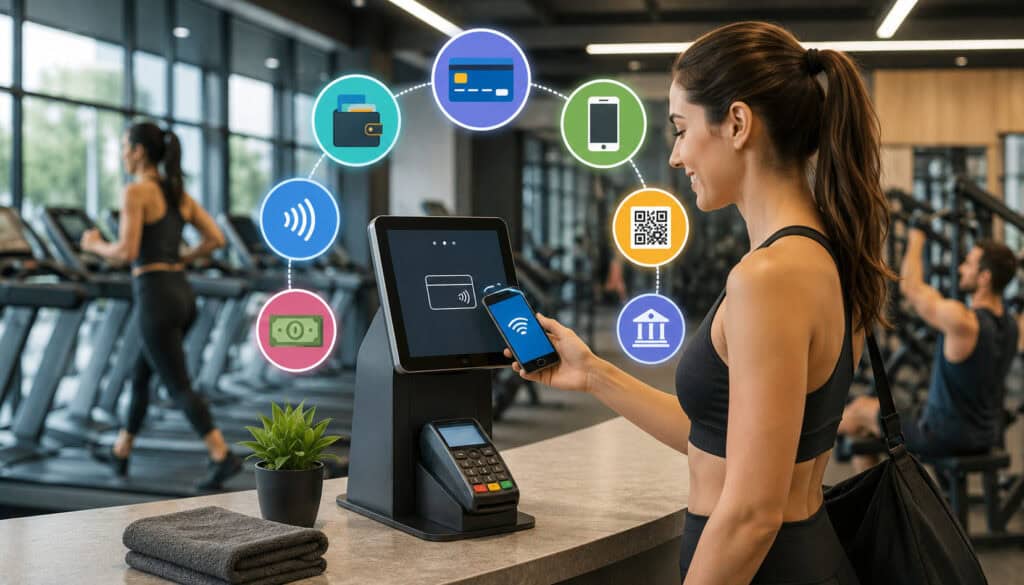
A modern fitness payment processing setup should support multiple payment methods because members have different preferences. Some prefer cards. Others prefer bank drafts. Some want mobile wallets for quick purchases. Others want invoices with online payment links.
Credit cards remain common for memberships, retail purchases, personal training, and online class bookings. They are familiar, fast, and convenient. Debit cards are also widely used because members can pay directly from available funds.
ACH payments for gyms are especially useful for recurring memberships. Bank accounts often remain stable longer than cards, which may reduce interruptions caused by expiration dates, card replacements, and spending limits.
ACH can work well for monthly dues, annual plans, family memberships, and larger training packages. This article on ACH payment processing for gyms and fitness centers explains how bank payments can fit into gym billing workflows.
Mobile wallets and contactless payments are helpful for front-desk transactions, smoothie bars, merchandise, day passes, and drop-in classes. They make checkout faster and reduce friction during busy hours.
Online invoices and payment links are useful for balances that are not tied to standard membership dues. For example, a gym may send an invoice for a private coaching package, event registration, or corporate wellness program.
A flexible gym payment automation system may support:
- Credit cards
- Debit cards
- ACH bank drafts
- Mobile wallets
- Contactless payments
- Online invoices
- Payment links
- Recurring card-on-file billing
- Recurring bank drafts
- Digital receipts
How Automated Gym Payment Processing Improves Member Experience

The member experience does not end after a workout. Billing, checkout, renewals, receipts, and payment communication all shape how members feel about the gym. Automated gym payment processing can make those interactions smoother and more professional.
Members appreciate convenience. They do not want to stand in line to update a card, call during business hours to pay an invoice, or wonder whether their membership is renewed. Automated membership payments for gyms allow members to stay active without manually paying every month.
Online account management also improves the experience. A member portal can allow members to update payment details, view invoices, download receipts, pay balances, and manage certain account preferences. This reduces the need for staff involvement and gives members more control.
Automated receipts help reduce confusion. When a payment is processed, the member receives confirmation. If an invoice is due, the system can send a reminder. If a payment fails, the member can receive a secure link to update payment information.
Fast checkout also matters. Fitness clubs often sell drinks, supplements, apparel, equipment, and training add-ons. Integrated fitness club payment systems make it easier to complete these purchases without slowing down the front desk.
Automation can also support renewals. When a class package is about to expire or a membership renewal is approaching, the system can notify the member. This creates a cleaner renewal process and can support retention.
Security and Compliance Best Practices
Secure payment processing for fitness businesses is essential because gyms handle sensitive payment information. Members trust fitness businesses to process payments safely, protect stored credentials, and prevent unauthorized access.
Encryption helps protect data while it is being transmitted. Tokenization replaces sensitive card details with a secure token, allowing the gym to process future payments without storing raw card numbers in its own systems. Secure card-on-file storage is especially important for recurring billing for gyms because membership payments often repeat over long periods.
PCI-aware workflows help reduce risk when accepting card payments. This can include using hosted checkout pages, secure terminals, tokenized storage, permission-based staff access, and payment tools designed to reduce exposure to sensitive card data. This external resource on PCI compliance and secure payment workflows provides additional background.
Fraud monitoring is also important. Gyms should watch for unusual refund activity, repeated failed payments, duplicate transactions, suspicious account changes, and chargeback patterns. Refund controls can help ensure only authorized staff can issue refunds or void transactions.
User permissions matter because not every employee needs full access to billing tools. Front-desk staff may need to accept payments, while managers may need refund permissions, reporting access, and billing adjustments. Limiting access reduces the chance of mistakes or misuse.
Best practices include:
- Use secure payment gateways
- Avoid storing raw card data
- Enable tokenized card-on-file billing
- Use strong staff permissions
- Review refund activity
- Monitor disputes and chargebacks
- Use secure online checkout
- Train staff on payment procedures
- Keep billing software updated
- Document cancellation and refund policies
Common Payment Challenges Gyms Face
Even well-run gyms face payment challenges. The difference is whether those challenges are handled manually and reactively or automatically and systematically.
Expired cards are one of the most common issues. Members may receive a new card and forget to update their gym account. If the system does not catch the issue quickly, the membership payment may fail. Automated reminders and update links help reduce this problem.
Failed recurring payments can happen for many reasons. A card may be declined, an ACH draft may return, or a bank account may have insufficient funds. Without automated retry tools and alerts, these failed payments can remain unresolved.
Chargebacks and membership disputes are another challenge. Members may dispute a charge if they do not recognize the billing descriptor, misunderstand cancellation terms, or believe they were charged incorrectly. Clear billing descriptions, digital receipts, signed agreements, and transparent policies can help reduce disputes.
Late payments create cash flow uncertainty. If a gym depends on members paying manually each month, revenue can become unpredictable. Automated billing solutions for gyms help reduce late payments by charging on schedule and sending reminders before balances become overdue.
Billing confusion is also common. Members may not understand prorated charges, freeze fees, annual fees, package renewals, or cancellation timelines. Clear invoices and automated notifications help reduce confusion.
Software integration issues can create additional problems. If membership software, scheduling tools, POS systems, and payment processors do not work together, staff may have to reconcile data manually. Integrated fitness club payment systems reduce duplication and improve reporting accuracy.
Common Mistakes Gyms Should Avoid
One of the biggest mistakes gyms make is relying too heavily on manual billing. Manual processes may work for a very small operation, but they become risky as membership volume grows. Spreadsheets, handwritten notes, and manual invoice reminders can lead to missed payments and reporting errors.
Weak cancellation policies are another common issue. If members do not understand how to cancel, when cancellation takes effect, or whether notice is required, disputes become more likely. Clear written policies should be included in membership agreements and reinforced in billing communication.
Poor payment security is a serious mistake. Gyms should not write down card numbers, store sensitive payment details in unsecured files, or share staff logins. Secure payment processing for fitness businesses requires proper systems, access controls, and staff training.
Ignoring failed payment reports can also hurt revenue. Automated systems can identify failed payments, but managers still need to review reports and follow up when needed. Automation should reduce manual work, not replace oversight.
Not automating reminders is another missed opportunity. Payment reminders can reduce late payments and make members more aware of upcoming charges. This is especially helpful for annual fees, package renewals, and overdue balances.
Lack of staff training can create inconsistent billing experiences. If employees do not know how to update payment methods, explain invoices, process refunds, or handle disputes, members may lose confidence.
Gyms should also avoid failing to review billing data regularly. Reports can reveal trends such as rising failed payments, declining renewals, increased chargebacks, or underperforming membership plans.
Best Practices for Gym Payment Automation Systems

The best gym payment automation systems are not just payment tools. They are part of a larger operational strategy that supports revenue, member experience, and financial control.
Start by offering multiple payment methods. Cards, ACH, mobile wallets, and online invoices all serve different needs. A member joining online may prefer card-on-file billing, while a long-term family plan may work better with ACH. Retail purchases may be faster with contactless payments.
Automate reminders for upcoming payments, failed transactions, expiring cards, package renewals, and unpaid invoices. These reminders should be clear, timely, and easy to act on. Include secure payment links whenever possible.
Monitor failed payments regularly. A dashboard is only useful if someone reviews it. Assign responsibility to a manager or billing team member so failed payments do not pile up.
Review billing reports at least weekly. Look at recurring revenue, failed payments, refunds, chargebacks, membership freezes, cancellations, and outstanding invoices. These reports can help identify operational problems before they become larger financial issues.
Train staff properly. Employees should understand how the gym membership billing software works, how to explain charges, and when to escalate billing concerns. Good training reduces mistakes and improves member trust.
Keep billing policies clear. Members should understand when they are billed, what payment methods are accepted, how renewals work, how cancellations are handled, and what happens if a payment fails.
Test recurring billing workflows before using them widely. Run through signup, payment authorization, invoice generation, payment reminders, failed payment notices, receipt delivery, refunds, freezes, upgrades, and cancellations.
For broader payment setup considerations, this resource on best payment solutions for gyms can help compare important features.
What is automated payment processing for gyms?
Automated payment processing for gyms is a system that collects and manages payments through scheduled billing, saved payment methods, automatic invoices, digital receipts, reminders, and reporting tools.
It is commonly used for memberships, class packages, personal training, retail purchases, and recurring services.
The main goal is to reduce manual billing work while making payments easier for members. Instead of staff processing every transaction by hand, the system follows preset billing rules. This helps gyms collect payments on time, reduce missed dues, and improve cash flow.
How do recurring gym payments work?
Recurring gym payments work by saving a member’s approved payment method and charging it automatically based on a billing schedule. That schedule may be monthly, quarterly, annually, or tied to a specific membership agreement.
The system can send receipts, retry failed payments, notify members when updates are needed, and track billing history. Recurring billing for gyms is especially useful because memberships usually depend on ongoing payments rather than one-time purchases.
Can gyms automate ACH billing?
Yes. Gyms can automate ACH billing by collecting proper authorization from members and setting up scheduled bank drafts through a payment system that supports ACH. ACH payments for gyms can be useful for monthly dues, family plans, annual agreements, and larger training packages.
ACH billing can also reduce card-related interruptions because bank accounts often change less frequently than cards. However, gyms should use clear authorization language, secure data handling, and reliable return management procedures.
How does automation reduce missed payments?
Automation reduces missed payments by charging members on schedule, sending reminders, retrying failed transactions, and alerting members when payment details need to be updated. It also gives staff better visibility into unpaid balances.
Instead of discovering missed payments weeks later, managers can review failed payment reports quickly. This improves recurring payment management and helps protect revenue.
Are automated gym payment systems secure?
Automated gym payment systems can be secure when they use proper safeguards such as encryption, tokenization, secure checkout, staff permissions, fraud monitoring, and PCI-aware workflows. The goal is to reduce exposure to sensitive payment information.
Gyms should avoid storing raw card details, sharing logins, or using unsecured manual processes. Secure payment processing for fitness businesses depends on both technology and staff procedures.
What payment methods should gyms accept?
Gyms should consider accepting credit cards, debit cards, ACH payments, mobile wallets, contactless payments, online invoices, and recurring bank drafts. The right mix depends on the gym’s services, member preferences, and billing model.
For recurring memberships, cards and ACH are often the most important. For front-desk sales and retail, mobile wallets and contactless payments can make checkout faster.
How can gyms reduce chargebacks?
Gyms can reduce chargebacks by using clear billing descriptors, transparent membership agreements, digital receipts, written cancellation policies, and responsive customer support. Automated reminders and payment confirmations can also help members recognize charges.
Good documentation matters. If a member disputes a charge, billing records, signed agreements, receipts, and communication history can help clarify what happened.
What features should gyms look for in billing software?
Gyms should look for billing software that supports recurring payments, ACH billing, card-on-file payments, automated invoices, payment reminders, failed payment recovery, digital receipts, reporting, refund controls, staff permissions, and secure online checkout.
Integration also matters. Gym membership billing software should work smoothly with scheduling, membership management, POS, and accounting workflows whenever possible. This article on online billing systems for fitness businesses explains additional features to consider.
Conclusion
The benefits of automated payment processing for gyms are practical, measurable, and closely tied to daily operations. Automated systems help gyms collect payments faster, reduce missed dues, improve cash flow, and spend less time on repetitive administrative tasks.
They also improve the member experience by supporting convenient payment methods, digital receipts, online account access, easy renewals, and clearer billing communication. For staff and owners, automation provides better reporting, stronger billing consistency, and more control over recurring revenue.
Gyms that rely on memberships, training packages, class subscriptions, and retail sales need payment tools that can keep up with the way members buy and renew services. Automated gym payment processing, recurring billing, ACH drafts, online invoices, and secure payment workflows all work together to create a more reliable financial foundation.
When implemented thoughtfully, payment automation for fitness studios and gyms is more than a back-office upgrade. It is a smarter way to manage revenue, support members, reduce errors, and build a more efficient fitness business.