
Fitness businesses run on consistency. Membership dues, class packs, personal training packages, merchandise sales, online bookings, and recurring subscriptions all depend on timely payments.
When billing is handled manually, even a healthy fitness business can lose revenue through missed payments, delayed follow-ups, expired cards, and inconsistent recordkeeping.
That is why payment automation strategies for fitness businesses are becoming essential for gyms, boutique studios, yoga centers, martial arts schools, personal training facilities, wellness clubs, and hybrid online fitness brands.
The right billing setup does more than collect money. It supports predictable cash flow, improves the member experience, reduces administrative work, and helps staff focus on service instead of chasing payments.
Modern fitness payment processing solutions can automate recurring membership payments, ACH drafts, card-on-file billing, digital invoices, failed payment retries, reminders, receipts, and reporting. They can also connect with scheduling tools, access control systems, online booking platforms, and point-of-sale systems.
For fitness businesses comparing billing options, resources like fitness payment processing solutions can help explain how payment systems support memberships, recurring billing, card payments, mobile payments, and gym operations.
What Is Payment Automation for Fitness Businesses?
Payment automation for fitness businesses means using technology to manage routine payment tasks with minimal manual work. Instead of manually charging each member, sending individual invoices, checking spreadsheets, and following up on overdue accounts, the business sets billing rules once and allows the system to handle recurring activity.
This can include automated gym membership payments, recurring invoices, ACH drafts, card-on-file transactions, online checkout, payment reminders, and digital receipts. It may also include failed payment recovery workflows, such as retrying a declined card, asking a member to update payment details, or sending a secure payment link.
A strong fitness business payment automation setup usually includes:
- Recurring membership billing
- ACH billing for gyms
- Credit and debit card autopay
- Online gym billing systems
- Automated invoicing for gyms
- Payment links for one-time charges
- Digital receipts and notifications
- Failed payment alerts
- Member self-service payment portals
- Billing reports and reconciliation tools
For example, a gym may bill all monthly members on the first day of each month, charge personal training clients every two weeks, and automatically invoice corporate wellness accounts at the end of each billing cycle.
A yoga studio may charge recurring class subscriptions, workshops, retail purchases, and private sessions through one connected platform.
Why Fitness Businesses Need Payment Automation
Fitness businesses often depend on recurring revenue. Memberships, subscriptions, installment plans, and training packages create stability, but only when payments are collected reliably. Manual billing creates gaps because staff must remember payment dates, update accounts, send reminders, track failed payments, and reconcile records.
Payment automation strategies for fitness businesses help reduce these gaps. Automated systems can bill members on schedule, send notices before or after payment, retry failed transactions, and keep payment records organized. This improves cash flow and reduces the number of accounts that slip into overdue status.
Member convenience is another major reason to automate. Customers expect simple payment experiences. They want to join online, store a payment method securely, receive confirmations, update billing details, and manage payments without calling the front desk. Automated gym membership payments make that possible.
Automation also supports growth. A gym with fifty members may manage billing manually for a while. A gym with hundreds or thousands of members needs systems that scale. Fitness studio billing automation helps staff avoid repetitive work and gives owners better visibility into revenue, churn, unpaid invoices, and payment trends.
| Automation Strategy | How It Works | Business Benefit | Best Use Case |
| Recurring card billing | Charges saved cards on a schedule | Predictable membership revenue | Monthly memberships and subscriptions |
| ACH billing | Pulls payments from member bank accounts | Lower-cost recurring collection | Long-term memberships and large packages |
| Automated invoicing | Sends invoices automatically | Less manual billing work | Training, events, corporate accounts |
| Payment reminders | Notifies members before or after due dates | Fewer late payments | Membership renewals and invoices |
| Failed payment recovery | Retries payments and sends update requests | Reduces revenue leakage | Declined cards and expired payment methods |
| Online payment portals | Lets members pay or update details online | Better customer experience | Hybrid and online fitness businesses |
Automated Gym Membership Payments
Automated gym membership payments are one of the most important parts of fitness business payment automation. Membership billing is usually repetitive, predictable, and high-volume, which makes it ideal for automation.
With recurring payment systems for fitness businesses, a member’s billing schedule can be created at signup. The system can charge monthly dues, annual memberships, family plans, student plans, premium memberships, or specialty subscriptions without requiring staff to process each payment manually.
This approach also helps prevent billing inconsistency. If staff members process payments by hand, one account may be charged late, another may be missed, and another may not be updated after a membership change. Automated gym membership payments follow the billing rules already assigned to the account.
Automation can also support upgrades, downgrades, freezes, cancellations, and renewals. For example, a member who moves from a basic plan to a premium plan can be billed at the new rate on the next cycle.
A family account can combine multiple members under one payment method. An annual plan can renew automatically with proper advance notice.
Automated Invoicing and Payment Reminders
Automated invoicing for gyms is useful for services that do not always fit into standard membership billing. Personal training sessions, nutrition coaching, private lessons, specialty workshops, youth programs, corporate wellness plans, and retail purchases may need separate invoices.
Fitness studio billing automation can create invoices based on a set schedule or specific trigger. For example, a personal training client may receive an invoice after a package is completed. A corporate group may receive a monthly invoice for employee participation. A studio may invoice members for workshops or special events.
Payment reminders make the process even smoother. A system can send a reminder before a payment is due, another notice when the invoice is available, and a follow-up if payment is late. Digital receipts can be sent automatically after successful payment.
This reduces awkward manual follow-ups. Staff no longer need to call members repeatedly or search through notes to see who has paid. Members also appreciate reminders because they help avoid missed due dates.
Failed Payment Recovery Strategies
Failed payments are common in recurring billing. Cards expire, accounts change, spending limits are reached, bank payments return, and members sometimes forget to update payment details. Without automation, these failed payments can quickly become lost revenue.
Failed payment recovery tools help fitness businesses respond quickly. A good gym payment processing automation setup may automatically retry a declined payment after a set period, send a secure update link, notify staff, and mark the account for follow-up.
Common failed payment recovery strategies include:
- Automatic retry schedules
- Expired card update tools
- ACH fallback billing
- Reminder emails or texts
- Member self-service payment portals
- Staff alerts for unresolved accounts
- Clear account suspension rules
ACH billing for gyms can also reduce certain card-related issues because bank account details may remain stable longer than card numbers. However, ACH still requires authorization, clear communication, and return monitoring.
Popular Automated Payment Solutions for Gyms
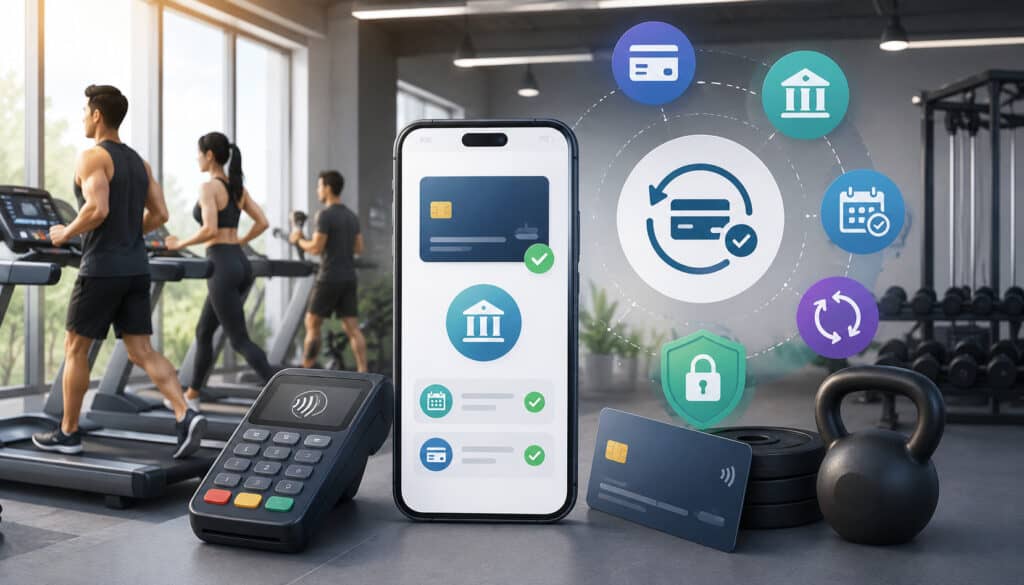
Automated payment solutions for gyms can include several payment methods and software tools. The best setup depends on the business model, member preferences, transaction volume, and software integrations.
Recurring card billing is one of the most common options. Members store a card securely, and the system charges it according to the membership agreement. This works well for monthly plans, class subscriptions, and recurring training packages.
ACH payments are another strong option for recurring memberships. ACH billing for gyms can be useful for predictable dues, larger packages, and long-term memberships. For a deeper breakdown of this payment method, see this guide on ACH payment processing for gyms and fitness centers.
Mobile wallet payments can support in-person purchases, retail sales, guest passes, drop-in classes, and mobile checkout. Online payment portals allow members to pay invoices, update payment details, buy packages, or manage billing from their own devices.
Payment links are useful when a staff member needs to collect a one-time payment quickly. For example, a trainer may send a payment link for a private session, consultation, or event registration.
Integrated POS billing systems combine front-desk sales, memberships, retail inventory, and payment processing. Fitness software payment automation may also connect billing with scheduling, class booking, attendance tracking, member management, and reporting.
Benefits of Fitness Business Payment Automation

The most obvious benefit of fitness business payment automation is faster payment collection. When payments happen automatically, staff spend less time reminding members and more time improving operations. Recurring billing also helps revenue arrive on a predictable schedule.
Better cash flow is another major advantage. Fitness businesses often have fixed expenses such as rent, payroll, equipment, software, utilities, cleaning, and marketing. Automated payment collection helps match incoming revenue with these ongoing obligations.
Automation also reduces missed payments. Instead of relying on memory or manual spreadsheets, the system follows billing schedules and alerts staff when something goes wrong. This makes it easier to identify overdue accounts before they become a bigger issue.
Member experience improves as well. Members can enroll in autopay, receive digital receipts, update payment methods online, and avoid repeated payment conversations. This supports a more professional relationship between the business and the customer.
Financial reporting becomes easier because payment data is centralized. Owners can review recurring revenue, failed payments, refunds, chargebacks, invoice status, payment method usage, and membership trends.
Key benefits include:
- Faster payment collection
- Better cash flow
- Fewer missed payments
- Reduced manual work
- Improved member convenience
- Better reporting
- More predictable revenue
- Easier reconciliation
- Stronger operational control
Gym Recurring Billing Strategies That Improve Retention

Gym recurring billing strategies should support retention, not just collection. Billing is part of the member experience. If payments feel confusing, rigid, or poorly communicated, members may become frustrated even if they like the facility.
Flexible billing schedules can help. Some members prefer monthly billing, while others may want annual plans, prepaid packages, or installment options. Offering a few structured choices can make membership easier to maintain.
Autopay incentives can also encourage consistent billing. A fitness business may offer a small discount, bonus class, or simplified renewal process for members who enroll in automated payments. The incentive does not need to be large; it simply needs to reinforce convenience and reliability.
Installment plans can make higher-value services easier to sell. Personal training packages, transformation programs, and specialty coaching may be more accessible when broken into automated payments.
Family memberships and group accounts should also be easy to manage. A parent, partner, or account holder may want one payment method for multiple members. A good fitness membership billing system should support this without creating confusion.
Transparent billing policies are essential. Members should understand when they are charged, how cancellations work, what happens when payments fail, and how to update payment information.
Payment Security and Compliance Best Practices
Payment security is critical for any fitness business that stores payment methods, processes recurring payments, or accepts online transactions. Members trust the business with sensitive payment information, and that trust must be protected.
Secure payment automation starts with encryption and tokenization. Tokenization replaces sensitive payment details with a token that can be used for future transactions without exposing the original card data.
This is especially valuable for recurring billing and card-on-file payments. Tokenization can also help reduce exposure to sensitive payment data when implemented correctly.
Fitness businesses should use PCI-aware workflows. This means avoiding unnecessary handling of card numbers, using secure hosted payment pages, limiting staff access, and working with systems designed for compliant payment processing.
Secure card-on-file storage is also important. Staff should not write card numbers on paper, store them in spreadsheets, or save them in unsecured notes. Payment details should be stored only through approved payment systems.
Other best practices include:
- Use role-based staff permissions
- Enable strong passwords and multi-factor authentication where available
- Monitor refunds and voids
- Review chargeback activity
- Use secure online checkout
- Limit manual overrides
- Train staff on payment data handling
- Keep software updated
Common Payment Automation Challenges
Even the best automated payment collection system needs oversight. Automation reduces manual work, but it does not eliminate the need for billing management.
Failed recurring payments are one of the most common challenges. Cards can expire, bank payments can return, and members may dispute charges they do not recognize. A system should help identify failed payments quickly and provide a clear recovery path.
Expired cards are another issue. Card updater tools may help, but they are not perfect. Members should still have easy ways to update payment information through a secure portal.
Billing disputes can happen when members misunderstand cancellation rules, freeze policies, renewal terms, or package expiration dates. Clear communication and written billing policies help reduce these problems.
Software integration issues can also create challenges. If the payment system does not sync properly with membership software, access control, scheduling, or accounting tools, staff may need to correct records manually.
Poor communication is another major problem. Members should receive receipts, renewal notices, failed payment alerts, and policy updates when appropriate.
Common Mistakes Fitness Businesses Should Avoid
One of the biggest mistakes fitness businesses make is relying on manual billing for too long. Manual billing may seem manageable early on, but it becomes inefficient as membership volume grows. It also increases the risk of missed payments and inconsistent follow-up.
Ignoring failed payment reports is another costly mistake. Failed payments should be reviewed regularly. Even small unpaid balances can become significant when repeated across many members.
Weak cancellation policies can also create disputes. Members should know how to cancel, when cancellation takes effect, whether advance notice is required, and what happens to unpaid balances.
Poor staff training creates avoidable problems. Staff should understand how to update payment details, explain billing policies, process refunds, handle failed payments, and escalate disputes.
Another mistake is choosing systems without integrations. If payment automation software for fitness centers does not connect with scheduling, membership management, or accounting tools, staff may end up doing duplicate work.
Weak payment security practices are especially risky. Never store sensitive payment information in unsecured files, messages, or paper forms.
Best Practices for Automated Gym Billing Systems
The best automated gym billing systems are simple for members, efficient for staff, and reliable for owners. They should support multiple payment methods, clear reporting, secure storage, and flexible billing structures.
Offer multiple payment methods whenever practical. Members may prefer cards, ACH, mobile wallets, online payments, or payment links depending on the situation. A flexible system can reduce friction and improve collection rates.
Automate reminders for upcoming payments, overdue invoices, and failed transactions. This keeps members informed and reduces staff follow-up.
Monitor failed payments consistently. Automation should identify problems, but managers should still review unresolved accounts. A weekly billing review can help prevent avoidable revenue loss.
Use ACH for recurring billing where it makes sense. ACH can be useful for memberships, training packages, and long-term plans. This guide on how to accept ACH payments for gyms and fitness centers explains operational considerations for using ACH in fitness billing.
Simplify member payment management. Members should be able to update payment methods, pay balances, view receipts, and manage billing details through secure online tools.
Keep billing policies transparent. Put payment terms in membership agreements, signup flows, invoices, and renewal communications.
For businesses evaluating billing platforms, this resource on online billing systems for fitness businesses offers additional context on recurring payments, billing tools, and operational simplification.
What is payment automation for fitness businesses?
Payment automation for fitness businesses is the use of software and payment tools to handle recurring billing, invoices, reminders, receipts, failed payment recovery, ACH drafts, and card-on-file payments. It helps gyms and studios collect payments on schedule while reducing manual work.
A complete setup may include recurring payment systems for fitness businesses, online gym billing systems, automated invoicing for gyms, member payment portals, and reporting dashboards. The goal is to make billing more reliable, organized, and convenient for both the business and its members.
How do automated gym membership payments work?
Automated gym membership payments work by saving a member’s approved payment method securely and charging it according to a billing schedule. The schedule may be monthly, annual, weekly, biweekly, or based on a custom membership agreement.
The system can send receipts, notify members about failed payments, retry declined transactions, and update billing records automatically. This makes membership billing more predictable and reduces the need for staff to process payments manually.
Can gyms automate ACH billing?
Yes. ACH billing for gyms can be automated for recurring memberships, training packages, installment plans, and other scheduled payments. Members authorize bank payments, and the system drafts payments according to the agreed billing schedule.
ACH can be useful for recurring billing because bank account information may remain stable longer than card details. However, businesses still need clear authorization, return monitoring, member communication, and secure payment workflows.
How does automation reduce missed payments?
Automation reduces missed payments by charging accounts on schedule, sending reminders, retrying failed transactions, and notifying staff when accounts need attention. This creates a structured payment process instead of relying on manual follow-up.
Automated payment collection also helps identify issues earlier. If a card fails or an invoice goes unpaid, the system can trigger reminders or account updates before the balance becomes harder to recover.
Are automated gym payment systems secure?
Automated gym payment systems can be secure when they use encryption, tokenization, secure card-on-file storage, PCI-aware workflows, role-based permissions, and protected online checkout. Security depends on the technology used and how staff manage payment processes.
Businesses should avoid storing card details in spreadsheets, paper forms, email, or unsecured notes. Sensitive payment information should be handled only through approved payment systems.
What payment methods should gyms support?
Gyms should consider supporting credit cards, debit cards, ACH payments, mobile wallets, online payment portals, and payment links. The right mix depends on the business model, member preferences, pricing structure, and recurring billing needs.
Recurring card billing is convenient for memberships. ACH may be useful for long-term memberships and larger packages. Payment links and portals are helpful for one-time charges, invoices, and online services.
How can gyms reduce failed recurring payments?
Gyms can reduce failed recurring payments by using automated retries, card update tools, ACH options, billing reminders, secure self-service portals, and clear member communication. Staff should also review failed payment reports regularly.
A clear failed payment policy helps. Members should know what happens when a payment fails, how quickly they need to update payment details, and whether access may be affected.
What should fitness businesses look for in payment automation software?
Fitness businesses should look for recurring billing, ACH support, card-on-file payments, automated invoicing, failed payment recovery, secure payment storage, reporting, member portals, and software integrations.
The system should also be easy for staff to use. Complicated tools can create errors if the team avoids using them properly.
Conclusion
Payment automation strategies for fitness businesses help create a stronger, more reliable revenue cycle. By automating memberships, invoices, ACH drafts, reminders, failed payment recovery, and reporting, gyms and studios can reduce administrative work while improving cash flow.
The right system also improves the member experience. Customers can enroll in autopay, receive digital receipts, update payment details, pay invoices online, and avoid unnecessary billing friction.
For fitness businesses that depend on recurring revenue, automation is not just a convenience. It is an operational strategy that supports retention, predictable income, fewer missed payments, better reporting, and long-term growth.