
Running a fitness business means managing far more than workouts. Memberships, personal training sessions, class packs, online bookings, merchandise, supplements, cancellation policies, account freezes, and recurring payments all create payment complexity.
That is why merchant services for fitness businesses are not just about accepting credit cards. The right setup helps collect dues on time, reduce billing errors, simplify front-desk work, support online sales, and give members a smoother payment experience.
Fitness businesses often rely on recurring revenue. When payments fail, cards expire, invoices are missed, or billing records are scattered across different systems, cash flow suffers.
Reliable fitness business merchant services help solve those problems by connecting payment acceptance, membership billing software, reporting, security, and automation into one organized process.
For additional background on gym payment workflows, see this guide to gym payment processing and automated membership billing.
What Are Merchant Services for Fitness Businesses?
Merchant services for fitness businesses are the tools, accounts, and technology that allow gyms, studios, trainers, and wellness facilities to accept and manage payments.
These services usually include credit card processing, debit card acceptance, ACH payments, online checkout, mobile payments, point-of-sale systems, payment gateways, recurring billing tools, and transaction reporting.
A merchant account allows a fitness business to accept electronic payments and receive deposits after transactions are approved. A payment gateway securely sends online or card-not-present transactions for authorization. A POS system helps process in-person payments for memberships, retail items, drop-in classes, shakes, supplements, and apparel.
For gyms and studios, payment processing is often tied directly to member management. A member may enroll online, save a payment method, sign up for monthly billing, purchase a personal training package, and later buy merchandise at the front desk. Fitness payment processing connects all these transactions so the business can track revenue accurately.
Common components include:
- Merchant accounts for gyms
- Fitness business credit card processing
- ACH payments for fitness businesses
- Fitness POS systems
- Online payments for gyms
- Mobile payments for fitness studios
- Recurring billing for gyms
- Automated billing for fitness studios
- Payment reporting dashboards
- Secure card-on-file tools
A good payment setup supports both convenience and control. Members expect easy checkout, automatic billing, digital receipts, and flexible payment options. Owners need predictable deposits, clear fees, accurate reports, secure payment storage, and tools to resolve failed payments quickly.
Why Fitness Businesses Need Specialized Payment Processing
Fitness businesses have payment needs that are different from many traditional retail businesses. A standard retail merchant account may work for one-time purchases, but gyms and studios usually need more advanced billing and customer management features.
Most fitness businesses rely on recurring memberships. That means payments need to run automatically, usually on a monthly or scheduled basis. The system must handle renewals, upgrades, downgrades, family plans, failed payments, pauses, freezes, cancellations, and refunds.
Specialized fitness business merchant services also help with member convenience. Customers may want to pay online, update their card from a portal, buy class packages from a phone, use mobile wallets, or pay through a booking app. A flexible system reduces friction and makes it easier for members to stay active.
Fitness businesses also face more billing disputes than some other industries. Members may forget cancellation terms, misunderstand renewal dates, dispute a charge after failing to attend, or ask for refunds on unused sessions. Clear payment records, digital receipts, signed terms, and automated billing history help reduce confusion.
| Feature | Standard Payment Processing | Fitness Merchant Services | Business Benefit |
| Recurring billing | Limited or manual | Built for memberships and renewals | More predictable cash flow |
| Card-on-file | Basic storage | Tokenized recurring payment support | Safer repeat billing |
| Failed payment handling | Manual follow-up | Automated retries and reminders | Fewer missed payments |
| ACH payments | Not always supported | Often available for memberships | Lower-cost recurring option |
| Online booking payments | Separate setup | Integrated checkout tools | Easier class and session sales |
| Reporting | Transaction-level data | Membership and revenue insights | Better decision-making |
| POS integration | Retail-focused | Fitness-specific sales and check-in support | Smoother operations |
Recurring Membership Billing
Recurring billing for gyms is one of the most important parts of fitness payment processing. Instead of manually collecting dues each month, the business stores an approved payment method and charges members automatically according to their membership agreement.
This supports monthly memberships, family plans, annual subscriptions, installment programs, and automated renewals. It can also support special billing rules, such as prorated first months, trial periods, paid-in-full memberships, and scheduled rate changes.
Recurring billing improves consistency. Staff do not need to chase every member for payment, and members do not need to remember due dates. When paired with membership billing software, recurring payments can also update member status, access permissions, and account history automatically.
The best systems include failed payment recovery. For example, if a card declines, the system can retry the payment, notify the member, send a secure payment update link, and alert staff if the issue remains unresolved.
Online and Mobile Payments
Online payments for gyms are now essential. Members often want to join, book, upgrade, or purchase without visiting the front desk. Fitness studio payment processing solutions should support website checkout, payment links, online invoices, ecommerce purchases, and app-based payments.
Mobile payments for fitness studios are useful for pop-up classes, outdoor boot camps, personal training sessions, events, and on-site retail sales. Trainers and staff can accept payments through mobile readers, tablets, or secure checkout links.
Mobile wallet payments can also improve the checkout experience. Many customers prefer contactless payment because it is fast and familiar. For drop-in classes, smoothie bars, apparel, and event registrations, fast checkout helps reduce lines and frustration.
Gym ecommerce payments matter too. Many fitness businesses sell branded apparel, supplements, nutrition plans, digital programs, or class packs online. A connected payment system helps track both membership revenue and ecommerce revenue in one place.
Payment Automation Features
Payment automation for fitness centers reduces repetitive administrative work. Instead of manually sending invoices, checking spreadsheets, calling members about declines, or entering payment details by hand, automation keeps billing moving.
Useful automation features include:
- Automated billing schedules
- Failed payment retries
- Card updater tools
- Digital invoices
- Automatic receipts
- Payment reminders
- Membership renewal notices
- Refund and void controls
- Revenue dashboards
- Batch settlement reports
Automated billing for fitness studios is especially helpful when the business has multiple payment types. A studio may sell unlimited memberships, limited class packs, private training sessions, workshops, and merchandise. Automation helps keep those payment rules consistent.
Types of Payment Methods Fitness Businesses Should Accept

Fitness customers have different payment preferences. Some prefer credit cards for rewards, some prefer debit cards, and others prefer bank drafts for recurring memberships. A flexible payment setup improves member convenience and helps reduce barriers at checkout.
Credit cards are common for memberships, personal training packages, retail purchases, and online sales. They are convenient, fast, and familiar. However, they may come with higher processing costs than some alternatives.
Debit cards are also widely used for memberships and day-to-day purchases. They can be useful for members who do not want to use credit. However, debit cards can still expire, be replaced, or decline when funds are unavailable.
ACH payments for fitness businesses are valuable for recurring memberships because they move money directly from a bank account. They may be especially useful for monthly dues, annual programs, corporate wellness billing, and larger packages. You can learn more about this option in this guide to ACH payment processing for gyms and fitness centers.
Mobile wallets and contactless payments support fast in-person checkout. These payment methods are helpful at front desks, juice bars, retail counters, and fitness events.
Online invoices are useful for personal training, corporate accounts, team programs, and special events. A trainer or manager can send a secure invoice link, allowing the customer to pay without sharing card details over the phone.
Recurring bank drafts can help reduce card expiration issues. Since bank accounts often remain stable longer than cards, they may reduce failed payments in certain membership programs.
Merchant Accounts for Gyms and Fitness Studios
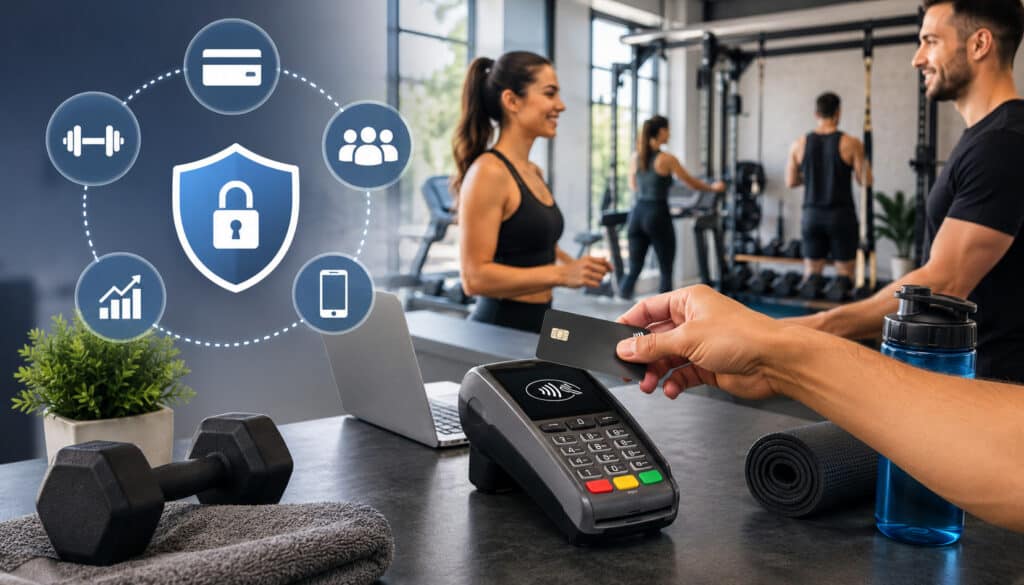
Merchant accounts for gyms allow fitness businesses to accept electronic payments and receive deposits after transactions are processed. When a member pays by card or bank transfer, the transaction moves through authorization, clearing, and settlement before funds are deposited.
The approval process usually involves underwriting. The processor may review business type, ownership details, expected sales volume, average ticket size, refund policies, chargeback history, and how payments are accepted. For fitness businesses, recurring billing terms and cancellation policies can also matter.
Processing fees vary depending on payment method, transaction type, pricing model, risk profile, and equipment or software needs. Card-present payments often cost differently from online or card-on-file transactions. ACH payments may have a different fee structure than card payments.
Settlements are another key consideration. Fitness businesses should understand how quickly funds are deposited, whether weekend transactions affect timing, how refunds are deducted, and how chargebacks are handled.
Some accounts may involve reserves, especially if the business has high future-delivery risk, large prepaid memberships, unusual billing patterns, or a history of disputes. A reserve means a portion of funds may be held temporarily to protect against chargebacks or refunds.
Chargeback management is important for gyms and studios. A member may dispute a charge because they forgot about auto-renewal, did not understand cancellation terms, or believe they were billed after stopping attendance. Clear records help defend valid charges.
Important records include:
- Signed membership agreements
- Billing authorization
- Cancellation policy acknowledgment
- Check-in history
- Email notices
- Digital receipts
- Refund records
- Staff notes
For setup details, this guide on how to set up a merchant account for a fitness business explains common steps and requirements.
Fitness Studio Payment Processing Solutions

Fitness studio payment processing solutions should fit the way the business sells. A yoga studio, martial arts school, Pilates studio, CrossFit-style gym, dance studio, personal training facility, and wellness center may all need different workflows.
Integrated payment systems connect payments to scheduling, membership records, and reporting. When someone books a class online, the payment can automatically update their account. When a recurring payment fails, the system can flag the member, send a reminder, and prevent unpaid access if that is part of the policy.
Fitness POS systems are useful for front-desk sales. They can process drop-ins, retail purchases, drinks, supplements, towels, rental items, event tickets, and merchandise. A good POS setup should be fast, secure, and easy for staff to use.
Member management software helps track customer profiles, attendance, waivers, billing status, package balances, communication history, and account notes. When payment processing is connected, staff can view member status without switching between multiple platforms.
Ecommerce integration supports online sales. A gym may sell apparel, digital programs, nutrition guides, gift cards, or class packages through its website. Gym ecommerce payments should be secure, mobile-friendly, and easy to reconcile.
Mobile terminals help businesses accept payments away from the front desk. They are useful for outdoor classes, wellness fairs, competitions, personal training sessions, and off-site programs.
Booking software connections are also important. A member should be able to reserve a class, pay for it, receive confirmation, and see it in their account without staff manually entering the transaction.
Benefits of Modern Gym Payment Systems
Modern gym payment systems help fitness businesses become more efficient and more member-friendly. When payments are connected to membership records, scheduling, and reporting, owners get better visibility into revenue and staff spend less time on manual billing tasks.
Better cash flow is one of the biggest benefits. Automated billing runs payments on schedule, while failed payment tools help recover revenue faster. This makes it easier to forecast income, manage payroll, invest in equipment, and plan marketing campaigns.
Faster collections also reduce stress. Instead of calling members individually or waiting for checks, staff can rely on automatic billing, digital reminders, and secure payment update links. This keeps conversations focused on service rather than collections.
Member convenience improves as well. Customers can pay online, use saved payment methods, update cards, receive receipts, and manage billing preferences more easily. A smooth payment experience supports retention because it removes unnecessary friction.
Reduced administrative work is another major advantage. Staff can spend less time entering payments, reconciling spreadsheets, and tracking overdue accounts. That time can be redirected toward member support, sales, coaching, and facility operations.
Better reporting and analytics help owners understand performance. Reports may show membership revenue, failed payments, refunds, chargebacks, product sales, class revenue, and payment method trends. These insights help identify problems early.
Modern systems can also support growth. As a fitness business expands into new locations, online programs, merchandise, or corporate wellness, scalable payment tools make it easier to manage additional revenue streams.
Payment Security and Compliance Best Practices
Secure gym payment processing protects both the business and its members. Fitness businesses often store payment credentials for recurring billing, which makes security especially important.
Encryption helps protect payment data during transmission. Tokenization replaces sensitive card data with a secure token that can be used for future billing without storing the actual card number in the business system.
PCI-aware workflows are essential. Staff should not write down card numbers, store payment details in spreadsheets, send card data by email, or keep paper forms with sensitive information. Payment details should be entered only through secure, approved systems.
Secure card-on-file storage is critical for recurring billing. The system should use tokenized storage and clear authorization records. Members should know when they will be billed and how to update their payment method.
Fraud prevention tools can help reduce suspicious transactions. These may include address verification, CVV checks, velocity controls, transaction monitoring, and user permissions.
User permissions matter inside the business. Not every staff member needs access to refunds, stored billing profiles, reports, or account adjustments. Limit permissions based on role.
Refund controls can prevent mistakes and misuse. Require manager approval for large refunds, track refund reasons, and review refund reports regularly.
Secure online checkout is also important. Online payment pages should use secure connections, trusted payment gateways, clear pricing, and transparent terms before payment is submitted.
Common Payment Challenges Fitness Businesses Face
Fitness businesses often face recurring payment challenges because memberships involve ongoing customer relationships. The most common issue is failed recurring payments. Cards expire, accounts have insufficient funds, banks block transactions, or members replace cards without updating their billing profile.
Expired cards can create a steady stream of declines. Card updater tools may reduce this problem by refreshing eligible card details automatically. Secure member portals can also let customers update payment information without calling the front desk.
Chargebacks are another challenge. A member may dispute a charge after forgetting about the billing date, misunderstanding the cancellation policy, or claiming they did not authorize renewal. Good documentation is the best defense.
Membership disputes often come from unclear communication. If cancellation rules, freeze policies, renewal dates, or refund terms are hard to understand, members may feel surprised when billed. Clear agreements and confirmation emails reduce confusion.
Billing confusion can also happen when a business sells multiple products. For example, a member might have monthly dues, a personal training package, a nutrition plan, and a retail purchase. Clear descriptions on receipts and statements help members recognize charges.
Late payments are another issue, especially when billing is manual. Manual invoicing creates delays and increases the risk of missed follow-ups.
Software integration problems can also create operational headaches. If the booking system, POS, payment gateway, and membership database do not communicate well, staff may need to reconcile records manually.
Common Mistakes Fitness Businesses Should Avoid
One common mistake is choosing providers only based on low advertised rates. Low rates may not include all costs, such as gateway fees, monthly fees, PCI-related fees, chargeback fees, equipment costs, batch fees, or software add-ons. Compare total cost, not just one percentage.
Weak cancellation policies are another major problem. If members cannot understand how to cancel, when cancellation takes effect, or whether notice is required, disputes become more likely. Policies should be clear, consistent, and easy to document.
Manual billing systems can hold a business back. Spreadsheets, paper invoices, and handwritten payment notes increase errors and consume staff time. Automated billing for fitness studios is usually more reliable and scalable.
Poor payment security is a serious risk. Staff should never store card numbers in unsecured documents or request payment details through unsafe channels. Secure tools and training are essential.
Ignoring failed payments is also costly. A small number of unresolved declines can become a significant revenue leak over time. Use automated retries, reminders, and reporting.
Lack of staff training creates inconsistent payment handling. Staff should understand how to process payments, explain billing terms, issue receipts, handle refunds, and escalate disputes.
Not reviewing processing statements is another mistake. Statements can reveal fee changes, downgrades, chargebacks, and transaction patterns. Regular reviews help spot issues early.
Best Practices for Choosing Fitness Business Merchant Services
Choosing the right merchant services for fitness businesses starts with understanding your revenue model. A gym with monthly memberships needs strong recurring billing. A boutique studio may need booking integration and class package tracking. A personal training business may need invoices, mobile payments, and package billing.
Compare total fees carefully. Look beyond the headline rate and review monthly fees, gateway fees, chargeback fees, PCI-related costs, ACH fees, equipment costs, and cancellation terms. Ask how different transaction types are priced.
Review integration options. Your payment tools should connect with your website, booking software, membership billing software, POS system, accounting tools, and ecommerce platform where needed.
Test recurring billing features before relying on them. Make sure the system can handle prorations, pauses, freezes, retries, upgrades, downgrades, family plans, and annual renewals.
Check reporting tools. Reports should help you understand deposits, transaction history, membership revenue, failed payments, refunds, chargebacks, and sales by category.
Offer multiple payment methods. Credit cards, debit cards, ACH, mobile wallets, online invoices, and contactless payments can all serve different customer preferences.
Monitor chargebacks. Track dispute reasons, response deadlines, documentation, and patterns. If disputes come from confusion, improve billing descriptions and member communication.
Automate reminders and receipts. Members should receive clear payment confirmations, upcoming billing notices when appropriate, failed payment alerts, and secure update links.
For more detail on solution selection, this guide to best payment solutions for gyms covers practical features to compare.
What are merchant services for fitness businesses?
Merchant services for fitness businesses are the payment tools and accounts that allow gyms, studios, trainers, and wellness facilities to accept and manage electronic payments.
They may include merchant accounts, credit card processing, ACH payments, payment gateways, POS systems, recurring billing, online checkout, mobile payments, and reporting tools.
These services help fitness businesses collect membership dues, sell class packages, accept personal training payments, process retail sales, and manage online transactions. The best setup also supports security, automation, and clear financial reporting.
Do gyms need recurring billing?
Yes, most gyms benefit from recurring billing because memberships are usually subscription-based. Recurring billing allows monthly dues, family plans, annual renewals, and installment payments to run automatically.
This reduces manual work and helps stabilize cash flow. It also improves convenience for members because they do not need to pay manually each billing cycle. For more detail, see this guide to setting up recurring gym membership payments.
Can fitness studios accept ACH payments?
Yes, many fitness studios can accept ACH payments for memberships, packages, and recurring bank drafts. ACH payments for fitness businesses can be useful because bank account details often remain stable longer than card details.
ACH may be a good fit for monthly memberships, corporate wellness programs, long-term coaching packages, and larger recurring payments. Businesses should still use proper authorization, clear billing terms, and return management procedures.
What fees do gym merchant accounts charge?
Gym merchant accounts may include transaction fees, monthly fees, gateway fees, ACH fees, chargeback fees, PCI-related fees, equipment costs, and software fees. Costs depend on payment method, pricing model, transaction volume, average ticket size, risk profile, and how payments are accepted.
Fitness businesses should compare total monthly cost, not just the advertised rate. A slightly higher transaction rate with better automation may be more valuable than a cheaper setup that creates manual work and missed payments.
How can gyms reduce failed payments?
Gyms can reduce failed payments by using automated retries, card updater tools, ACH options, member self-service portals, payment reminders, and clear billing communication. Staff should review failed payment reports regularly and follow a consistent recovery process.
It also helps to collect backup payment methods when appropriate. Clear receipts and billing descriptors can reduce confusion and prevent unnecessary disputes.
Are fitness payment systems secure?
Fitness payment systems can be secure when they use encryption, tokenization, secure checkout, access controls, and PCI-aware workflows. Businesses should avoid storing card numbers in spreadsheets, emails, paper files, or unsecured systems.
Security also depends on staff training. Employees should know how to handle payment information, refunds, receipts, and member billing questions safely.
What payment methods should gyms accept?
Gyms should usually accept credit cards, debit cards, ACH payments, mobile wallets, contactless payments, online invoices, and recurring bank drafts. The right mix depends on the business model.
A full-service gym may need recurring billing, front-desk POS payments, ecommerce checkout, and ACH. A mobile trainer may need payment links, invoices, and mobile card acceptance.
How can fitness businesses reduce chargebacks?
Fitness businesses can reduce chargebacks by using clear membership agreements, transparent cancellation policies, accurate billing descriptors, digital receipts, signed authorizations, and strong customer communication.
When disputes happen, documentation matters. Keep records of membership terms, payment authorization, attendance, communication, cancellation requests, and refund activity.
Conclusion
Merchant services for fitness businesses help gyms, studios, trainers, and wellness facilities manage the payment side of member relationships. The right setup supports recurring billing, online payments, mobile checkout, ACH processing, POS sales, ecommerce, reporting, and secure card-on-file storage.
Modern fitness business merchant services do more than process transactions. They help automate memberships, reduce missed payments, improve cash flow, save staff time, strengthen security, and create a smoother member experience.
The best approach is practical: match payment tools to your business model, compare total costs, prioritize secure automation, offer multiple payment methods, and review reports consistently.
When payment systems are organized and member-friendly, fitness businesses can spend less time chasing payments and more time building stronger customer relationships.